The studio lights in Washington, D.C., were blinding, yet nothing felt hotter than the tension radiating across the broadcast desk that Tuesday evening.
Millions of Americans had tuned in expecting a routine, polite exchange between two prominent figures from entirely different worlds of public influence.
On one side sat Joyce Meyer, the globally recognized Christian author and televangelist whose media empire reaches millions of households every single week.
Across from her sat Senator John Kennedy of Louisiana, famous on Capitol Hill for his folksy Southern drawl and razor-sharp, unforgiving wit.
The live segment was supposed to focus on charity accountability, federal tax exemptions, and the moral responsibilities of high-profile leaders in modern America.
For the first six minutes, the conversation remained remarkably civil, filled with rehearsed talking points, gentle nods, and courteous smiles from both guests.
Behind the scenes, however, veteran producers knew that placing a blunt fiscal hawk beside a billionaire-tier ministry leader was playing with fire.
The moderator, a seasoned cable news anchor, leaned forward at the seven-minute mark and asked a pointed question regarding private jets and lavish lifestyles.
Specifically, he referenced ongoing public debates over whether religious nonprofits should use tax-free donations to fund luxury real estate and executive travel.
Joyce Meyer shifted slightly in her leather chair, her expression tightening instantly as she prepared to defend her organization’s global humanitarian outreach.
With practiced confidence, she argued that modern global ministry requires modern transportation, dismissing critics as people who simply do not understand faith-based logistics.
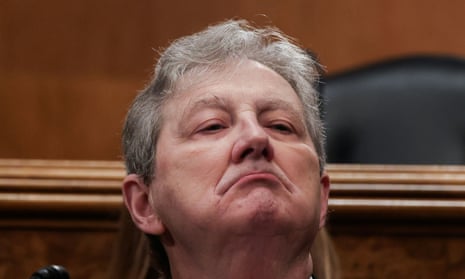
Senator Kennedy listened quietly without interrupting, resting his chin on his folded hands, his eyes narrowing behind his signature wire-rimmed glasses.
When the moderator finally turned to Kennedy for his perspective on taxpayer-funded oversight of mega-ministries, the Louisiana Republican offered a dry, skeptical chuckle.
He remarked casually that whenever someone claims a Gulfstream jet is a strict spiritual necessity, Washington ought to double-check the receipts.
The live studio audience let out a collective gasp, followed immediately by a ripple of nervous laughter that echoed off the soundstage walls.
Joyce Meyer did not laugh at all; instead, she turned directly toward the senator, her jaw set and her voice dripping with sudden disdain.
She looked him dead in the eye and declared on live television that Senator John Kennedy was nothing more than “a joke.”
The word hung in the air like a thunderclap, instantly freezing the camera operators on the floor and visibly shocking the veteran moderator.
In the brutal arena of cable news, insults are thrown around daily, yet rarely does a prominent religious figure hurl one so bluntly.
Producers in the control room scrambled, bracing themselves for the loud, defensive, table-pounding outburst that usually follows such a calculated public humiliation.
Most politicians in Washington would have immediately launched into a breathless tirade, listing their legislative achievements and attacking their opponent’s personal integrity.
But John Kennedy is not most politicians, and he did not raise his voice by even a single decibel during the confrontation.
He didn’t blink, didn’t flinch, and didn’t even bother to wipe the faint, knowing half-smile from the corner of his mouth.
Instead, the senator slowly leaned forward, adjusted the lapel of his dark suit, and brought his lips inches from the desk microphone.
The entire studio went dead silent, the low hum of the air conditioning suddenly audible over the collective held breath of the room.
With surgical precision and icy calm, Kennedy delivered seven words: “At least my punchlines don’t cost millions.”
For three agonizing seconds, nobody in the studio moved a muscle, and the moderator looked as though he had completely forgotten how to speak.
The confident smirk that had lingered on Joyce Meyer’s face vanished instantly, replaced by a pale, stunned expression of pure disbelief.

She opened her mouth as if to fire back a sharp rebuttal, then closed it again, visibly searching for words that refused to come.
Her hands, which had been gesturing effortlessly moments earlier, suddenly gripped the edge of the glass desk until her knuckles turned white.
In seven simple syllables, Kennedy had bypassed every talking point, every legal defense, and every PR-crafted excuse in her entire arsenal.
He had tapped directly into a decades-long public debate surrounding televangelism, personal wealth accumulation, and the millions donated by working-class believers.
To understand why those seven words hit with the force of a wrecking ball, one must look closely at the history behind them.
For years, independent watchdog groups and congressional committees have scrutinized the opaque finances of tax-exempt religious organizations across the United States.
Back in 2007, Senator Chuck Grassley famously launched a high-profile Senate Finance Committee investigation into six major media-based ministries, including Joyce Meyer Ministries.
That exhaustive inquiry examined executive compensation packages, multimillion-dollar properties, private aircraft, and whether donor funds were being spent appropriately on charitable missions.
At the time, critics pointed to eye-popping expenditures revealed in public reports, including luxury furnishings and corporate jets maintained by ministry funds.
While Meyer’s organization later implemented certain financial reforms and successfully maintained its federal tax-exempt status, public skepticism never truly faded away.
Every time a new clip of a private jet or a sprawling estate surfaces online, everyday Americans ask hard questions about faith and fortune.
Meanwhile, Senator John Kennedy has built his entire political brand on speaking the blunt, unfiltered thoughts of ordinary, hardworking taxpayers.
Before entering the U.S. Senate in 2017, Kennedy served five consecutive terms as Louisiana’s State Treasurer, earning a reputation as a relentless fiscal hawk.
He made his name hunting down wasteful government spending, exposing bloated state contracts, and mocking bureaucratic nonsense in plain, memorable Southern English.
Viewers across the political spectrum often tune into his Senate Judiciary hearings just to hear what folksy metaphor he will unleash next.
Yet beneath the charming Louisiana drawl and self-deprecating humor lies an Oxford-educated legal mind that rarely misses an opening in a debate.
When Meyer called him “a joke,” she unknowingly handed a master cross-examiner the exact rhetorical setup he needed to end the discussion.
By accepting the premise of her insult and flipping it back onto her financial footprint, Kennedy turned her attack into a devastating boomerang.
Back inside the studio, the silence stretched past the five-second mark before the control room finally panicked and cut to an unscheduled commercial break.
Even as the red tally lights on the cameras blinked off, studio microphones briefly picked up Meyer whispering furiously to her off-stage assistant.
According to two floor technicians who spoke afterward, the atmosphere on set felt like the aftermath of a sudden, unexpected lightning strike.
Within four minutes of the broadcast cutting to ads, a viewer had already recorded the twenty-second exchange and uploaded it to X and TikTok.
By midnight, the raw video clip had racked up more than fourteen million views, sparking a massive firestorm across social media and talk radio.
Supporters of the Louisiana senator flooded comment sections, praising his icy restraint and calling the moment a masterclass in verbal judo.
One viral post noted that most Washington politicians spend fifty thousand words saying nothing, while Kennedy needed only seven to say everything.
Conservative commentators hailed the exchange as proof that calm, surgical wit cuts far deeper than partisan screaming matches ever could.
Surprisingly, even several progressive pundits acknowledged online that Kennedy’s timing and composure during the segment were nothing short of extraordinary.
On the other side of the divide, loyal defenders of Joyce Meyer argued that the senator’s remark was a cheap shot that ignored her charity work.
They pointed out that her organization feeds millions of hungry children, funds medical clinics, and supports disaster relief efforts across dozens of countries.
To her devoted followers, attacking her ministry’s financial resources was tantamount to attacking the faith and generosity of the people who support her.
Several prominent evangelical leaders took to social media to accuse Kennedy of grandstanding for cameras at the expense of a respected Christian teacher.
Yet even among devout churchgoers, the viral clip triggered intense, uncomfortable conversations at kitchen tables and Sunday morning coffee hours nationwide.
Many believers admitted online to feeling deeply conflicted, admiring Meyer’s inspirational books while still feeling uneasy about the immense wealth surrounding televangelism.
One viral thread started by a pastor from Ohio asked a simple question: why do modern ministries require private jets when early apostles walked everywhere?
That single question drew over forty thousand replies, proving that Kennedy’s seven-word remark had struck a nerve running straight through American culture.
Media analysts spent the entire following morning dissecting the exchange, noting how drastically television confrontation has evolved in the modern digital age.
In previous decades, a loud shouting match might have dominated the cable news cycle for a day or two before fading into obscurity.
Today, social media algorithms reward quiet devastation—the brief, quotable moment that fits neatly onto a smartphone screen and lingers in the viewer’s memory.
Kennedy’s refusal to lose his temper deprived his opponent of the emotional chaos she desperately needed to regain control of the narrative.
Had he shouted back or interrupted her, morning headlines would have focused on a messy brawl between a senator and a Christian leader.
Because he remained completely motionless and calm, the spotlight stayed locked squarely on the devastating implication of his seven-word reply.
Sources inside the network later revealed that the veteran moderator actually apologized to both guests during the commercial break for losing control of the segment.
According to backstage staffers, Kennedy simply sipped his water, thanked the crew for their hospitality, and walked out with a polite nod.
Joyce Meyer, by contrast, reportedly bypassed the green room entirely and headed straight to her waiting black SUV without speaking to producers.
The fallout continued on Capitol Hill the very next afternoon, where a crowd of reporters ambushed Kennedy outside the Senate chamber hoping for a quote.
True to form, the senator declined to pile on, telling journalists that he had already said everything he intended to say on air.
He added with a wry grin that in Louisiana, folks learn early on not to wrestle with a pig because everybody gets dirty.
That offhand remark only poured more gasoline on the viral fire, ensuring the clip remained the number-one trending topic for seventy-two straight hours.
Political strategists in both parties immediately took note of the moment, viewing it as a blueprint for handling hostile appearances in a polarized era.
In an age where public figures constantly scream over one another for clicks, silence and brevity have suddenly become the ultimate weapons of persuasion.
For Joyce Meyer Ministries, the incident served as a stark reminder that public trust is remarkably fragile, especially when money and faith intersect.
No amount of polished messaging, loyal viewership, or carefully curated television broadcasts can fully shield a leader from a single, unscripted moment of truth.
As the dust finally began to settle, television historians compared the exchange to some of the most memorable live-broadcast takedowns in modern memory.
It wasn’t planned by consultants, it wasn’t scripted by writers, and no producer in Washington could have predicted how fast the room would turn.
All it took was one careless insult, one steady microphone, and seven words that echoed from a quiet studio straight across America.


