Team USA survived a tense championship test against France and captured another gold medal, turning a shaky opening half into a decisive second-half statement that transformed what looked like a potential embarrassment into a triumphant chapter for American women’s basketball.
The game began with immediate warning signs for the United States, as France played with greater urgency, sharper execution, and noticeably more energy while Team USA’s veteran-heavy lineup struggled to establish rhythm, defend consistently, or create enough offensive separation early.
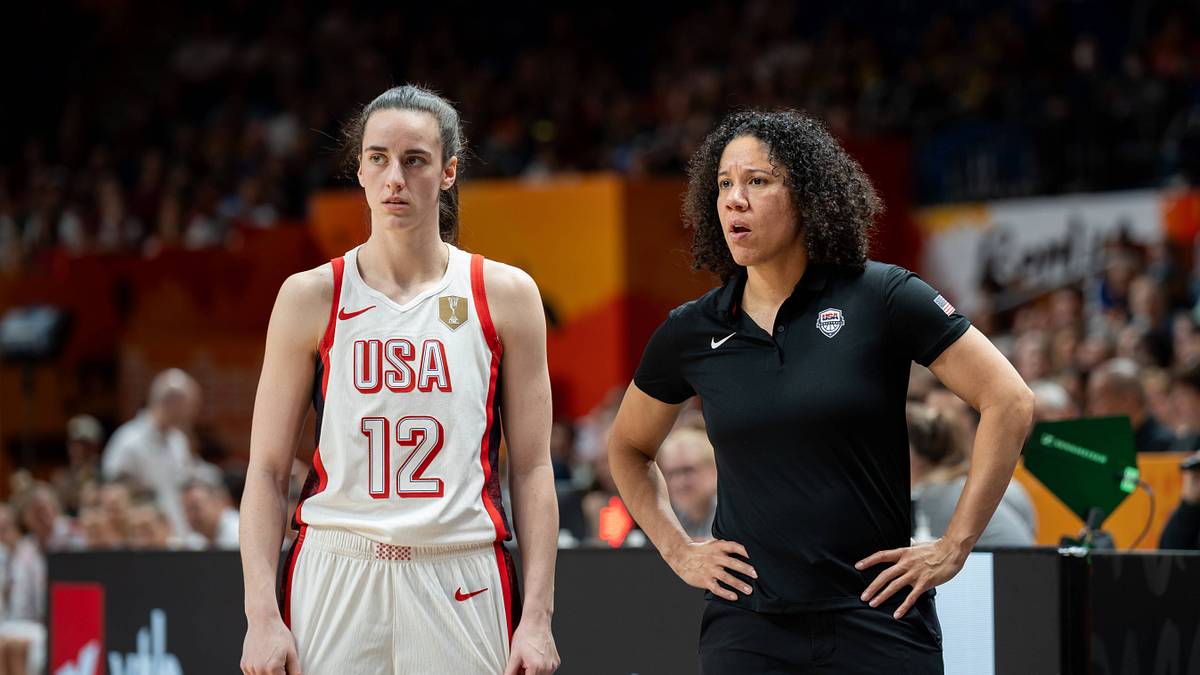
For long stretches of the opening half, the Americans looked vulnerable, and the pressure surrounding head coach Kara Lawson intensified with every missed opportunity, defensive breakdown, and French possession that made the gold-medal favorite appear uncomfortable on the biggest stage.
France did not simply hang around; it built real momentum, pushed the American defense backward, and forced Team USA into a difficult chase, creating the kind of scoreboard pressure that can expose nervous decision-making even among experienced international players today.
According to the game commentary, the deficit became large enough to raise a question before halftime: could the United States recover before France turned belief into control and transformed an uncomfortable championship game into one of the tournament’s biggest shocks?
That question became even more dramatic because much of the criticism surrounding Team USA centered on the rotation, particularly the continued reliance on established veterans while younger players waited for shorter opportunities despite bringing speed, defensive pressure, and offensive unpredictability.
Then came one of the game’s most important moments, when Caitlin Clark entered late in the first half and knocked down a three-pointer that helped cut France’s advantage to only two points heading into halftime, instantly shifting the emotional temperature.
The shot did not erase the problems Team USA had displayed, but it changed the atmosphere because the Americans entered halftime within one possession, giving Lawson and her staff a chance to reset rather than desperately rescue a collapsing game.
Whatever adjustments were made at halftime, the veteran group returned with far greater intensity in the third quarter, defending with purpose, making tougher shots, attacking France’s confidence, and finally looking like the team expected to control a world championship final.
Breanna Stewart became the most reliable offensive force for the United States, finishing with 22 points and 10 rebounds while providing the kind of production and stability that Team USA badly needed during a game that threatened to become unpredictable.
Jackie Young also delivered a major performance, scoring 18 points while adding six rebounds and five assists, giving the United States another strong two-way presence and helping the Americans stretch their lead once the momentum finally shifted away from France.
Kahleah Copper added 15 points, while Chelsea Gray produced 12 points, five assists, and four rebounds, giving Lawson the veteran scoring and playmaking she needed after an opening stretch that had generated questions about whether the lineup could respond successfully.
But Caitlin Clark’s impact stood out because it came in limited minutes and under championship pressure, with the guard scoring 12 points in roughly 13 minutes while also contributing rebounds and assists during the most important game of the tournament.
Clark’s production immediately fueled the larger debate surrounding Team USA’s rotation, because matching veteran scorers in a fraction of the playing time naturally raises questions about whether she should have received a larger role earlier in the competition than expected.
The box-score discussion became even more striking because Clark’s minutes were far below those of several leading scorers, yet she still finished among the team’s most productive offensive players, reinforcing the belief that her efficiency can change games very quickly.
Her late first-half three-pointer became especially symbolic because it arrived when Team USA needed a spark, reducing the deficit and helping prevent France from carrying a larger emotional advantage into the locker room at the championship’s most dangerous moment possible.
Angel Reese also contributed when the younger group entered, and the broader second-half rotation brought fresh legs and renewed defensive energy, allowing Team USA to protect the advantage created by the veterans rather than surrendering control once substitutions arrived late.
Rhyne Howard’s defensive work was another important piece of the comeback, as she recorded four steals in limited minutes and helped increase the pressure on a French offense that became less organized and increasingly mistake-prone after losing the lead completely.
Once France fell behind, the game changed rapidly, because the confidence that had carried the French through the first half began to disappear, replaced by rushed possessions, missed shots, turnovers, and more difficult decision-making against a suddenly aggressive American defense.
The United States recognized the shift and kept applying pressure, refusing to give France the breathing room needed to rebuild momentum while extending the lead through disciplined defense, stronger rebounding, and more composed offensive execution during those critical late possessions.
France’s perimeter attack also cooled dramatically, and key scorers struggled to regain rhythm as Team USA tightened its coverage, challenged passing lanes, and turned several possessions into the kind of chaotic sequences that favor a deeper, more athletic American roster.
What had looked like a championship game slipping toward disaster became a controlled second-half performance, and the contrast between the two halves became the central story of the night as Team USA moved from uncertainty to authority with gold approaching.
For Kara Lawson, the victory delivered both relief and validation, although it did not erase the rotation questions that had followed the team throughout the tournament and became even louder after Clark’s efficient production in only thirteen minutes that night.
The criticism is unlikely to disappear because fans will continue asking why a player capable of producing 12 points so quickly was not given more opportunities, especially when the offense looked stagnant and vulnerable during key stretches before halftime too.
At the same time, the final demonstrated why veteran experience remains valuable, because Stewart, Young, Copper, and Gray all responded when the stakes were highest, turning a tense deficit into the foundation of another American gold-medal performance under intense pressure.
The championship therefore became a story of two groups working together under pressure: the experienced veterans stabilized the game and built the advantage, while the younger players entered with enough pace, confidence, and defensive energy to maintain it to victory.
Clark’s role will still dominate conversation because her numbers were impossible to ignore, and her ability to provide instant offense off the bench created another example of why every minute involving her becomes a major talking point after every appearance.
Paige Bueckers’ extremely limited playing time also raised questions, particularly because she appeared for only a few minutes, leaving viewers to wonder whether the decision reflected injury concerns, matchup choices, or a coaching preference in the final under pressure late.
Those questions may continue after the celebration ends, because championship victories often quiet criticism only temporarily, and Team USA’s uneven first-half performance provided enough material for supporters and skeptics to debate the coaching decisions long after the medals were awarded.
Still, when the final buzzer sounded, the most important result remained unchanged: the United States was once again world champion, capturing another gold medal after surviving pressure, absorbing France’s best early punch, and responding with a dominant second-half surge late.
For Clark, the night added another major achievement to an already heavily scrutinized career, as she became a gold medalist while contributing efficient scoring, playmaking, and one of the most important momentum-changing shots of the championship game under enormous pressure.
For Lawson, the result prevented a potentially humiliating defeat and delivered the one outcome every Team USA coach is ultimately judged by, even if the path toward gold generated far more anxiety and controversy than many expected before the final.
The final also offered a reminder that talent alone does not guarantee control, because even a roster loaded with established stars can be pushed into uncomfortable territory when opponents defend aggressively, play without fear, and force difficult decisions under pressure.
France proved that point for nearly an entire half, but Team USA proved something important afterward: elite teams can survive poor stretches when they defend harder, trust their depth, and seize momentum before an opponent can turn pressure into history.
In the end, Team USA left with gold, Clark left with 12 points off the bench, the veterans left with redemption, and Lawson left with a championship that rescued the night from becoming a humiliating loss in recent program history.


