The debate surrounding Caitlin Clark’s role with Team USA has reached another level, and this time the controversy extends far beyond a simple argument about whether she should be starting.
Questions are now being raised about how Clark is being used when she actually gets on the floor, who is influencing Kara Lawson’s rotation decisions, and whether Team USA is maximizing one of its most creative offensive players.
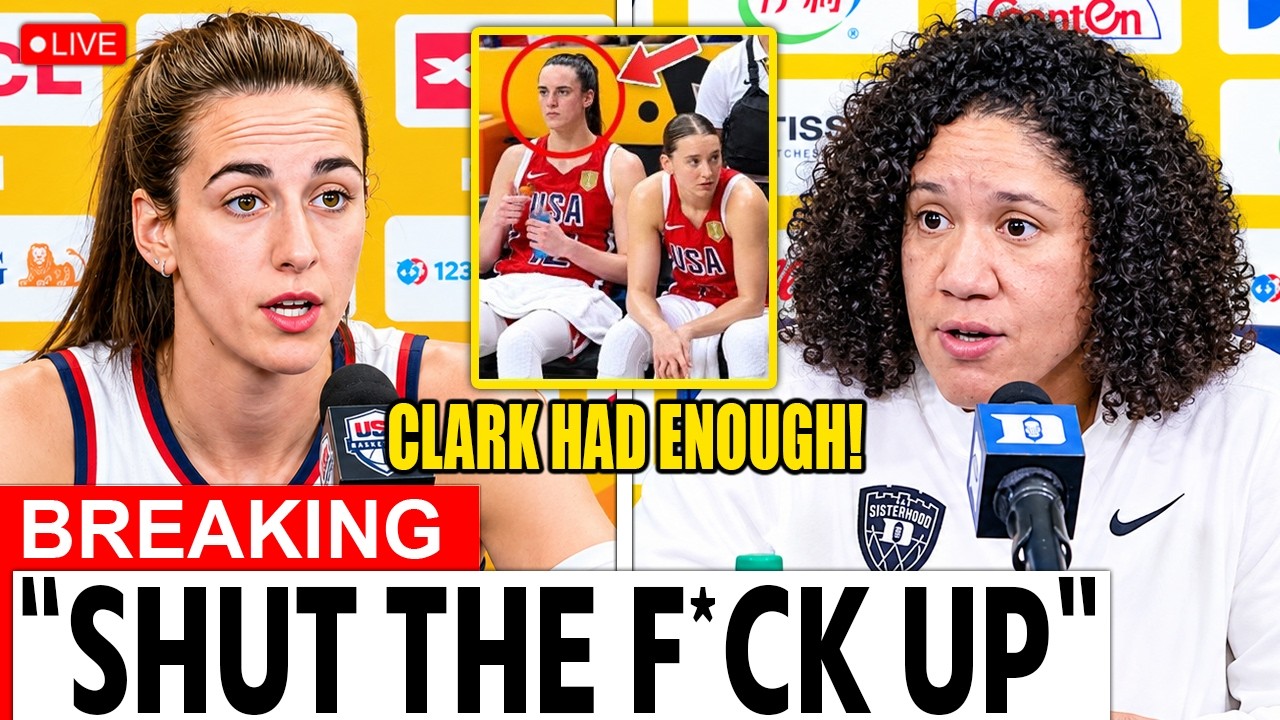
According to the transcript, critics are particularly frustrated because Clark sometimes shares the court with veteran players without being allowed to operate consistently as the primary point guard.
Instead, forwards or other guards occasionally initiate possessions while Clark moves away from the basketball.
For supporters who believe Clark’s greatest strength is controlling tempo, that approach makes little sense.
It is one thing to bring an elite point guard off the bench.
It is another thing entirely to put that player on the floor and then remove the basketball from her hands.
That distinction has become the latest flashpoint around Team USA.
The transcript opens with criticism that veterans sometimes play beside Clark without consistently finding her with passes.
It also argues that Team USA occasionally allows forwards to bring the ball up the floor instead of letting Clark organize the possession.
Those tactical choices have fueled frustration because Clark’s ability to create opportunities is one of the primary reasons she became such a transformative figure in women’s basketball.
Her passing range forces defenders to remain alert before she even crosses half court.
Her shooting range stretches defensive structure.
Her ability to increase tempo can turn defensive rebounds into transition opportunities before opponents have time to organize.
When Clark is reduced primarily to an off-ball role, Team USA sacrifices part of what makes her unique.
That does not mean Clark must control every possession.
No championship-level team should become completely dependent on one player.
But if Clark is on the court, critics argue that Team USA should at least take advantage of the skills that made her one of basketball’s most recognizable playmakers.
The video then escalates the controversy dramatically.
It alleges that Clark confronted Lawson about being benched despite her production and questioned why veterans continued receiving opportunities.
However, the transcript does not provide independent evidence confirming that the quoted confrontation occurred exactly as described.
That allegation should therefore remain separated from what can actually be evaluated on the basketball court.
The source also claims Lawson revealed that assistant coach Stephanie White had major influence over the rotation involving Clark.
Again, that interpretation goes considerably further than Lawson’s actual comments included later in the transcript.
What Lawson clearly did say was that White is a highly valued member of her staff.
Lawson described White as excellent in areas including game planning, scouting, and tactical preparation.
She also explained that the coaching staff works collaboratively.
According to Lawson, coaches regularly gather around a whiteboard, review film, exchange ideas, draw actions, and discuss potential defensive adjustments.
Lawson even acknowledged that she has learned extensively from her assistants.
Those statements provide evidence that White has influence within Team USA’s coaching process.
They do not, by themselves, prove that White ordered Lawson to bench Clark.
That distinction matters enormously.
Modern national teams are built around collaborative coaching staffs.
Assistant coaches are supposed to influence strategy.
They are supposed to challenge the head coach.
They are supposed to participate in scouting and game planning.
The existence of influence is normal.
The relevant question is what basketball philosophy that influence creates.
That is where White’s history with Clark becomes part of the debate.
The transcript strongly criticizes White’s previous handling of Clark with the Indiana Fever.
It argues that Clark was too often moved away from the ball and used more like a wing while other players initiated offense.
The commentary also criticizes offensive sets that involved Aliyah Boston operating as a playmaking hub near the top of the floor.
Those tactical ideas are not inherently irrational.
Using a skilled center as a facilitator can create backdoor opportunities and force opposing bigs into uncomfortable positions.
Using Clark off the ball can also generate movement and prevent defenses from loading pressure directly toward her.
The issue is balance.
Clark’s off-ball gravity has value precisely because defenders fear what she can do with the basketball.
If she spends too many possessions away from the action, Team USA risks turning a strength into a limitation.
That is why Lawson’s comments about White immediately attracted scrutiny from Clark supporters.
The concern is not simply that White participates in meetings.
The concern is that some fans believe Team USA is repeating offensive concepts they already disliked during Clark’s WNBA experience.
The transcript repeatedly interprets that similarity as evidence of deliberate suppression.
That conclusion is not established by the material provided.
But the tactical similarities are enough to sustain a legitimate basketball conversation.
Should Clark be initiating more possessions?
Should Team USA play faster when she enters?
Should younger players receive a larger role beside her?
Should Clark spend less time positioned away from the basketball while veteran players control the offense?
Those questions can be answered through game film rather than conspiracy theories.
Lawson’s own comments suggest that Team USA spends considerable time discussing ways to simplify defensive responsibilities for veterans and identify the coverages in which those players feel most comfortable.
That is normal coaching.
Veteran players often receive input because they possess extensive international experience.
But critics heard something else.
They interpreted Lawson’s repeated references to veteran comfort as evidence that the system is being designed primarily around older players.
That interpretation becomes especially controversial because Team USA also possesses a remarkable young core.
Clark provides elite passing and range.
Paige Bueckers provides scoring versatility and secondary creation.
Angel Reese brings rebounding, physicality, and transition energy.
Aliyah Boston adds interior strength, screening, and intelligent movement.
Rhyne Howard adds athleticism and perimeter scoring.
If the younger players create a faster and more dynamic style, Lawson eventually has to decide how heavily she wants to lean into that identity.
Experience matters.
Production matters too.
Clark has already shown throughout her career that she can change the tempo of a game.
She does not need to score 30 points to control an offense.
Sometimes the most important contribution is simply getting the ball into the right teammate’s hands several seconds earlier than the defense expects.
That is why every decision involving Clark attracts enormous attention.
If she comes off the bench but immediately generates a run, fans ask why she did not start.
If she plays significant minutes but does not initiate offense, fans ask why Team USA is not using her properly.
If the offense stagnates while she waits on the perimeter, the questions become even louder.
That level of scrutiny can become excessive.
Coaches possess information that viewers do not.
They see practices.
They evaluate conditioning.
They understand defensive matchups.
They know what players are being asked to execute inside specific sets.
They may have strategic reasons for decisions that appear confusing on television.
The transcript itself eventually acknowledges this point.
It notes that coaching decisions are complicated and that fans should avoid assuming every unexplained rotation is automatically evidence of malicious intent.
That is an important correction to the earlier, more explosive accusations.
The real debate should remain focused on basketball.
Which lineups produce the best results?
Which guards should control the offense?
Which combinations create the most efficient spacing?
What pace gives Team USA its greatest advantage?
And when the game becomes close, which players should be trusted to make decisions?
Those are the questions Lawson must answer.
Clark does not necessarily require the entire offense to revolve around her.
But ignoring her ability to initiate offense would also be difficult to defend.
Her vision can create layups before defenses are organized.
Her deep shooting range can pull defenders several feet away from their preferred positions.
Her willingness to advance the basketball immediately encourages teammates to run.
Those qualities are particularly valuable in international basketball, where half-court defenses can become extremely compact and disciplined.
A stagnant Team USA offense allows opponents to establish their structure.
A faster Team USA offense forces opponents to react.
Clark’s greatest tactical contribution may be that she prevents defenders from becoming comfortable.
This is why the debate surrounding Lawson and White should not simply become personal.
White is not automatically wrong because she values certain offensive structures.
Lawson is not automatically incompetent because she trusts veterans.
Clark is not automatically being sabotaged because she spends time on the bench.
But those decisions still deserve analysis.
If Team USA repeatedly looks better when Clark controls the offense, the coaching staff has an obligation to recognize the pattern.
Championship coaching requires adaptation.
The best coaches do not fall in love with their original plan.
They observe.
They adjust.
They use the tournament itself as evidence.
That becomes especially important when younger players begin outperforming expectations.
Clark entered international basketball carrying extraordinary attention.
Every performance was going to be scrutinized.
Every mistake was going to become a headline.
Every assist was going to become a highlight.
Every benching was going to become a controversy.
That pressure can become exhausting.
But it also means the easiest way for Clark to influence the debate is through basketball.
If she receives more minutes, she has to produce.
If Lawson continues bringing her off the bench, Clark has to change the game when she enters.
If defenses blitz her, she must punish the coverage with passing.
If opponents sag, she must become aggressive as a scorer.
If teammates miss her while she is open, she must remain engaged rather than allowing frustration to affect the next possession.
That approach gives Clark the strongest possible argument.
Not social-media outrage.
Not accusations.
Production.
The same standard should apply to the veterans.
If Chelsea Gray remains the starting point guard, she must justify Lawson’s confidence by controlling games.
If veteran wings receive more minutes, they must defend, create, and make winning decisions.
Experience cannot become immunity from evaluation.
Nobody on Team USA should receive guaranteed status simply because of reputation.
The objective is not to protect hierarchy.
The objective is to win.
That is where Lawson’s leadership will ultimately be judged.
The transcript makes White’s influence sound sinister.
Lawson’s actual comments sound considerably more conventional.
She described a coaching staff exchanging ideas.
She praised an assistant coach.
She said she was learning.
There is nothing inherently controversial about any of that.
The controversy begins when those ideas are compared with what viewers see on the floor.
If Clark is playing but rarely touching the basketball, questions are fair.
If Team USA slows down dramatically with certain veteran combinations, questions are fair.
If the younger group produces stronger offensive stretches and still receives fewer opportunities, questions are fair.
What is not fair is turning every coaching decision into proof of a secret conspiracy without evidence.
There is already enough basketball evidence to create a serious discussion.
Clark’s supporters want to see her empowered as a point guard.
They want her making early decisions.
They want her pushing pace.
They want Bueckers running beside her.
They want Reese sprinting toward the rim.
They want Boston operating as a devastating screen-and-roll partner rather than replacing Clark as the primary organizer.
That vision of Team USA is exciting.
It may also be effective.
But Lawson has to balance that style with defense, experience, physical matchups, and roster chemistry.
The tournament will eventually tell us whether she has found the right balance.
If Team USA continues winning comfortably, Lawson will have a strong defense of her approach.
She can argue that the veteran starters provide stability while Clark and the younger group create a devastating second wave.
That strategy has precedent throughout basketball history.
Some elite creators have been used from the bench because coaches wanted to maintain offensive pressure across all 40 minutes.
But if Team USA enters another close game and cannot generate offense while Clark waits on the sideline, the criticism will become much harder to dismiss.
Those are the moments when theories become consequences.
Every tournament eventually produces one possession where the coaching philosophy is exposed.
Maybe Team USA needs one basket.
Maybe an opponent has successfully eliminated the first option.
Maybe the shot clock is falling.
Maybe the entire championship depends on someone seeing an opening before everyone else.
That is where Clark’s value becomes obvious.
She has built her reputation around seeing possibilities other players do not immediately recognize.
The debate is therefore bigger than Clark versus Lawson.
It is bigger than Clark versus White.
It is bigger than veterans versus young players.
The real issue is whether Team USA’s system is flexible enough to use every form of talent on the roster.
Can Lawson preserve veteran leadership without slowing the offense?
Can White contribute strategic ideas without limiting Clark’s creativity?
Can Clark learn to operate effectively both on and off the basketball?
Can the younger core integrate with established stars without turning lineup discussions into personal battles?
Those answers determine championships.
Team USA represents the highest level of American women’s basketball.
Every rotation decision is amplified.
Every possession is studied.
Every coaching quote becomes material for debate.
Lawson understood that when she accepted the job.
White understood it when she joined the staff.
Clark has been living under that microscope for years.
Now the only thing that matters is how the basketball develops.
Clark’s ability is not in question.
Her shooting range is proven.
Her passing imagination is proven.
Her confidence is proven.
Her capacity to attract defensive attention is proven.
What remains unresolved is how Team USA chooses to use those abilities.
The coaching staff can treat Clark as one weapon among many.
It can turn her into the central organizer of the offense.
Or it can attempt to combine both approaches depending on matchup and game situation.
The correct answer may not be identical every night.
But the wrong answer would be refusing to adapt when the evidence changes.
That is why the next close game will matter so much.
If Clark receives a larger role and delivers, the pressure on Lawson to maintain that role will become enormous.
If Team USA continues succeeding with Clark as a reserve, Lawson will have results supporting her philosophy.
And if the Americans lose while the offense stagnates and Clark watches critical possessions from the bench, every decision will be revisited.
The accusations in the transcript may be exaggerated.
The basketball questions are not.
Team USA has one of the most gifted playmakers in the world available.
The coaching staff now has to determine how much of the offense should belong in her hands.
Because when the pressure rises, arguments about politics, hierarchy, favoritism, and coaching meetings disappear.
Only the game remains.
And Caitlin Clark will eventually receive another opportunity to answer the controversy in the place where her argument has always been strongest.
On the basketball court.


