A highly dramatic account of Team USA’s international matchup against Hungary portrayed Caitlin Clark as the driving force behind an unforgettable offensive transformation.
According to the video transcript, Hungary entered the contest determined to prove that Clark’s celebrated American style would struggle against disciplined European defense.
The Hungarian team reportedly prepared an aggressive game plan built around physical contact, full-court pressure, and repeated double teams.
For several minutes, that strategy appeared to disrupt Team USA’s rhythm.
Then Clark allegedly changed the entire direction of the game through deep shooting, rapid transition attacks, and passes that repeatedly defeated Hungary’s defensive rotations.
The video presented the performance as proof that her unusual skill set could succeed against any style of international basketball.
It also claimed NBA commissioner Adam Silver watched from a private suite and recognized the global commercial significance of what was unfolding.
However, the transcript did not provide official statistics, direct quotations, or independent confirmation for several of its most dramatic claims.
The performance should therefore be described as presented by the video rather than treated as a fully verified game report.
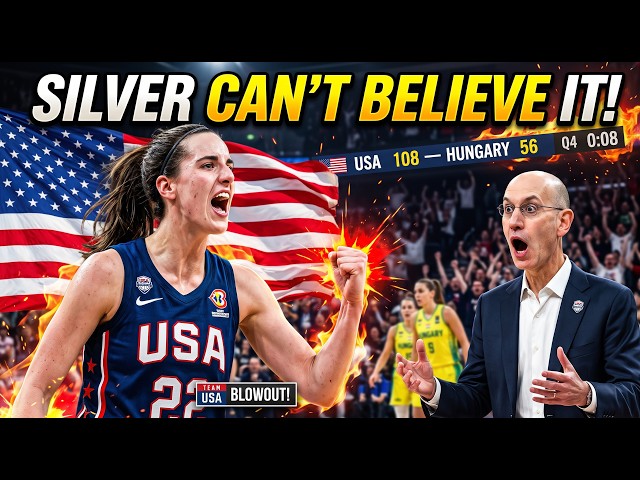
Hungary Prepares a Physical Defensive Test
European teams have traditionally used disciplined half-court systems to challenge opponents that prefer faster, perimeter-oriented basketball.
Hungary was described as a particularly physical and tactically organized opponent.
Its plan reportedly focused on limiting Clark’s freedom from the opening possession.
Defenders attempted to crowd her space across the entire court, deny comfortable catches, and force her away from the three-point line.
The strategy also involved making every screen, cut, and passing lane difficult.
Hungary wanted the game to become a slow contest decided through physical defense and patient half-court execution.
That approach appeared logical.
Clark is most dangerous when she receives the ball early and attacks before the defense organizes.
Slowing the game could reduce her transition opportunities and force Team USA to operate through more predictable possessions.
During the opening minutes, the plan reportedly succeeded.
American possessions moved deeper into the shot clock, while Hungary challenged passing lanes and contested perimeter attempts.
The Hungarian bench responded energetically as its defenders prevented Team USA from establishing an immediate rhythm.
Confidence began growing among the underdogs because the contest was unfolding according to their preparation.
One Transition Possession Changes Everything
The turning point reportedly began with an ordinary defensive rebound.
Instead of waiting for a called half-court play, Clark accelerated down the floor and forced Hungary’s defenders to retreat.
As the primary defender moved toward the paint, Clark stopped several feet behind the three-point line.
She then launched a deep jumper before Hungary could establish its coverage.
According to the transcript, the shot fell cleanly and changed the atmosphere inside the arena.
The basket carried greater importance than three points.
It warned Hungary that protecting the lane would leave dangerous space beyond the arc.
On the following sequence, Clark allegedly anticipated a cross-court pass and moved into the passing lane.
She collected the ball, attacked in transition, and delivered a behind-the-back pass to a trailing teammate for an uncontested finish.
Within approximately one minute, Hungary’s early confidence reportedly disappeared.
The team could no longer focus on only one element of Clark’s game.
Defenders had to guard her shooting, passing, speed, and ability to anticipate developing plays.
Clark Forces Hungary to Change Its Defense
Hungary reportedly abandoned its original coverage during the second quarter.
The coaching staff shifted toward aggressive traps designed to prevent Clark from receiving comfortable touches near the perimeter.
Two defenders frequently moved toward her around midcourt.
That pressure was intended to force the ball from her hands before she could enter a dangerous shooting position.
However, Clark’s passing made the traps increasingly risky.
When multiple defenders committed to her, teammates became available elsewhere on the floor.
Clark allegedly split several traps with quick dribbles before sending diagonal passes toward open shooters.
Hungary then attempted a more protective zone.
That adjustment kept additional defenders closer to the basket but provided Clark with greater room beyond the three-point line.
According to the video, she responded by making long-range shots that forced the defense to extend again.
Every adjustment created another weakness.
If Hungary pressured Clark high, she passed through the coverage.
If defenders retreated, she attacked with deep shots.
If multiple players moved toward her, American cutters received additional space near the basket.
That tactical dilemma represents the central reason Clark can become so difficult to contain.
Shooting Range Changes the Geometry of Basketball
Clark’s most visible skill is her willingness to shoot from distances many defenders are not accustomed to guarding.
Her range can change every player’s position on the floor.
Traditional defenses are designed to protect the area near the basket while contesting ordinary perimeter shots.
A player capable of scoring from near the logo forces the first defender several feet higher.
That movement opens passing lanes behind the initial coverage.
Interior defenders must decide whether to remain close to the basket or move outward to help.
The decision creates opportunities for rolling screeners, backdoor cutters, and teammates attacking from the weak side.
Clark’s influence therefore extends beyond the shots she makes.
The possibility of a deep attempt can manipulate defensive spacing before the possession properly begins.
Against Hungary, the video claimed this effect became overwhelming.
The defense reportedly appeared uncertain whether to challenge Clark’s range or protect the space created behind the pressure.
Team USA Turns Defense Into Immediate Offense
As the game progressed, Team USA reportedly increased its transition pressure.
Every Hungarian miss or turnover became an opportunity for the Americans to attack before the defense recovered.
Clark’s ability to recognize open teammates made those moments particularly dangerous.
She did not need to carry the ball into the frontcourt before making a decision.
A pass could travel forward immediately, forcing Hungary to defend while retreating and communicating simultaneously.
The transcript described several possessions in which American players reached open space before Hungarian defenders identified their assignments.
That speed reportedly transformed the matchup from a physical struggle into an offensive exhibition.
Hungary’s players continued competing, but the demands of defending Clark across the entire court gradually affected their energy.
Chasing deep shooters requires more movement than protecting a conventional three-point line.
Repeated traps also consume defensive strength because players must recover long distances after the ball escapes.
By the second half, Hungary’s rotations were described as slower and less connected.
An Alleged Long-Range Shot Captures the Moment
One of the video’s most dramatic sequences involved a deep step-back attempt after Hungary called a timeout.
According to the narration, Clark received the inbounds pass against full-court pressure and moved around two defenders.
She then attempted a shot from approximately 35 feet.
The transcript claimed the ball touched the backboard before falling through the net.
Even some Hungarian supporters reportedly applauded the extraordinary attempt.
The moment was presented as the point when the opponent’s defensive confidence finally collapsed.
However, no official highlight, box score, or independent report was included with the transcript to verify the precise distance or circumstances.
The play remains a vivid part of the video’s storytelling, but its details should be confirmed before being reported as historical fact.
Hungary’s Coach Reportedly Admits the Plan Failed
The transcript also claimed Hungary’s head coach openly acknowledged the difficulty of defending Clark.
According to the narration, he said his team prepared for speed, physicality, and complex offensive actions.
He allegedly explained that Hungary could not control a player capable of shooting from extreme distances while anticipating rotations several seconds in advance.
The video did not provide the coach’s name or an uninterrupted direct quotation.
It also did not include an official press conference recording.
Therefore, the statement should remain attributed to the video rather than presented as verified testimony.
Still, the tactical principle described by the alleged comments is reasonable.
A defense can prepare for a specific formation, but Clark’s range forces adjustments before ordinary formations even begin.
Adam Silver’s Presence Is Not Confirmed
Another major element of the video involved NBA commissioner Adam Silver.
The narration claimed Silver watched the performance from a VIP suite alongside basketball federation officials.
It described him reacting with surprise as Clark’s influence expanded.
The video further alleged that Silver discussed the game with executives and recognized its potential importance to global media rights, merchandise sales, and international promotion.
No direct footage, official itinerary, statement, or credible source was provided to establish Silver’s presence.
His alleged private conversations were also unsupported by identifiable evidence.
As a result, those claims cannot be treated as confirmed events.
The article’s central basketball analysis does not require inventing an executive reaction.
Clark’s ability to attract attention and influence modern basketball can be discussed without placing unverified words or behavior on Silver.
Clark’s Commercial Influence Continues to Grow
Clark’s popularity has helped women’s basketball reach viewers who previously paid limited attention to the sport.
Her long-range shooting and ambitious passes create highlights that travel rapidly across television and social media.
That visibility carries commercial value.
Broadcasters benefit when games attract larger audiences, sponsors gain greater exposure, and international organizers can market events around recognizable athletes.
However, commercial popularity should not become the only measurement of a player’s value.
The strongest argument for Clark remains connected to basketball.
Her passing creates efficient opportunities.
Her range stretches defenses.
Her pace prevents opponents from controlling the game through slower half-court tactics.
Those qualities can produce competitive success while also entertaining audiences.
The combination makes Clark valuable to coaches and business executives for different but overlapping reasons.
International Basketball Presents Unique Challenges
The video framed Hungary as a test of whether Clark’s game could translate beyond the American professional environment.
International basketball can feature tighter spacing, greater physicality, and different defensive rules.
Teams may protect the paint more aggressively and use experienced players familiar with complex tactical systems.
Those differences can challenge guards accustomed to greater freedom.
At the same time, Clark’s abilities may offer answers to several international problems.
Her shooting can stretch compact defenses.
Her passing can punish traps.
Her transition instincts can attack before disciplined teams establish their structure.
Success against international opponents would demonstrate that her game is not dependent on one league or one defensive environment.
Nevertheless, broad conclusions should be based on verified performances rather than dramatic narration alone.
One extraordinary game cannot answer every question about long-term international dominance.
The Old Hierarchy Faces a New Basketball Reality
The transcript repeatedly contrasted established veterans with a younger generation attracting unprecedented attention.
It suggested some traditional decision-makers wanted emerging players to wait before receiving major international responsibility.
That tension has existed throughout many sports.
Experienced players earn trust through years of performance, while younger stars often arrive with abilities capable of changing established systems.
A responsible national-team program must balance both considerations.
Veterans should not lose respect simply because another player becomes popular.
Young talent should not be restricted solely because tradition demands patience.
The correct standard is whether a player’s skills improve the team’s chances of winning.
If Clark creates the strongest offensive advantages, coaches should expand her role.
If another combination provides better control in a particular matchup, the staff should adjust accordingly.
Team USA Must Build Around Function
The best version of Team USA is unlikely to depend entirely on one player.
The roster contains experienced scorers, elite defenders, versatile forwards, and several capable playmakers.
Clark’s presence should make those teammates more effective rather than reduce their importance.
Her deep range can create space for interior players.
Her transition passing can help wings score before the defense recovers.
Her ability to attract traps can produce numerical advantages for everyone behind the pressure.
Using Clark correctly does not mean allowing her to attempt every shot.
It means organizing actions that force opponents to react to her repeatedly.
She can begin as a ball handler, relocate as a shooter, and return as a secondary creator.
That variety prevents defenses from becoming comfortable.
Dramatic Claims Require Reliable Evidence
The video used powerful language to describe a historic performance that supposedly changed the future of basketball.
It claimed records were shattered, executives were stunned, international media plans changed, and political resistance inside basketball disappeared.
Those claims may create an exciting narrative, but they require evidence.
An official box score would be needed to verify scoring and assist totals.
Game footage would be required to confirm the described shots and passes.
Attendance records and ratings data would be necessary to establish the commercial impact.
Official press conference material would be needed to confirm statements attributed to Hungary’s coach.
Evidence of Silver’s attendance or comments would also require direct confirmation.
Without those sources, the safest approach is to describe the story as the video presented it.
A Performance Symbolizing Basketball’s Evolution
Even when its unverified details are separated, the transcript captures a compelling idea about the evolution of modern basketball.
Long-range shooting has changed where defenses must begin applying pressure.
Rapid passing has reduced the time teams have to establish coverage.
Creative guards can now influence the court from distances once considered unreasonable.
Clark represents those changes more clearly than most players.
Her style challenges traditional assumptions about shot selection, pace, and acceptable passing risk.
When successful, that style can make an organized defense appear unprepared.
It can also encourage teammates to run harder because every transition opportunity might become a scoring chance.
That influence helps explain why her performances generate such intense reactions.
A Powerful Future Still Requires Verification
The video concluded that Clark’s performance against Hungary permanently elevated the standard of international basketball.
That conclusion may be premature, particularly without verified statistics or independent reporting.
However, the broader possibility remains exciting.
A player who combines deep range, passing vision, and fearless tempo can influence how teams build offenses and prepare defenses.
If Clark consistently produces that impact against elite international opponents, her importance will extend far beyond ticket sales or media attention.
She could help define a new tactical era for Team USA.
Coaches would need to create systems capable of maximizing her range while surrounding her with players prepared to move continuously.
Opponents would need to defend larger areas of the court and make faster decisions under pressure.
The Real Story Is Bigger Than One Highlight
The most meaningful lesson from the transcript is not a single deep three-pointer or behind-the-back pass.
It is the idea that basketball’s geometry is changing.
Players capable of threatening from extreme distances force every defender into uncomfortable choices.
When that shooting is combined with elite passing, traditional solutions such as traps and protective zones can become dangerous.
Clark’s game contains the ingredients necessary to create those dilemmas.
Whether the Hungary performance occurred exactly as described must be confirmed through reliable records.
The video’s claims about Silver, shattered records, and private executive conversations also remain unverified.
Still, the excitement surrounding Clark reflects something real about modern basketball.
Fans see a player capable of making the court feel larger, the game move faster, and every ordinary possession become unpredictable.
If Team USA learns to integrate those qualities with its veteran talent, the result could become more powerful than any sensational online headline.
It could produce an offense capable of defining the next era of international women’s basketball.


