BERLIN — Team USA has reached the knockout stage of the FIBA Women’s Basketball World Cup undefeated, yet one of the tournament’s loudest debates remains unresolved.
Should Caitlin Clark be starting?
The Indiana Fever guard has come off the bench throughout the opening phase, while veteran Chelsea Gray has continued to occupy the starting point guard position.
That decision has generated enormous discussion among fans, analysts and commentators watching how dramatically the American offense can change when Clark controls the basketball.

Now assistant coach Nate Tibbetts has been pulled into that conversation.
A viral video claims Tibbetts revealed troubling behind-the-scenes information about Clark’s treatment by the coaching staff.
The available evidence supports a considerably different interpretation.
Tibbetts discussed lineup performance and balance.
He did not publicly reveal a conspiracy against Clark.
That distinction is important.
NATE TIBBETTS IS PART OF A HIGH-PROFILE TEAM USA STAFF.
Tibbetts is not an outside observer commenting on Team USA.
He is part of Kara Lawson’s national-team coaching staff.
FIBA identified Lawson as head coach, supported by Natalie Nakase, Nate Tibbetts and Stephanie White during the preparation cycle for the 2026 World Cup.
That gives Tibbetts meaningful insight into how the American roster is being evaluated.
It also means every public comment he makes can receive unusual scrutiny when Clark’s role is involved.
The transcript opens with Tibbetts discussing how different groups responded during a game.
He praised strong stretches from the starters and emphasized that Team USA received balanced contributions.
The narrator then interprets those remarks through a much more controversial lens.
Those are two different things.
THE VIDEO CLAIMS AN “AGENDA,” BUT THE QUOTE DOES NOT PROVE ONE.
The source immediately suggests there may be an agenda surrounding Clark.
That is commentary from the video creator.
It is not something Tibbetts himself states in the supplied remarks.
In fact, the transcript itself briefly asks the correct question.
Was Clark genuinely being treated differently?
Or was social media transforming ordinary coaching decisions into something much larger?
That distinction should remain central to any serious analysis.
There is abundant evidence for a basketball debate.
There is not equivalent evidence for intentional sabotage.
CAITLIN CLARK MADE THE DEBATE IMPOSSIBLE TO IGNORE AGAINST CHINA.
The controversy surrounding Clark’s bench role intensified because of what happened in Team USA’s opening game.
USA defeated China 94-61.
Clark came off the bench and immediately became the game’s most productive facilitator.
She finished with 14 points.
She delivered 11 assists.
She committed zero turnovers.
She also produced three made three-pointers and finished with a game-best efficiency rating of 22.
Those numbers would be impressive for any point guard.
For a player making her Women’s World Cup debut, they were extraordinary.
ELEVEN ASSISTS WITH ZERO TURNOVERS WAS HISTORIC.
FIBA confirmed that Clark became the first player in Women’s World Cup history to record at least 10 assists without committing a turnover.
Only a small collection of players have exceeded 10 assists in a single Women’s World Cup game since assists began being officially tracked in 1994.
Clark joined that group immediately.
She did it in her first appearance.
That performance changed expectations surrounding her role.
Suddenly, bringing Clark off the bench no longer looked like a simple developmental decision.
It became a legitimate strategic debate.
CLARK CHANGES TEAM USA’S TEMPO.
The argument for Clark starting goes beyond points and assists.
It begins with pace.
Clark receives the basketball and immediately looks forward.
She wants transition.
She wants early passing opportunities.
She wants the defense making decisions before it becomes organized.
That style can completely change the geometry of a possession.
Defenders must respect Clark’s shooting range several feet beyond the three-point line.
That stretches the floor.
It creates space for cutters.
It creates room for screeners.
It creates passing lanes toward the basket.
HER PASSING MAKES THE ENTIRE ROSTER MORE DANGEROUS.
Team USA presents Clark with an unusual luxury.
Almost every teammate receiving one of her passes can finish the possession.
Breanna Stewart can score inside or outside.
Paige Bueckers can attack gaps.
Rhyne Howard can punish defenders from three-point range.
Aliyah Boston can roll toward the basket.
Jackie Young can attack immediately.
That changes Clark’s responsibility.
She does not need to produce 30 points every night.
She can control games by making everyone else more efficient.
THE CHINA GAME SHOWED EXACTLY HOW THAT CAN WORK.
FIBA reported that Clark produced four assists during her first four minutes against China.
The transition from reserve to offensive organizer happened almost immediately.
Clark herself explained that facilitating and playing fast were major priorities.
She wanted penetration against China’s zone.
She wanted to generate opportunities for teammates.
The plan worked.
The ball moved.
Players scored.
Team USA pulled away.
That became the strongest argument for giving Clark more control.
CHELSEA GRAY REPRESENTS A DIFFERENT STYLE.
The starting-point-guard discussion naturally includes Chelsea Gray.
That should not become disrespect.
Gray is a decorated veteran.
She has championship experience.
She has played in enormous international games.
She understands how to organize half-court offense under pressure.
Clark provides something different.
She accelerates.
Gray stabilizes.
Clark looks toward early offense.
Gray is comfortable manipulating slower possessions.
Neither style is inherently wrong.
The question is which style best suits this specific Team USA roster.
USA BASKETBALL HAS DELIBERATELY LEANED ON VETERANS TO START GAMES.
USA Basketball’s own knockout-stage preview acknowledged that Lawson used the same veteran-oriented starting structure during the first three group games.
Stewart, Young, Napheesa Collier, Kahleah Copper and Gray formed that group.
The younger players generally came from the bench.
However, USA Basketball also noted that playing time remained relatively balanced because of the roster’s extraordinary depth.
That context matters.
Clark has not been buried at the end of the rotation.
She has received meaningful minutes.
THE CZECHIA GAME ADDED ANOTHER PIECE OF EVIDENCE.
Team USA finished Group D by defeating Czechia 105-64.
Clark again came from the bench.
She played 22 minutes.
She finished with nine points and seven assists.
Her official plus-minus was plus-22.
The Americans scored 29 points in the first quarter and 28 in the second.
The offense looked far more comfortable than it had during the difficult Italy game.
Clark again contributed as a creator.
HER TOURNAMENT ASSIST NUMBERS ARE PARTICULARLY SIGNIFICANT.
Through the first three games, Clark averaged 6.3 assists.
That ranked third at the tournament according to FIBA’s official player page.
She accumulated 19 assists in 66 total minutes.
That production helps explain why fans continue asking the same question.
If Clark is one of the tournament’s best facilitators, why wait to introduce her?
Why not establish that passing and pace immediately?
Lawson clearly sees value in another approach.
USING CLARK AS A BENCH WEAPON IS NOT AN ABSURD STRATEGY.
There is a basketball argument for the current rotation.
Starting Gray gives Team USA veteran control at the beginning.
Then Clark can enter against a defense that has already spent several minutes dealing with another style.
Her arrival immediately changes the speed.
That can create tactical shock.
A defense prepares for one rhythm.
Suddenly Clark enters and everything accelerates.
That strategy resembles using an elite sixth player whose impact is designed to change the shape of the game.
There is nothing inherently disrespectful about that role.
BUT THE OBVIOUS COUNTERARGUMENT REMAINS.
Why intentionally wait?
If Clark’s pace creates advantages, Team USA could establish those advantages from the opening possession.
If she stretches defenses, begin stretching them immediately.
If she creates easier opportunities for teammates, allow those opportunities to develop before an opponent establishes confidence.
That is why the debate refuses to disappear.
Both arguments contain legitimate basketball logic.
The knockout stage may determine which one proves more useful.
TIBBETTS HAS PREVIOUS EXPERIENCE LEADING THIS GROUP.
There is another important piece of context surrounding Nate Tibbetts.
During World Cup qualifying earlier in 2026, he assumed significant coaching responsibilities while Lawson returned to her Duke commitments.
USA Basketball and FIBA documented his involvement during that qualification process.
Clark was already part of that environment.
This means Tibbetts has seen her inside the USA Basketball system beyond the current World Cup.
He understands her pace.
He understands her passing.
He understands the roster decisions involved.
That makes his tactical perspective genuinely interesting.
WHAT TIBBETTS DID NOT SAY MATTERS TOO.
The transcript does not contain Tibbetts saying Lawson is intentionally limiting Clark.
It does not contain him claiming Chelsea Gray is receiving minutes because of politics.
It does not contain him revealing a secret internal dispute.
Those conclusions come from commentary layered around his remarks.
The actual basketball discussion is much less sensational.
Team USA is trying to balance veterans and younger players.
It is trying to develop multiple styles.
And it is trying to win another world championship.
THE ITALY GAME EXPLAINS WHY FANS ARE IMPATIENT.
Between the China and Czechia victories came a very different experience.
Italy forced Team USA into an ugly, slow game.
The Americans struggled offensively.
That performance intensified criticism of the veteran-heavy approach.
Clark did not have a good individual game either.
She scored one point and missed all six field-goal attempts.
Her official line included four rebounds, one assist and two turnovers in 19 minutes.
That game complicated every simplistic narrative.
CLARK IS NOT AUTOMATICALLY THE ANSWER TO EVERY PROBLEM.
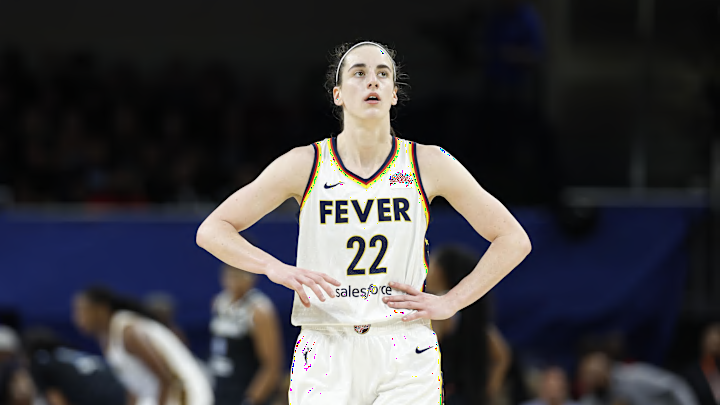
The Italy performance demonstrated an important reality.
Even elite players struggle.
Clark can miss shots.
She can be disrupted.
She can make mistakes.
International opponents will study her tendencies.
They will pressure her.
They will attempt to take away transition.
They will force her into difficult half-court possessions.
That is part of the World Cup challenge.
Starting Clark does not guarantee perfect offense.
BUT ONE BAD NIGHT DOES NOT ERASE WHAT SHE PROVIDES.
Clark followed the Italy game with seven assists against Czechia.
That response matters.
She did not need a spectacular scoring night to contribute.
She simply returned to creating.
That is one reason point guards must be evaluated differently.
A scorer experiencing a cold shooting night can disappear.
An elite creator can still influence the game through passing, pace and spacing.
Clark has already demonstrated that ability.
PAIGE BUECKERS MAKES THE YOUNGER GROUP EVEN MORE INTERESTING.
Bueckers has become another major factor in the rotation discussion.
She provides secondary creation.
She can operate in the mid-range.
She can play on or off the basketball.
That makes her an intriguing partner for Clark.
Two elite decision-makers force defenses into difficult choices.
Pressure Clark and Bueckers can attack.
Focus on Bueckers and Clark can relocate.
Switch aggressively and another USA star can exploit the mismatch.
The possibilities are enormous.
BREANNA STEWART SHOWS WHY THIS IS NOT SIMPLY OLD VERSUS YOUNG.
Stewart was outstanding against Czechia.
She scored 19 points and earned Player of the Game recognition.
That matters when discussing generational narratives.
The real issue is not veterans against younger players.
Some veterans fit beautifully with fast basketball.
Stewart is an obvious example.
She runs.
She passes.
She can screen.
She can finish.
She can shoot.
That versatility makes her compatible with almost any guard.
TEAM USA’S BEST VERSION MAY MIX BOTH GENERATIONS.
The Americans do not need to choose youth or experience.
They need combinations.
Imagine Clark directing transition with Stewart sprinting ahead.
Imagine Bueckers attacking the second side.
Imagine Boston screening.
Imagine Howard waiting on the perimeter.
Then imagine Gray entering later to slow the game and control a difficult stretch.
That is the advantage of exceptional depth.
Different styles can solve different problems.
THE BIGGEST MISTAKE WOULD BE TURNING FLEXIBILITY INTO RIGIDITY.
Lawson’s coaching challenge is not easy.
Every player on this roster is accustomed to significant responsibility.
Someone must sacrifice minutes.
Someone must come from the bench.
Someone will not close certain games.
The danger comes when roles remain unchanged despite new evidence.
If Clark repeatedly changes games, that information should matter.
If Gray controls critical possessions, that should matter too.
The coaching staff must remain flexible.
PLUS-MINUS CAN INFORM THE DEBATE, BUT IT CANNOT SETTLE IT ALONE.
The source repeatedly emphasizes lineup impact and plus-minus.
Those statistics can reveal useful patterns.
They should not become absolute proof of individual superiority.
A player’s plus-minus depends on who shares the floor.
Opponent combinations matter.
Timing matters.
Garbage-time possessions matter.
Still, Clark’s plus-30 against China was impossible to completely dismiss.
Team USA dominated during her minutes.
That deserves consideration.
TIBBETTS’ COMMENTS FIT A BROADER TEAM PHILOSOPHY.
The opening quote in the supplied transcript emphasizes balance.
Different groups contributed.
Starters produced strong stretches.
Other players responded.
Everyone shared responsibility.
That message is consistent with how USA Basketball has publicly described the roster.
The national team is extraordinarily deep.
No player is supposed to carry the entire burden.
That includes Clark.
Her importance can coexist with collective responsibility.
THIS DOES NOT MEAN FANS SHOULD STOP ASKING QUESTIONS.
Fans can reasonably argue Clark should start.
They can analyze Gray’s possessions.
They can question Lawson’s rotation.
They can compare the pace generated by different units.
That is normal sports debate.
The line should be drawn at claims of hidden sabotage without evidence.
A coaching disagreement is not automatically an agenda.
Reduced minutes are not proof of hostility.
A lineup decision is not proof of conspiracy.
THE KNOCKOUT STAGE WILL PROVIDE BETTER ANSWERS.
Team USA completed group play 3-0.
USA Basketball listed Clark as its assist leader at 6.3 per game entering the knockout stage.
Now experimentation becomes more dangerous.
One poor quarter can change a tournament.
One wrong rotation can become decisive.
One inspired substitution can rescue a game.
That is where Lawson’s decisions will receive their most meaningful test.
CLARK’S ROLE MAY MATTER MORE THAN WHETHER SHE HEARS HER NAME DURING INTRODUCTIONS.
Starting receives enormous attention.
Closing is more important.
Who controls the final five minutes?
Who gets the ball when the opponent makes a run?
Who creates the shot when the half-court offense stalls?
Those situations reveal genuine trust.
Clark can remain technically a reserve and still become one of Team USA’s most important players.
The minutes that matter most will reveal the hierarchy.
CHELSEA GRAY’S EXPERIENCE MAY BECOME MORE VALUABLE LATER.
Knockout basketball often becomes slower.
Defenses become more prepared.
Possessions become more deliberate.
Transition becomes harder to find.
Those conditions can favor Gray’s experience.
That should not be ignored simply because Clark is more explosive.
The ideal solution may involve switching between them according to game state.
Clark can break a game open.
Gray can help stabilize it.
Lawson has both available.
CLARK’S BIGGEST ADVANTAGE REMAINS HER ABILITY TO CREATE EASY BASKETS.
That may ultimately decide the debate.
Championship games become difficult because easy opportunities disappear.
Clark can manufacture them.
One outlet pass can eliminate three defenders.
One deep three can stretch an entire defense.
One perfectly timed pass can turn a routine cut into a layup.
That ability is rare.
It becomes even more valuable when the pressure increases.
NATE TIBBETTS DID NOT “EXPOSE” A SECRET PLOT.
The viral framing promises something explosive.
The evidence is more ordinary and more useful.
Tibbetts is a member of the Team USA staff.
He has worked with Clark.
He has coached within the national-team system.
His remarks emphasize lineup performance and collective balance.
That does not reveal sabotage.
It reveals a coaching staff managing an unusually deep roster while facing extraordinary public scrutiny.
THE REAL STORY IS A PHILOSOPHICAL QUESTION.
How should Team USA play?
Should it begin games through veteran control?
Or should it immediately unleash Clark’s speed?
Should Bueckers share more minutes with her?
Should Boston become a primary screen partner?
Should Gray handle slower late-game possessions?
Those are fascinating questions.
They are also questions that can be answered by actual basketball.
No hidden conspiracy is required.
CAITLIN CLARK HAS ALREADY MADE HER CASE WITH PRODUCTION.
Fourteen points against China.
Eleven assists.
Zero turnovers.
A plus-30 rating.
Then seven assists against Czechia.
Through three games, 19 assists in 66 minutes.
Those numbers provide a much stronger argument than speculation.
Clark has demonstrated that Team USA can trust her as a creator.
The remaining question is how much responsibility Lawson will ultimately give her.
LAWSON’S DECISION WILL BE JUDGED BY RESULTS.
If Team USA wins the World Cup, the rotation will be remembered as part of a championship formula.
If the Americans lose after another stagnant offensive stretch, every decision involving Clark will be examined again.
That is the reality of coaching Team USA.
The standard is not simply competence.
The standard is gold.
Lawson knows that.
Tibbetts knows it.
Clark knows it.
Every player wearing USA across her chest knows it.
THE DEBATE IS ABOUT TO BECOME MORE SERIOUS.
Group play generated arguments.
Knockout basketball generates consequences.
Clark has already proven she can change tempo at the highest international level.
Gray has already proven she carries championship experience.
Bueckers has demonstrated she belongs.
Stewart remains elite.
Team USA possesses answers everywhere.
The challenge is selecting the correct one at the correct moment.
AND THAT IS WHERE NATE TIBBETTS’ REAL MESSAGE MATTERS.
Balance.
Contribution.
Shared responsibility.
Those concepts may sound less dramatic than a secret “anti-Clark” revelation.
They are far more relevant to winning a World Cup.
Caitlin Clark can be one of Team USA’s most important players without every teammate becoming secondary.
Chelsea Gray can remain valuable without every possession flowing through her.
The coaching staff can value experience while recognizing when youthful pace creates the better matchup.
That balance is the real challenge.
THE COURT WILL SETTLE WHAT SOCIAL MEDIA CANNOT.
Fans will continue arguing about the starting lineup.
They will continue analyzing Clark’s minutes.
They will continue comparing Gray and Clark.
They will continue scrutinizing Lawson.
That attention is not disappearing.
But the knockout stage provides something better than speculation.
Evidence.
If Clark enters and changes another game, the argument for expanding her role will become stronger.
If the veteran starting group dominates, Lawson’s approach will receive validation.
Either way, the answer will emerge through basketball.
Nate Tibbetts did not publicly expose a verified behind-the-scenes campaign against Caitlin Clark.
What he did help illuminate is a much more interesting reality.
Team USA possesses two competing strengths.
One is championship experience.
The other is a new generation capable of playing faster, stretching defenses farther and changing the sport’s offensive geometry.
Clark sits directly at the center of that second force.
Whether she starts may remain controversial.
Whether she matters is no longer debatable.
The World Cup has already demonstrated that.
Now Team USA must decide exactly how far it wants Caitlin Clark to drive the offense when the games become impossible to recover from.


