Team USA should have been enjoying an uncomplicated celebration after defeating France 97–79 and capturing another FIBA Women’s World Cup championship.
Instead, a sensational online narrative claimed that Caitlin Clark had privately resigned from the national team immediately after receiving her gold medal.
The video presenting the story described an emotional confrontation involving Clark, USA Basketball officials, and NBA commissioner Adam Silver.
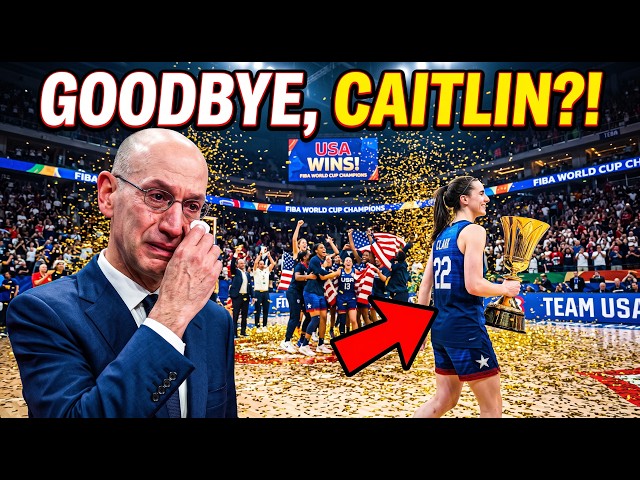
It claimed Clark entered a private executive room after the final and announced that she would never represent Team USA again.
According to the video’s dramatic account, Silver became visibly emotional after realizing what Clark’s supposed departure could mean for international basketball, television ratings, sponsorship agreements, and the future popularity of the American program.
However, those extraordinary allegations require careful examination.
As of September 16, 2026, no official statement from Clark, USA Basketball, the NBA, or Silver confirming her resignation was identified in the credible reporting reviewed for this article.
The absence of confirmation does not prove that every private disagreement described online is impossible.
It does mean the viral narrative should be treated as an unverified claim rather than established news.
What has been publicly documented is considerably less explosive.
Team USA defeated France 97–79 in the World Cup final, with Breanna Stewart producing 22 points, ten rebounds, and four assists during the championship victory. New York Post
Clark contributed throughout the tournament while operating primarily as a reserve.
Before the knockout rounds, she averaged 8.5 points, seven assists, and 2.8 rebounds while receiving substantial playing time despite not entering the starting lineup. New York Post
Her role naturally generated debate because Clark remains one of basketball’s most visible players.
Many supporters believed her passing, shooting range, and pace deserved a larger place within Team USA’s offensive system.
Coach Kara Lawson maintained a veteran-heavy starting lineup featuring established guards.
Clark, Paige Bueckers, and Angel Reese were among the younger stars who accepted reserve responsibilities during the tournament.
The arrangement did not prevent Clark from making meaningful contributions.
Her ability to accelerate possessions, find teammates in transition, and stretch defenses beyond the three-point line gave the Americans another offensive identity.
A reserve role can still become strategically important during an international tournament.
Players entering from the bench may be asked to change the tempo, disrupt an opponent’s preferred rhythm, or provide a specific skill missing from the starting group.
Clark was capable of accomplishing all three objectives.
Her popularity also guaranteed that every substitution would receive intense scrutiny.
When Team USA struggled, critics questioned why Clark was not playing more.
When the Americans succeeded, others argued that the existing rotation had been justified.
Those disagreements created ideal conditions for a sensational rumor.
The video transformed legitimate basketball questions into a sweeping allegation involving locker-room isolation, deliberate sabotage, commercial pressure, and a private resignation witnessed by powerful executives.
It described veteran players allegedly refusing to pass to Clark, excluding her from social circles, and omitting her from team celebrations.
No named sources or independently verifiable documentation accompanied those accusations in the supplied transcript.
The narrative also claimed television networks and sponsors had pressured USA Basketball into selecting Clark because her absence would damage commercial agreements.
That allegation was similarly presented without contracts, attributed statements, or identifiable sources.
Clark unquestionably possesses enormous commercial influence.
Her games have attracted exceptional attention, and her popularity has helped expand the audience surrounding women’s basketball.
Commercial importance alone does not verify a secret institutional conspiracy.
The most dramatic section of the video described Clark entering an executive suite after the gold-medal ceremony.
There, she supposedly accused USA Basketball of treating her as a commercial commodity while tolerating a hostile team culture.
The account claimed Silver pleaded with Clark to reconsider.
It further alleged that he became tearful after realizing that sponsors and broadcasters might react negatively to her departure.
Those details were delivered with cinematic precision.
Yet, the transcript did not identify the witnesses who allegedly observed the conversation, nor did it provide recordings, documents, public comments, or corroborating reports.
That distinction matters because storytelling confidence can easily be mistaken for factual certainty.
A narrator may describe facial expressions, private thoughts, contractual panic, and closed-door dialogue with extraordinary detail.
Without evidence, however, those descriptions remain assertions.
Credible journalism requires more than an emotionally powerful sequence.
A claim involving Clark’s withdrawal from Team USA would normally produce immediate interest from major sports organizations, established reporters, sponsors, and national basketball officials.
Such a decision would also require clarification from Clark or her representatives.
No comparable confirmation appeared in the material reviewed.
Recent reporting instead focused on Team USA’s championship, Stewart’s leadership, Clark’s tournament contributions, and the developing chemistry among the younger American players.
Clark’s public comments during the tournament also emphasized the honor of representing her country.
Before the competition, she recognized that her national-team role would differ from her responsibilities with the Indiana Fever. Reuters
That difference was visible throughout the World Cup.
With Indiana, Clark regularly controls possessions and creates much of the team’s offense.
With Team USA, she shared responsibility with several elite guards and experienced international stars.
Adapting to a reduced role can challenge any highly competitive athlete.
It does not automatically establish personal resentment, organized exclusion, or a decision to abandon the national program.
Clark had legitimate reasons to value the experience.
She gained exposure to international defenses, played beside accomplished veterans, and competed with younger stars who could join her during future Olympic cycles.
The tournament also offered an opportunity to develop without dominating every possession.
Clark could practice relocating without the ball, defending through offensive struggles, and making immediate decisions after entering from the bench.
Those skills could strengthen her game when she returns to Indiana.
Team USA’s championship environment also appeared more cooperative than the viral narrative suggested.
After the final, Clark firmly rejected a reporter’s attempt to manufacture conflict between her and Reese.
When asked whether they had become friends, Clark replied that they had always been friends and warned the reporter against creating that storyline. People
That response did not resemble an athlete attempting to expose a hostile national-team environment.
Instead, Clark appeared frustrated by the media’s tendency to transform professional relationships into personal feuds.
Clark and Reese did not need to become inseparable friends to function effectively as teammates.
They needed mutual respect, communication, and commitment to the shared objective of winning gold.
Public footage from the tournament showed them celebrating each other’s success.
The supplied video interpreted certain gestures and groupings as evidence of isolation.
Body-language analysis, however, remains highly subjective.
A player standing separately during a ceremony does not prove a fractured locker room.
A measured smile does not prove emotional devastation.
A delayed press conference does not automatically confirm an organizational crisis.
Without direct testimony, ordinary postgame behavior can be edited into almost any desired narrative.
This is particularly easy when the subject already attracts intense public emotion.
Clark generates passionate support and equally passionate criticism.
Content presenting her as mistreated, rejected, or vindicated can spread rapidly because it confirms beliefs already held by different sections of the audience.
Sensational headlines capitalize on that emotional investment.
The claim that Clark “walked away on her own terms” creates a powerful story of an athlete confronting an unfair institution.
It offers conflict, betrayal, victory, and revenge within a single narrative.
Those elements make compelling entertainment.
They do not substitute for verification.
The allegation concerning Silver also raises structural questions.
The NBA commissioner is not the direct head of USA Basketball’s women’s national team.
He remains an influential basketball executive, but any private involvement described in the video would require specific evidence.
The transcript instead treated his presence, emotional reaction, and commercial calculations as unquestioned facts.
It even attributed precise financial fears to executives and sponsors without identifying any supporting documents.
Claims about billions of dollars, reduced broadcast guarantees, or one athlete producing most cultural engagement require transparent sourcing.
Otherwise, numbers can create an illusion of authority without establishing accuracy.
None of this diminishes Clark’s genuine value.
Her ability to attract attention is extraordinary, and basketball institutions would undoubtedly prefer to have her involved in future international competitions.
Her participation can increase interest among audiences who might otherwise ignore early tournament rounds.
She also possesses a style ideally suited to international growth.
Deep shooting, fast passing, and creative transition play produce memorable highlights that cross language and national boundaries.
Young fans can recognize those qualities instantly.
USA Basketball therefore has strong sporting and promotional reasons to maintain a positive relationship with Clark.
The same organization must also construct balanced rosters rather than allowing popularity alone to determine playing time.
Lawson faced the difficult task of managing accomplished veterans, emerging stars, defensive specialists, scorers, and primary ball handlers within limited minutes.
Every rotation decision inevitably disappointed someone.
A coach may choose an experienced starter without secretly resenting the younger player behind her.
Likewise, a reserve can want more minutes without viewing the entire environment as abusive.
Professional teams frequently contain competitive tension.
The existence of tension does not verify the extreme allegations described in the video.
Clark’s long-term international future remains a valid subject for discussion.
By the 2028 Los Angeles Olympics, she could become one of Team USA’s central offensive leaders.
Bueckers, Reese, Aliyah Boston, and other younger players may also assume larger responsibilities.
Veteran stars will continue contributing, but the balance of influence will evolve.
USA Basketball must manage that transition intelligently.
It should create transparent expectations, evaluate players on current performance, and ensure every athlete feels respected.
That principle remains important even if the resignation rumor proves entirely false.
Organizations benefit when players understand their responsibilities and believe opportunities are distributed fairly.
Coaches also benefit when they explain why particular combinations receive important minutes.
Clear communication prevents ordinary competition from becoming destructive resentment.
Clark has significant influence, but that influence does not make her responsible for carrying the entire commercial future of women’s basketball.
The suggestion that one athlete must accept every institutional decision because millions of fans depend upon her creates an unfair burden.
Clark is entitled to establish boundaries around her health, workload, and career.
If she eventually chooses to leave international competition, that decision should be reported through her own statement or credible, attributed journalism.
It should not be declared through anonymous cinematic narration.
Until such confirmation exists, the responsible conclusion remains straightforward.
Team USA won the World Cup, Clark contributed to that achievement, and claims that she immediately resigned during an emotional confrontation remain unverified.
Supporters should celebrate the documented accomplishment without accepting every viral allegation attached to it.
They should also remain attentive to future statements from Clark, USA Basketball, or her representatives.
Reliable confirmation could change the story immediately.
For now, the most dramatic version has moved far ahead of the available evidence.
That gap between evidence and emotion is the central lesson of the controversy.
Modern sports narratives can transform within hours, particularly when famous athletes, powerful executives, alleged betrayal, and billions of dollars appear in the same headline.
The stronger the emotional reaction, the more carefully the underlying claim should be examined.
Clark’s real story already contains enough significance without unsupported embellishment.
She returned to international competition, adapted to a different role, helped Team USA win gold, and strengthened her case for greater responsibility in future tournaments.
Those achievements deserve attention.
The national team’s next chapter should focus on how Lawson integrates a changing generation, how Clark expands her international role, and how the Americans respond to increasingly competitive opponents.
France’s championship challenge demonstrated that continued dominance cannot be assumed.
Team USA must evolve tactically while preserving the trust of both veterans and younger stars.
Clark could become essential to that evolution.
Her range stretches defenses, her passing accelerates possessions, and her visibility introduces the national program to millions of new supporters.
Losing her would certainly matter.
There is simply no reliable basis yet for declaring that loss permanent.
The gold medal remains real.
Clark’s contribution remains real.
The alleged resignation, tearful confrontation, locker-room conspiracy, and commercial emergency remain claims requiring substantial corroboration.
Until that evidence appears, the explosive story should be understood as a viral narrative surrounding a genuine championship, not a confirmed account of Caitlin Clark’s departure from Team USA.


