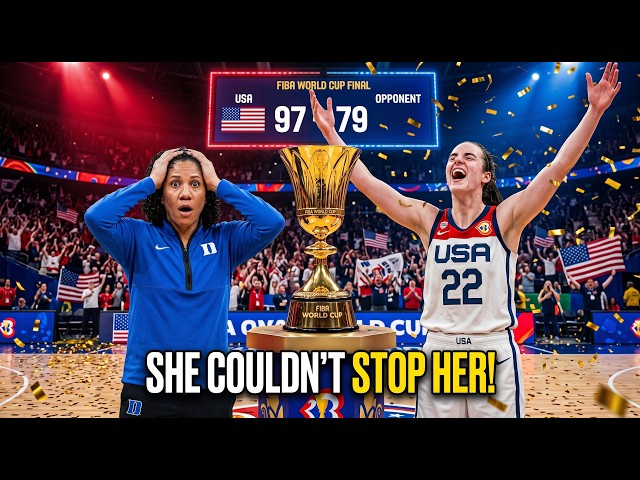
Caitlin Clark delivered a breathtaking championship performance, leading Team USA to an 89–74 victory in a fiercely contested FIBA final that tested her skill, physical endurance, leadership, and composure.
The American guard finished the gold-medal showdown with an extraordinary 40 points, 11 assists, and eight rebounds, completing one of the most commanding individual displays described on an international basketball stage.
Her performance carried added significance because Clark had entered the tournament surrounded by questions about whether her celebrated playing style could survive the aggressive defense and physical contact permitted under international rules.
Critics had repeatedly argued that her long-range shooting, creative passing, and perimeter-oriented offense were better suited to domestic basketball and highlight videos than the demanding environment of a major international tournament.
Some questioned whether her frame could withstand constant pressure from stronger defenders, while others predicted that packed defenses would eliminate the open spaces she often exploited when operating near the three-point line.
Those concerns followed Clark into the national team training camp, where she joined decorated veterans who had already spent years carrying the expectations associated with representing the United States in international competition.
The attention surrounding her arrival created understandable tension, particularly because every practice, interaction, and lineup decision threatened to become part of a larger public debate about hierarchy and opportunity.
Clark answered the uncertainty in the most effective way possible.
She performed.
During training sessions, her passing reportedly opened angles that ordinary playmakers would never attempt, allowing teammates to receive the ball in ideal positions before opposing defenders could recognize the developing danger.
Her shooting range also transformed the geometry of the court.
Defenders were forced to follow her several feet beyond the three-point line, leaving larger gaps around the basket for American forwards and centers to attack.
The veterans around Clark gradually recognized that her presence did not weaken the team’s established structure.
Instead, her uncommon offensive abilities gave every teammate additional room, better scoring opportunities, and greater freedom to move without the ball.
That impact became increasingly visible after the tournament began.
Opponents experimented with box-and-one defenses, full-court pressure, aggressive traps, physical double teams, and extended coverage designed to remove Clark from Team USA’s offensive rhythm.
The strategy produced limited success.
Whenever defenders stepped too far away from her, Clark punished them with deep three-pointers.
Whenever they crowded her, she escaped through quick changes of direction and delivered precise passes.
Team USA advanced through the preliminary stage, but the gold-medal game presented an entirely different challenge.
The Americans faced an undefeated opponent that had prepared specifically to disrupt their pace and challenge their international dominance.
From the opening possession, the atmosphere resembled a hostile road game.
The crowd loudly opposed every American touch, while defenders bumped cutters, crowded passing lanes, and applied relentless pressure to Clark across the entire court.
Team USA initially struggled to respond.
Normally reliable jump shots missed their targets, the offense became increasingly static, and foul trouble forced important interior players to spend valuable minutes on the bench.
The opposing defense successfully protected the paint while encouraging the Americans to settle for difficult outside shots.
Its players also used physical contact to prevent Clark from comfortably initiating the offense.
By halftime, Team USA faced an alarming 11-point deficit.
The scoreboard suggested that the Americans were approaching one of the most disappointing championship defeats in the program’s recent history.
Inside the locker room, coaches searched for tactical adjustments while players attempted to regain their confidence.
The opponent’s combination of physical defense and disciplined positioning had disrupted nearly every part of the American game plan.
Clark reportedly responded without delivering an elaborate speech.
She asked for the ball in transition, requested greater spacing, and made it clear that she was prepared to control the direction of the second half.
Her confidence immediately changed the emotional temperature surrounding the team.
The tension remained, but uncertainty was replaced by a specific plan built around Clark’s ability to create offense from almost anywhere.
The transformation began shortly after play resumed.
Facing pressure near the backcourt, Clark used a sharp hesitation move to escape her defender before advancing into the frontcourt with remarkable speed.
Instead of waiting for the offense to develop, she launched a three-pointer from approximately 33 feet.
The shot fell cleanly through the basket before the defense had enough time to challenge it.
On the next possession, Clark collected a defensive rebound and accelerated along the sideline.
She stopped suddenly, watched her defender slide past, and released another three-pointer while absorbing contact.
The ball dropped through the net as Clark fell toward the courtside seats.
A referee awarded the foul, giving her an opportunity to complete an emotionally charged four-point play.
That sequence silenced the hostile crowd and forced the opposing coach to call a timeout.
Team USA had rediscovered its energy, while the opponent suddenly appeared unsure of the defensive approach that had worked earlier.
When play resumed, two defenders attempted to trap Clark near the center of the court.
Clark recognized the pressure instantly and delivered a long overhead pass toward a cutting teammate.
The pass traveled over the defense and created an uncontested layup.
It also demonstrated why trapping Clark in open space could become a dangerous decision.
Sending two defenders toward her left another American player completely unguarded.
The opposition began alternating between aggressive pressure and conservative coverage.
Neither approach produced the desired result because Clark adjusted her choices according to the space presented on each possession.
When defenders remained near the paint, she attacked from long range.
When they advanced toward the perimeter, she drove into the lane or located teammates positioned near the corners.
Her control extended far beyond personal scoring.
During one decisive eight-minute stretch, Clark reportedly scored or assisted on 21 consecutive American points, erasing the halftime deficit and giving Team USA a nine-point advantage.
The sequence represented a complete reversal of the contest.
The same defensive system that had frustrated the Americans during the opening half suddenly appeared vulnerable, disorganized, and incapable of slowing Clark’s decision-making.
Her deep shooting forced defenders to guard areas of the court that international teams had traditionally been willing to concede.
That additional pressure created larger driving lanes and weakened the opponent’s interior protection.
Clark’s passing made the defensive problem even more complicated.
Any attempt to double-team her risked producing an open layup, a corner three-pointer, or an uncontested opportunity for a teammate moving behind the defense.
Team USA’s players responded enthusiastically to the momentum.
They ran the floor with renewed purpose, cut aggressively toward the basket, and trusted that Clark would find them whenever the defense shifted toward her.
The hostile crowd also underwent a noticeable transformation.
Supporters who had spent the first half booing American possessions reportedly began reacting with astonishment to Clark’s range and passing vision.
Many spectators raised their phones to record the developing performance.
The final quarter brought one last physical challenge.
The opposition increased its pressure and attempted to reduce the American advantage before the contest moved permanently beyond reach.
Clark answered with the defining shot of the championship game.
With only seconds remaining on the shot clock, she used several crossover dribbles to create separation from her primary defender.
She then stepped backward beyond the international three-point arc.
Clark released a high-arcing shot over the defender’s extended arm.
For a brief moment, the arena appeared frozen as the ball traveled beneath the lights.
It fell perfectly through the basket.
Clark held her shooting hand in the air while retreating toward the opposite end of the floor.
Her controlled reaction communicated that Team USA had survived its most dangerous moment.
The Americans managed the closing minutes with confidence and discipline.
The final buzzer confirmed an 89–74 victory, completing a remarkable turnaround after the team had trailed by double digits at halftime.
Clark’s teammates immediately rushed onto the court.
Veterans and younger players surrounded her beneath falling gold confetti, celebrating both the championship and the performance that had changed the final.
The scene challenged earlier suggestions that Clark’s enormous popularity might disrupt the national team’s chemistry.
Instead, the celebration showed a group united by competition, shared pressure, and collective achievement.
Clark had not succeeded independently of her teammates.
Her scoring mattered because American players continued running, screening, rebounding, defending, and converting the opportunities created by the attention directed toward her.
Her 11 assists illustrated that broader influence.
Clark’s greatest contribution was her ability to identify what each possession required, whether that meant shooting, passing, accelerating the tempo, or controlling the ball.
On the medal podium, the emotional intensity of the game gave way to a quieter moment.
Clark stood with the gold medal against her chest as the national anthem played inside the arena.
The expression captured by the broadcast reportedly reflected satisfaction rather than defiance.
She had answered questions about her readiness through sustained performance against the strongest pressure the tournament could produce.
Her championship display also carried tactical implications for international basketball.
Teams have traditionally relied on physical defense and crowded interior positioning to neutralize perimeter scorers during high-stakes games.
Clark demonstrated how exceptional shooting range can undermine that philosophy.
A defender positioned near the free-throw line cannot comfortably protect the paint when an opponent is willing and able to shoot from 35 feet.
Moving defenders farther from the basket creates additional space for every offensive player.
Clark’s vision magnifies that problem because she can punish rotations before they are completed.
Her passes routinely transform defensive aggression into scoring opportunities for teammates.
Future opponents may need to reconsider how they defend players possessing similar combinations of range, awareness, and confidence.
Traditional schemes cannot operate normally when the offense stretches several feet beyond conventional boundaries.
The performance also carried substantial cultural importance.
Clark’s popularity has already introduced many new viewers to women’s basketball, but an international championship could expand that influence across national borders.
After the arena had begun to empty, young supporters reportedly waited near the team bus wearing handmade number 22 jerseys.
Some carried signs in different languages, hoping for photographs or autographs.
Clark stopped to acknowledge many of them.
Her patient interaction with those supporters contrasted sharply with the relentless competitive personality she had displayed during the final.
That contrast explains an important part of her appeal.
Clark can perform with unapologetic confidence while remaining conscious of the young athletes who view her as evidence that ambitious dreams are achievable.
Her journey has also demonstrated the emotional cost of constant public evaluation.
Outstanding performances have frequently been followed by questions about turnovers, defense, physicality, experience, or whether her success can continue at another level.
The gold-medal performance offered a comprehensive answer.
Clark scored efficiently, created opportunities for teammates, rebounded, managed pressure, survived physical defense, and delivered her strongest basketball when Team USA faced its greatest danger.
There will always be new challenges because elite sports never provide permanent immunity from criticism.
Future opponents will study the final and develop additional plans intended to limit Clark’s influence.
However, the championship revealed why defending her remains so difficult.
She does not depend exclusively on one shot, one passing angle, or one area of the court.
Her presence demands continuous decisions from every defender.
A moment of hesitation can produce a deep three-pointer.
An overly aggressive rotation can produce an easy basket elsewhere.
For Team USA, the victory represented another gold medal and a reminder that established greatness can coexist with a new generation of leadership.
The veterans provided stability, experience, and resilience when the final became uncomfortable.
Clark supplied the explosive offensive force that changed the game’s direction.
Together, they turned an 11-point halftime deficit into a commanding 15-point championship victory.
The turnaround demonstrated the value of trust within a team filled with accomplished players.
Clark left the arena carrying more than a medal.
She carried a tournament-defining performance that strengthened her reputation as one of basketball’s most influential competitors.
The night began with doubts about whether she could survive international physicality.
It ended with Clark standing at the center of a global celebration after dismantling every defensive strategy placed before her.
Her 40-point masterpiece did not merely silence criticism.
It offered an unforgettable picture of what happens when extraordinary talent, tactical intelligence, competitive courage, and complete confidence arrive together on the biggest possible stage.
For the young players watching around the world, the message was powerful.
They could play boldly, challenge established expectations, develop their own style, and refuse to accept limits created by people who underestimated them.
For Clark, the gold medal represented another historic achievement in a career already defined by record-breaking performances, intense scrutiny, and an uncommon ability to transform pressure into motivation.
The final confirmed that her game did not possess the expiration date predicted by skeptics.
Under the brightest lights and against the strongest resistance, Caitlin Clark delivered a stunning championship performance that ensured her name would remain connected to basketball history.


