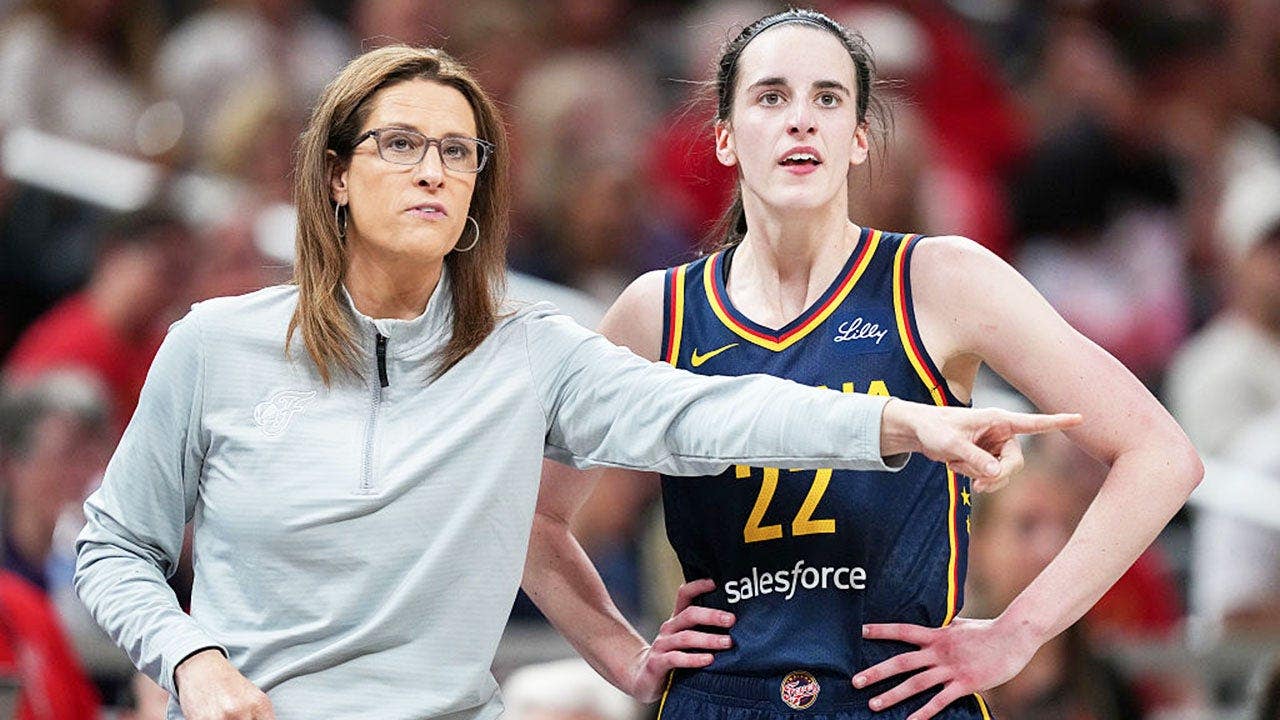
A few seconds of Caitlin Clark and Stephanie White arguing on an Indiana Fever sideline were enough to ignite another enormous debate around the WNBA’s biggest star.
The footage appeared dramatic.
Clark looked frustrated, White appeared animated, and teammates were caught in the middle of an exchange that immediately exploded across social media.
Within hours, however, the story had transformed into something almost unrecognizable.
Viral commentary claimed Clark had accused White of lying, exposed a secret agreement, threatened the organization, assembled legal evidence, and prepared to walk away from Indiana entirely.
Those allegations created a spectacular narrative.
There is just one enormous problem.
The most explosive parts are not supported by credible reporting.
What actually happened is still fascinating enough without inventing a secret conspiracy around it.
The real story begins with a Fever team carrying enormous expectations and a superstar whose every visible reaction is analyzed frame by frame.
Clark and White were captured having an animated sideline exchange during Indiana’s May 30 loss to the Portland Fire.
The Fever lost 100-84, falling to 4-4 and generating immediate questions about defense, rotations, roster construction, and the relationship between Clark and her coach.
Clark could be seen gesturing while White responded forcefully.
At one point, Clark moved away from the seated portion of the huddle while several teammates appeared to react to the tension.
The optics were perfect for social media.
A superstar looked angry.
A coach looked angry.
The team was losing.
The cameras were rolling.
For anyone already convinced that Clark and Indiana’s coaching staff were secretly battling for control, the footage seemed like instant confirmation.
But Clark herself rejected that interpretation.
Speaking afterward, she described the exchange as two competitive people trying desperately to win and criticized outsiders for turning normal basketball conflict into something much bigger.
Clark went even further.
She publicly said she supported White and emphasized that her coach had her back.
White similarly dismissed the idea of a major personal rupture between them.
That does not mean the sideline exchange was meaningless.
Players and coaches can respect each other while still disagreeing intensely.
In fact, championship-level sports are filled with arguments between people who remain deeply committed to the same goal.
The more interesting question is what caused the frustration.
Clark is one of the most ball-dominant and creative guards in basketball.
Her greatest strengths emerge when she controls tempo, attacks pick-and-roll coverage, and forces defenses to react to her shooting and passing simultaneously.
When Indiana struggles offensively, fans naturally ask whether enough of the offense is being organized around those abilities.
That is a legitimate basketball debate.
It does not require a secret contract.
The viral narrative claims Indiana privately promised Clark that the entire offense would permanently revolve around her pick-and-roll game.
No reliable reporting has established the existence of such an agreement.
There is also no credible evidence that White secretly dismantled a promised offense specifically to suppress Clark’s individual numbers.
That allegation represents speculation presented as fact.
The same problem appears in claims involving Kelsey Mitchell.
Mitchell has become one of Indiana’s most important offensive players and has produced elite scoring performances alongside Clark.
That does not prove the organization is intentionally taking possessions away from Clark to inflate Mitchell’s statistics.
Great teams frequently need multiple creators.
The tension comes from determining how those touches should be distributed.
That is a coaching problem, not automatically evidence of sabotage.
Indiana’s challenge is particularly complicated because Clark’s talent encourages an extremely specific style of basketball.
She sees passing windows few guards attempt.
She wants to play fast.
Her shooting range stretches defenses several feet beyond the normal point of attack.
When those qualities are fully activated, Indiana can become extraordinarily difficult to guard.
But the same style creates risks.
Aggressive passing produces turnovers.
Fast possessions can reduce defensive organization.
Opponents increasingly hunt Clark defensively and attempt to force Indiana into uncomfortable matchups.
CBS Sports noted that teams were targeting her in isolation frequently during Indiana’s early-season struggles.
That provides legitimate context for heated coaching moments.
White may want Clark attacking one way offensively while demanding something completely different defensively.
Clark may disagree with a substitution, assignment, or tactical decision.
Neither possibility requires corruption.
What made the viral clip powerful was precisely its ambiguity.
Nobody watching a silent or partially audible bench interaction could know every word being exchanged.
That uncertainty created space for increasingly sensational interpretations.
One version eventually claimed Clark shouted, “You lied to me.”
Another claimed she said, “This is not what we agreed to.”
Those quotations have been circulated as though cameras definitively captured them.
Credible reporting on the actual incident does not establish either statement.
Clark herself certainly did not confirm them afterward.
Instead, she told reporters the opposite of what the conspiracy narrative required.
She described the controversy around the exchange as disconnected from reality and emphasized her support for White.
The fabricated story then escalates dramatically.
It claims White’s silence represented a confession.
It claims Fever executives panicked behind closed doors.
It claims emergency meetings erupted into screaming matches.
It claims Indiana attempted to force Clark into a staged reconciliation.
None of those extraordinary allegations have been established by credible reporting.
Then comes an even larger supposed revelation.
According to the viral narrative, Clark’s lawyers allegedly delivered a secret case file containing rotation data, coaching logs, and an encrypted recording proving executives intentionally restricted her statistics.
That would be one of the largest scandals in modern professional basketball.
If authentic evidence of that magnitude existed, it would trigger investigations, legal reporting, union involvement, league scrutiny, and extensive coverage from major national sports organizations.
There is no credible evidence that such a case file exists.
There is also no established evidence that Fever executives ordered White to bench Clark to weaken her future contractual leverage.
The allegation sounds dramatic because it combines basketball frustration, corporate intrigue, and Clark’s extraordinary commercial power.
But sounding plausible inside a fictional narrative does not make something true.
The same caution applies to claims that Stephanie White was immediately fired.
False reports about White’s dismissal have already circulated during the 2026 season.
A fact check in August found that a widely shared claim stating Indiana had fired White was unsupported and contradicted by her continued appearances with the team.
As of September, the Fever’s own official website continued showing White participating in team media appearances with Clark.
Indiana’s official site also continued publishing material centered on the current team rather than announcing the dramatic organizational collapse described in viral videos.
In August, after another period of controversy, the Associated Press reported White receiving cheers from Fever fans while Clark produced 29 points and 10 assists in a victory over Dallas.
White publicly described the locker room as united and criticized efforts to create division around the team.
That reality looks very different from an organization supposedly destroyed by an irreparable feud.
It does not prove Indiana is perfectly harmonious.
No professional basketball team is.
It simply demonstrates why spectacular claims require spectacular evidence.
The transcript goes even further by claiming Clark rejected a massive extension, activated a buyout, permanently severed ties with Indiana, and joined a new player-owned global league.
There is no credible reporting establishing that sequence of events.
The story then claims multiple unnamed WNBA superstars secretly signed contracts to follow her.
Again, no reliable evidence supports that claim.
A development of that magnitude would fundamentally reshape professional women’s basketball.
It could not realistically remain confined to anonymous viral narration while major sports outlets, league officials, player representatives, and participating stars remained silent.
That is where the distinction between commentary and reporting becomes essential.
Commentary can ask whether Indiana is maximizing Clark.
It can criticize White’s rotations.
It can argue Clark deserves more control of the offense.
It can question whether the Fever’s system fully exploits her generational passing ability.
Those are legitimate opinions.
But claiming secret recordings, executive conspiracies, legal case files, multimillion-dollar payoff attempts, and an entirely new professional league requires evidence.
Without evidence, those details belong to fiction.
Ironically, exaggerating the situation may weaken the strongest criticism available against Indiana.
There are real basketball questions surrounding Clark and White.
Clark is a player around whom an offense can reasonably be built.
Her ability to create efficient shots for teammates is unusual even among elite professional guards.
Indiana therefore deserves scrutiny whenever its offense becomes static or pushes Clark away from the actions that make her most dangerous.
Fans are also justified in examining substitution patterns.
If Clark builds offensive rhythm and is immediately removed, people will ask why.
If Indiana’s offense collapses while she sits, the coaching staff must evaluate the consequences.
If another lineup performs better, the staff should be willing to use it.
Those debates become more meaningful when supported by actual possessions and actual numbers.
The relationship between Clark and White is also worth watching precisely because both appear intensely competitive.
Clark has never built her reputation around passive basketball.
She constantly communicates.
She reacts emotionally to mistakes.
She demands high standards from herself and teammates.
White possesses a similarly direct coaching personality.
Put those two personalities together inside the pressure surrounding Indiana and visible disagreements should surprise nobody.
The key question is whether disagreement becomes dysfunction.
So far, Clark has publicly argued that it has not.
Her comments matter more than speculative lip-reading.
White’s continued role matters more than fabricated firing announcements.
Indiana’s actual games matter more than fictional emergency board meetings.
And the team’s future decisions will eventually reveal far more than anonymous claims about secret agreements.
The Fever also have enormous incentive to make the relationship work.
Clark is not merely an important player.
She is one of the most commercially influential athletes in American sports.
Indiana has built significant competitive and business momentum around her presence.
That gives the organization every reason to construct the best possible environment for her development.
But Clark also needs a functioning team around her.
Basketball does not work when one player controls every possession regardless of matchup.
Kelsey Mitchell’s scoring matters.
Aliyah Boston’s interior presence matters.
Indiana’s wings matter.
Defense matters.
The challenge for White is integrating all of those pieces without reducing the qualities that make Clark extraordinary.
That balance will naturally produce disagreements.
A disagreement does not have to become a betrayal.
That distinction is especially important in the current media environment.
Clark generates enormous engagement.
Any clip involving her can become profitable content.
A normal coaching interaction can therefore acquire increasingly dramatic captions as different accounts compete for attention.
“Tense exchange” becomes “locker-room crisis.”
“Locker-room crisis” becomes “secret betrayal.”
“Secret betrayal” becomes “legal war.”
Eventually, an ordinary argument is transformed into a story involving hidden recordings, corporate conspiracies, mass protests, sponsor revolts, and an entirely new basketball league.
The emotional progression works brilliantly for entertainment.
It works terribly as journalism.
The strongest version of the Caitlin Clark story does not need fictional enhancement.
She is already one of the most watched athletes in women’s basketball.
Her relationship with Indiana’s coaching staff already matters.
Her offensive usage already deserves serious analysis.
Her ability to change the economic scale of the sport already gives every decision around her unusual significance.
That is enough.
The Fever’s season will ultimately answer the meaningful questions.
Can White construct lineups that consistently maximize Clark’s creativity?
Can Clark continue developing defensively while maintaining her extraordinary offensive influence?
Can Mitchell and Clark coexist as two elite scoring threats without either being unnecessarily marginalized?
Can Indiana turn enormous expectations into postseason success?
Those questions cannot be solved through a five-second bench clip.
They will be solved through months of basketball.
Clark and White may argue again.
They probably will.
Elite athletes argue with coaches.
Coaches challenge stars.
Stars challenge coaches.
Sometimes those conflicts become destructive.
Sometimes they produce championships.
What matters is what happens afterward.
After the heavily discussed Portland exchange, Clark did not announce a rebellion.
She publicly defended White.
White did not disappear from the organization.
She continued coaching.
The Fever did not collapse overnight.
The relationship continued.
That is the documented story.
Everything beyond it requires evidence.
And until such evidence exists, the supposed secret deal, legal dossier, forced contract exit, multimillion-dollar silence payment, and Clark-led breakaway league should not be presented as established reality.
The real tension is simpler and arguably more compelling.
Indiana possesses a generational guard whose expectations for herself are enormous.
Stephanie White possesses the responsibility of coaching that player while also coaching everyone around her.
When winning becomes difficult, those forces can collide.
The cameras will catch it.
The internet will exaggerate it.
And every visible disagreement will become another referendum on whether the Fever truly know how to handle the most important player in their franchise.
That is the story worth watching.
Not whether Caitlin Clark secretly destroyed the Indiana Fever in one dramatic confrontation.
But whether Indiana can build a championship structure around her without turning competitive tension into genuine organizational fracture.
Because if that relationship eventually does break, nobody will need fictional leaked recordings or imaginary midnight press conferences to prove it.
The basketball world will see it clearly.


