Team USA delivered another overwhelming victory, but the biggest story was not simply the final score.
It was what happened the moment Caitlin Clark entered the game.

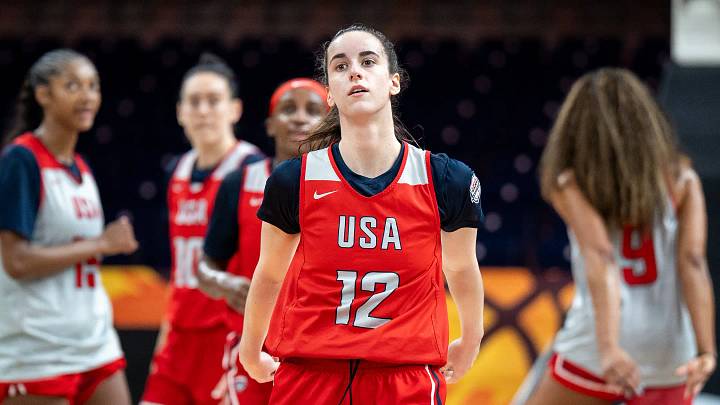
Clark came off the bench and immediately changed the pace, energy, movement, and overall identity of the American offense.
By the end of the night, she had produced 10 points and nine assists in only 20 minutes.
She finished one assist short of a double-double.
More importantly, Clark posted a staggering plus-36 rating while Team USA dismantled Hungary and advanced to the semifinals.
For those arguing that Kara Lawson must finally place Clark in the starting lineup, this performance provided more ammunition.
Team USA was already leading when Clark checked into the game.
But there was a massive difference between simply leading Hungary and completely overwhelming them.
The Americans held an 18-9 advantage when Clark entered.
What followed was the type of basketball that has become increasingly familiar whenever the young core takes control.
The tempo accelerated.
The ball moved faster.
Players attacked in transition.
Passing lanes suddenly opened everywhere.
Team USA transformed from a team comfortably controlling the game into one that appeared determined to end the competition immediately.
According to the transcript, Clark helped lead an 18-3 run in approximately four minutes after checking into the contest.
The result was devastating for Hungary.
The game quickly shifted from competitive to completely one-sided.
That transformation has become the central argument surrounding Clark’s role.
It is not simply about how many points she scores.
It is about what happens to everybody else when she is controlling the basketball.
Clark’s nine assists provide the obvious statistical evidence.
But the eye test described throughout the game tells an even larger story.
Team USA plays faster when Clark is operating as the point guard.
Players run harder because they know she can find them.
Bigs cut aggressively because the pass can arrive immediately.
Shooters relocate because Clark’s gravity forces defenders to make uncomfortable decisions.
Transition opportunities become more dangerous because she is constantly searching up the floor.
The offense simply looks different.
That difference became particularly obvious when Clark shared the court with Angel Reese.
For years, Clark and Reese have been surrounded by one of the most intense fan rivalries in women’s basketball.
Their history has generated endless arguments across social media.
But none of that mattered on the court against Hungary.
Instead, Clark and Reese looked like two talented basketball players discovering exactly how effectively their strengths can complement each other.
Reese set screens.
She ran the floor.
She attacked the glass.
She cut hard toward the basket.
Clark repeatedly rewarded those movements.
According to the transcript, Clark found Reese for several quick assists.
Then Reese returned the favor during a fast-break sequence by finding Clark attacking the basket.
That is basketball chemistry.
It does not require friendship narratives, internet arguments, or manufactured rivalry.
It simply requires two players understanding what the other does well.
Clark finally had an aggressive forward consistently moving into the spaces she wants to attack.
Reese finally had a point guard capable of recognizing her cuts almost immediately.
The connection looked natural.
And it created serious problems for Hungary.
The transcript describes Clark and Reese helping Team USA build a 29-9 run during one stretch.
That dominance made the contrast with other combinations even harder to ignore.
Once the younger group left the floor, the Americans no longer appeared to be separating at the same explosive rate.
They were still clearly superior.
But they were not creating the same chaos.
That distinction matters.
Against Hungary, Team USA possesses enough talent to survive slower stretches.
Against stronger opponents, those stretches could become dangerous.
That is exactly why Lawson’s starting lineup remains such a major discussion.
Chelsea Gray finished with six points and six assists in 18 minutes, according to the transcript.
Her plus-minus was listed at plus-21.
Those are certainly respectable numbers.
But Clark recorded 10 points, nine assists, and a plus-36 in approximately the same amount of playing time.
The argument is becoming increasingly difficult to ignore.
Team USA appears more explosive when Clark is leading the offense.
That does not mean every veteran player suddenly has no value.
It does not mean experience should be thrown away.
It means Lawson must evaluate which lineup gives the United States its highest ceiling.
Right now, the transcript’s argument is clear.
That lineup needs Clark controlling the basketball.
Rhyne Howard also delivered a strong performance with 15 points.
Jackie Young scored 10.
Angel Reese contributed nine points, six rebounds, and three assists.
Aliyah Boston finished with eight points and four rebounds.
Paige Bueckers added seven points and posted a plus-25 rating.
The depth remains ridiculous.
That is exactly why the point-guard decision matters so much.
Clark does not need to dominate the scoring column to dominate the game.
She can make elite players even more dangerous by getting them the basketball earlier and in better positions.
That ability was visible throughout the Hungary matchup.
When Clark pushed the tempo, Team USA’s athleticism became almost impossible to contain.
Defenders had less time to communicate.
Bigs were forced to retreat.
Wings had to choose between protecting the rim and locating shooters.
Every defensive decision created another opening.
Clark thrives inside that type of chaos.
She sees opportunities before many defenders recognize they exist.
And because her shooting range demands attention well beyond the three-point line, the court becomes dramatically larger for her teammates.
That is why a 10-point performance can still feel dominant.
Ten points alone does not explain plus-36.
Nine assists do not completely explain it either.
Her influence comes from the combination of pace, spacing, passing, pressure, and decision-making.
The transcript repeatedly emphasizes that the game becomes easier for everyone when Clark is on the floor.
Against Hungary, that conclusion appeared difficult to dispute.
Team USA ultimately won 108-56.
A 52-point victory looks overwhelming regardless of lineup analysis.
But focusing only on the final margin risks missing the most important question.
Which group created the decisive separation?
According to the source, the answer was the younger group featuring Clark, Bueckers, Reese, Boston, and Howard.
When those players arrived, the game changed.
It was no longer a comfortable advantage.
It became a demolition.
That is why the semifinal presents such an important coaching decision.
The United States cannot assume every opponent will allow them several minutes to discover their best rhythm.
Against elite international competition, four poor minutes can completely change a game.
France, Belgium, Australia, and Spain represent very different challenges from Hungary.
Better opponents can punish slow starts.
They can pressure the basketball.
They can exploit defensive mismatches.
They can force turnovers and quickly convert them into transition points.
Giving those teams an early advantage could create pressure Team USA has not consistently faced during blowouts.
That raises a simple question.
Why wait to introduce the lineup that changes the pace?
Why not establish that pace immediately?
Clark starting alongside Bueckers could place opposing defenses under maximum pressure from the opening possession.
Bueckers provides another creative ball handler.
Clark provides extraordinary transition passing and deep shooting gravity.
Reese and Boston give the offense physical interior options.
Howard adds scoring and movement.
The combination offers speed without sacrificing strength.
The transcript argues that the difference becomes particularly important when comparing this performance with Team USA’s earlier struggles.
The Americans dominated China.
They crushed Czechia.
They destroyed Hungary.
But the game against Italy looked dramatically different.
Team USA barely escaped that matchup.
That inconsistency is precisely why the rotation remains under scrutiny.
Dominating weaker opponents does not automatically guarantee the same formula will succeed against medal contenders.
Lawson must determine which group gives Team USA the strongest identity when the competition becomes uncomfortable.
Clark’s supporters believe that answer has already appeared repeatedly.
Every time she enters, the pace changes.
Every time the pace changes, teammates appear to receive easier scoring opportunities.
And every time the young group begins running, Team USA seems significantly more difficult to defend.
The developing chemistry between Clark and Reese may be one of the tournament’s most fascinating developments.
Their college rivalry helped define an era of women’s basketball.
Their fan bases have frequently clashed.
Yet their Team USA partnership demonstrates how irrelevant those narratives become once the ball is tipped.
Reese benefits from Clark’s willingness to reward hard cuts.
Clark benefits from Reese’s relentless movement and physicality.
One creates openings.
The other recognizes them.
That is exactly how complementary basketball should work.
The same principle applies to Bueckers.
Putting multiple intelligent creators around Clark prevents defenses from simply loading every possession toward her.
If Clark gives up the ball, Bueckers can immediately attack.
If both guards draw attention, Reese or Boston can find space inside.
If defenders collapse, Howard can punish them from the perimeter.
This is why the starting-lineup debate is bigger than Clark’s individual numbers.
It is about creating an offensive ecosystem.
Clark appears capable of organizing that ecosystem.
Her near double-double against Hungary reinforced that argument.
She did not need 25 shots.
She did not need 30 points.
She needed only 20 minutes to produce nine assists and help Team USA build a massive advantage.
That is the type of point-guard performance coaches normally celebrate.
It becomes even more impressive considering Clark came off the bench.
She entered an already-established game and immediately imposed a different rhythm.
Imagine that rhythm beginning from the opening tip.
That is the possibility Lawson must now consider.
There is also something important about Clark’s own approach.
Despite all the public debate about rotations, starting positions, fan wars, and star hierarchy, the basketball described in the transcript remains remarkably simple.
Clark passes to the open teammate.
Reese runs.
Boston runs.
Howard cuts.
Bueckers attacks.
Everybody benefits.
That simplicity may ultimately become Team USA’s greatest weapon.
The roster has overwhelming talent.
The challenge is ensuring that talent operates together rather than becoming trapped inside slower individual possessions.
Clark’s style naturally encourages movement.
Players understand that running creates opportunities.
They know a long outlet pass can arrive.
They know a backdoor cut can be rewarded.
They know the defense cannot relax because Clark may shoot several feet behind the arc.
That constant pressure creates purpose.
It creates urgency.
And against Hungary, it created another dominant American victory.
The result sends Team USA into the semifinals.
The next stage will provide a more meaningful test.
Lawson can continue with the established starting lineup and use Clark as an explosive weapon off the bench.
Or she can acknowledge what increasingly appears obvious to the source’s narrator.
The team looks different when Clark runs it.
There is nothing inherently wrong with being a sixth player.
Great teams throughout basketball history have used elite creators from the bench.
But this situation feels different because Clark is not merely adding scoring.
She appears to change the entire structure of the offense.
That is why the calls for her to start will only grow louder.
A plus-36 performance will do that.
Nine assists will do that.
A 52-point victory will do that.
And helping transform a nine-point lead into an overwhelming advantage will certainly do that.
Kara Lawson now faces the kind of decision every coach claims to want.
She has too many talented players.
But championship basketball requires more than collecting talent.
It requires identifying which players maximize everyone around them.
Against Hungary, Caitlin Clark once again made a powerful case that she is that player.
She nearly recorded a double-double.
She accelerated the offense.
She helped unlock Angel Reese.
She created easier opportunities throughout the lineup.
And she helped turn a comfortable Team USA lead into an absolute rout.
The numbers are becoming louder.
The chemistry is becoming clearer.
The semifinal pressure is approaching.
And now the question hanging over Team USA is impossible to avoid.
How many more performances like this does Caitlin Clark need before Kara Lawson finally puts her in the starting lineup?


