The United States and France arrived at the FIBA Women’s World Cup final carrying history, expectations and two very different paths toward the championship stage.
The supplied game transcript captures a contest in which France challenged the Americans before Team USA’s depth, defensive pressure and growing offensive rhythm began changing the direction of the game.
For the United States, the championship also became another showcase of the difficult balance between an established veteran core and an emerging generation featuring Caitlin Clark, Angel Reese and other younger players.
The opening minutes immediately established the physical nature of the matchup.
Chelsea Gray scored early.
Breanna Stewart attacked mismatches.
Jackie Young connected from outside.
But France demonstrated quickly that it was not going to allow the United States to dictate every possession.
Gabby Williams became one of France’s most important offensive weapons.
Marine Johannes also provided perimeter danger.
France repeatedly forced Team USA to defend difficult actions while attempting to exploit mismatches and move the Americans away from their preferred defensive positions.
The American veterans remained central.
Gray controlled possessions.
Stewart attacked.
Young looked for opportunities from the perimeter.
Napheesa Collier and Kahleah Copper provided additional size, athleticism and pressure.
Yet the younger players were never far from the story.
Clark, Reese and Paige Bueckers were specifically discussed during the broadcast as part of a newer generation gaining experience within an international environment.
The commentary acknowledged an important distinction.
The veterans had already experienced championship situations.
For younger players, the stage was different.
That did not mean they could not handle it.
It meant they were learning it in real time.
That contrast became one of the most interesting themes of the game.
The United States had players who knew exactly what championship pressure felt like.
It also had young stars whose talent was already capable of influencing the biggest moments.
Reese demonstrated that impact defensively.
During one first-half sequence, the transcript describes her picking the pocket and trying to push the ball coast to coast.
Her defensive activity would appear again later.
Clark’s first-half minutes included a baseline turnover while attempting to drive.
That moment represented some of the challenges facing a young guard adapting to the physicality and spacing of international basketball.
But Clark stayed involved.
Later, she secured a defensive rebound.
As the first half progressed, France continued making the Americans work.
The commentary repeatedly emphasized how connected the French defense looked.
That cohesion mattered.
France’s players had significant experience together.
The broadcast described much of the roster as essentially connected to the group that had competed previously on the international stage.
That familiarity allowed France to take defensive risks.
Players could attack passing lanes because they trusted the help behind them.
Team USA had to solve that structure possession by possession.
Gray repeatedly became one of the answers.
Her ability to create in difficult late-clock situations helped stabilize the American offense.
Young’s shooting also became increasingly valuable.
Then came one of the most memorable sequences of the half.
Reese created another defensive play.
Williams moved the basketball to Clark.
Clark loaded and fired.
The transcript captures the call emphatically.
“CLARK LOADS, FIRES CAITLYN Clark to end the half.”
That sequence gave Clark one of the game’s clearest spotlight moments.
More importantly, it arrived at a critical transition point.
The second half began with the United States attempting to seize control.
Stewart immediately attacked the middle.
Collier scored to give Team USA its first lead.
The momentum of the game had shifted.
Now the question was whether France could respond.
The Americans began producing the kind of possessions that have defined generations of Team USA basketball.
They attacked the glass.
They pressured the basketball.
They moved quickly after turnovers.
They punished defensive mistakes.
Copper’s hustle created an extra possession that became a three-point opportunity.
The commentary highlighted precisely what made that play important.
It was about who wanted the extra possession more.
Championship games are often remembered for stars and scoring totals.
But possessions created through effort can become equally important.
Team USA began collecting them.
Young continued producing offensively.
Her perimeter shooting stretched France and made defensive decisions increasingly difficult.
Whenever France collapsed toward the paint, another American player could become available.
Whenever defenders stayed home, Team USA could attack individual matchups.
The United States also tightened defensively.
The broadcast described France struggling to generate offense against increasingly suffocating American pressure.
Turnovers became damaging.
Missed opportunities accumulated.
The Americans began converting defensive stops into offensive chances.
Young eventually reached 18 points according to the live commentary.
France continued fighting through Williams and Dominique Malonga.
Malonga’s size created challenges around the basket.
Williams remained willing to attack.
But Team USA’s depth allowed it to continue applying pressure through multiple combinations.
Then Clark reentered the center of the action.
At 22:04 in the supplied transcript, she found Aliyah Boston inside.
Boston converted.
Soon afterward, Clark pulled up and knocked down a shot.
The sequence showed two different dimensions of her offensive game.
First came the creation for a teammate.
Then came her own scoring.
The broadcast reacted to an extraordinary third quarter.
Clark’s influence continued into the final period.
At approximately 22:43, the transcript captures another major moment.
Clark received the basketball and hit a three.
The commentary immediately recognized what was happening.
“She is having her best game here in the finals.”
That statement matters because it comes directly from the game broadcast rather than retrospective analysis.
Clark was producing when the championship pressure was highest.
Team USA had also established a 19-point advantage.
France was committing turnovers.
The game was increasingly moving toward American control.
Clark continued creating.
A later possession featured a pocket pass.
Another sequence showed her turning the corner and drawing a foul.
Then came another striking moment at 25:35.
“Clark wide open lane and she finishes for two.”
The Americans had opened the floor.
Clark attacked the space.
France’s help defense failed to arrive.
The broadcast expressed surprise at the lack of defensive support.
Moments later, Reese produced another defensive contribution with a block.
The two younger stars were impacting the championship in different ways.
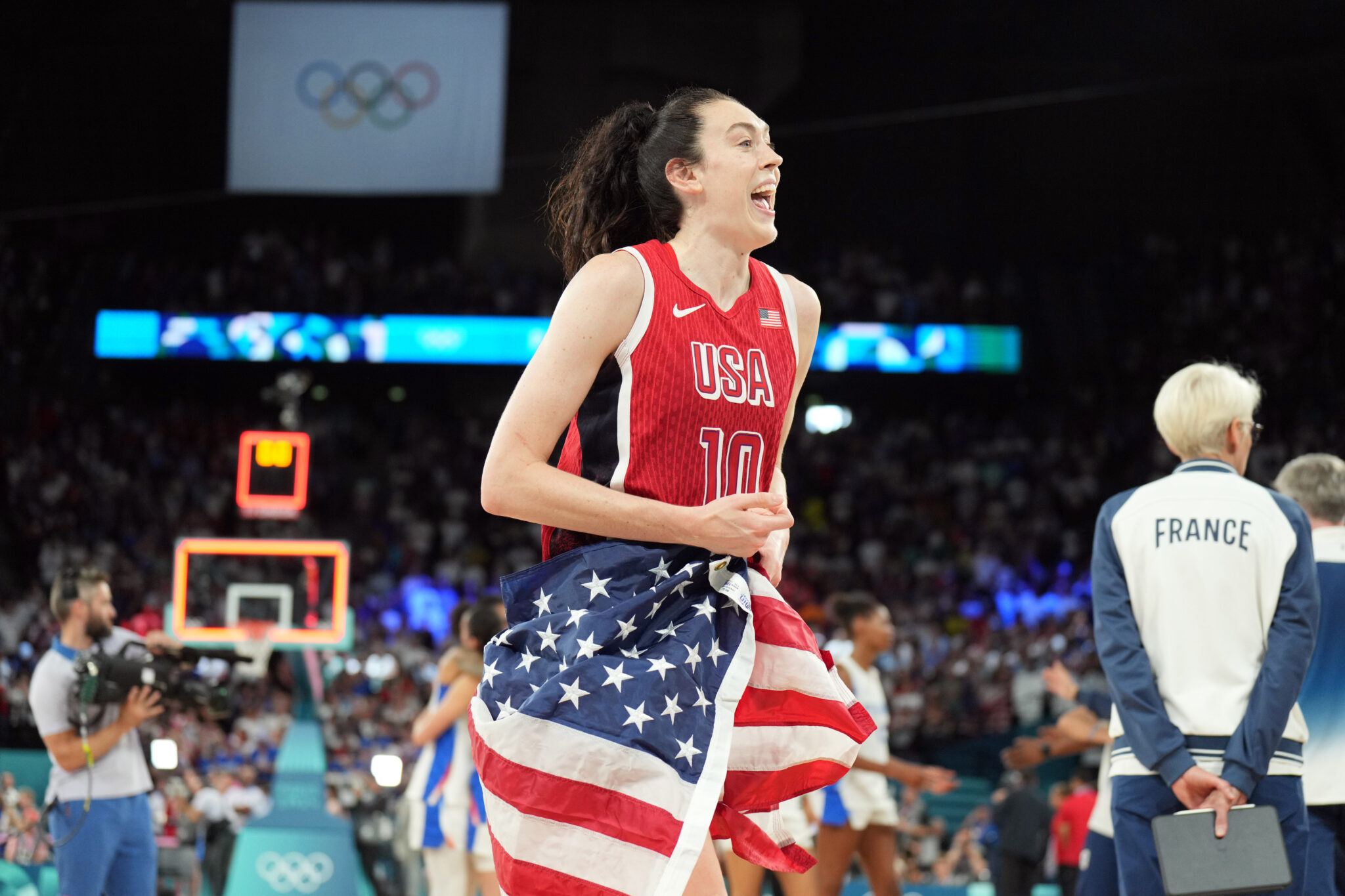 Clark was scoring and facilitating.
Reese was defending, rebounding and disrupting possessions.
That combination offered a glimpse of the depth available to the United States beyond its veteran core.
Still, the broadcast never suggested the veterans had become irrelevant.
Quite the opposite.
At another critical stage, Team USA returned to its starting group.
The commentary described those five players as athletes who knew what it took to win.
That is perhaps the clearest explanation of the American roster’s greatest advantage.
Team USA did not need to choose between experience and youth during this game.
It could use both.
Gray could control difficult possessions.
Stewart could exploit mismatches.
Young could punish defenses from the perimeter.
Copper could create extra possessions through hustle.
Collier could contribute on both ends.
Then Clark, Reese, Boston, Howard and other players could enter and change the energy or matchup.
That depth placed enormous pressure on France.
Even when the French created good stretches, another American combination could appear.
Even when one scorer cooled, another could take over.
France still found moments.
Malonga continued attacking.
Williams kept searching for scoring opportunities.
Johannes tried to create.
But the margin for error had disappeared.
The Americans were increasingly controlling the physical battle and recovering loose possessions.
France needed shots to fall.
It also needed Team USA to stop creating second opportunities.
Neither happened consistently enough.
Late in the game, Copper was left alone in the corner and connected.
That kind of breakdown reflected the challenge France faced.
Stopping the United States required defending every position.
Help too aggressively and an elite shooter could become available.
Stay attached to shooters and the Americans could attack the rim.
Meanwhile, the game transcript continued showing Reese involved around the glass and Clark contributing to the American offense.
For Clark specifically, the final offered a significant international-stage performance.
The transcript does not support every statistic or narrative claim that appeared in other commentary videos about the championship.
Therefore, those outside claims should not be inserted here.
What this source does support is clear.
Clark hit an important shot near halftime.
She found Boston inside during the second half.
She converted a pull-up.
She later hit another three.
She attacked an open lane for two more points.
And the live commentary described the championship as her best game of the finals.
Those moments provide enough evidence to understand her impact without exaggerating it.
The game also illustrates why Team USA’s generational transition will remain fascinating.
The veteran players still carry enormous responsibility.
The commentary explicitly emphasized Stewart, Gray and Young as players the Americans could lean on because they had already experienced these situations.
That experience matters.
International championship basketball is not identical to regular-season WNBA basketball.
Possessions become heavier.
Mistakes become more expensive.
Opponents bring years of national-team continuity.
France demonstrated exactly why experience can matter.
But younger players also need those experiences if they are eventually going to inherit larger roles.
Clark received that experience here.
So did Reese.
So did other members of the emerging group.
Every championship possession becomes part of their development.
That makes this final meaningful beyond the immediate result.
The United States is attempting to preserve its traditional dominance while simultaneously preparing its next generation.
Those objectives can create tension.
Veterans want to compete while they remain elite.
Younger stars are already talented enough to demand opportunities.
Coaches must decide which combinations offer the best balance.
Against France, the Americans were able to use both generations.
The veterans provided stability.
The younger group provided additional playmaking, defensive pressure and energy.
Clark’s performance became especially visible because of how her scoring developed as the game progressed.
She was not simply taking high-volume shots.
The transcript shows her contributing through multiple actions.
She rebounded.
She passed.
She attacked.
She hit from outside.
She found Boston.
That versatility is particularly valuable on a national team loaded with scorers.
Team USA does not necessarily require Clark to reproduce the exact role she carries elsewhere.
International basketball can demand adaptation.
When surrounded by elite players, a guard may need to create one possession and operate without the ball during the next.
Clark’s ability to influence both kinds of possessions could become increasingly important.
The same is true for Reese.
Her value does not depend exclusively on scoring.
The transcript repeatedly captures her around disruptive defensive plays, rebounds and physical possessions.
Those contributions can change a championship game without dominating a box score.
Meanwhile, France deserves significant credit for creating the challenge.
Williams repeatedly attacked the Americans.
Malonga continued competing around the interior.
Johannes offered perimeter danger.
The French defense showed cohesion and willingness to take risks.
The broadcast specifically discussed the familiarity of France’s players with one another.
That continuity is one of the biggest challenges the United States encounters internationally.
American rosters can contain extraordinary individual talent.
Other national programs may possess greater continuity.
The solution requires Team USA to transform talent into cohesion quickly.
The final showed that process happening under pressure.
Early difficulties did not become panic.
The Americans continued searching for favorable matchups.
They increased defensive pressure.
They attacked the glass.
They created transition opportunities.
Eventually, France’s resistance weakened.
For Clark, the lasting image from the supplied transcript may be that halftime shot.
“CLARK LOADS, FIRES.”
But her later possessions arguably reveal more about what her future with Team USA could become.
The pass to Boston mattered.
The pull-up mattered.
The three mattered.
The drive mattered.
Each showed a different way Clark could influence an international game.
And around her were veterans and young teammates capable of doing the same.
That is the challenge facing every opponent.
Stopping one American star is not enough.
France could pressure Stewart and still deal with Gray.
It could contain Gray and still find Young.
It could adjust to the starters and then watch Clark enter.
It could survive Clark’s offense and still confront Reese’s defense.
That depth remains Team USA’s defining weapon.
The championship also gave the emerging generation something statistics cannot fully capture.
Experience.
Clark now knows what a World Cup final feels like.
Reese knows.
The younger players have experienced the physicality, pressure and tactical demands of playing for a championship against one of the world’s strongest national programs.
Those lessons could become increasingly valuable in future tournaments.
The veterans may still lead the present.
The younger generation is clearly becoming part of the future.
This final allowed both realities to exist on the same floor.
And when Clark loaded and fired near halftime, then returned to score and create during the second half, the transition suddenly became much easier to see.


