BERLIN — For years, Caitlin Clark and Angel Reese were presented as opposites.
Rivals.
Competitors.
Two stars whose names could barely appear in the same basketball conversation without immediately creating another argument.
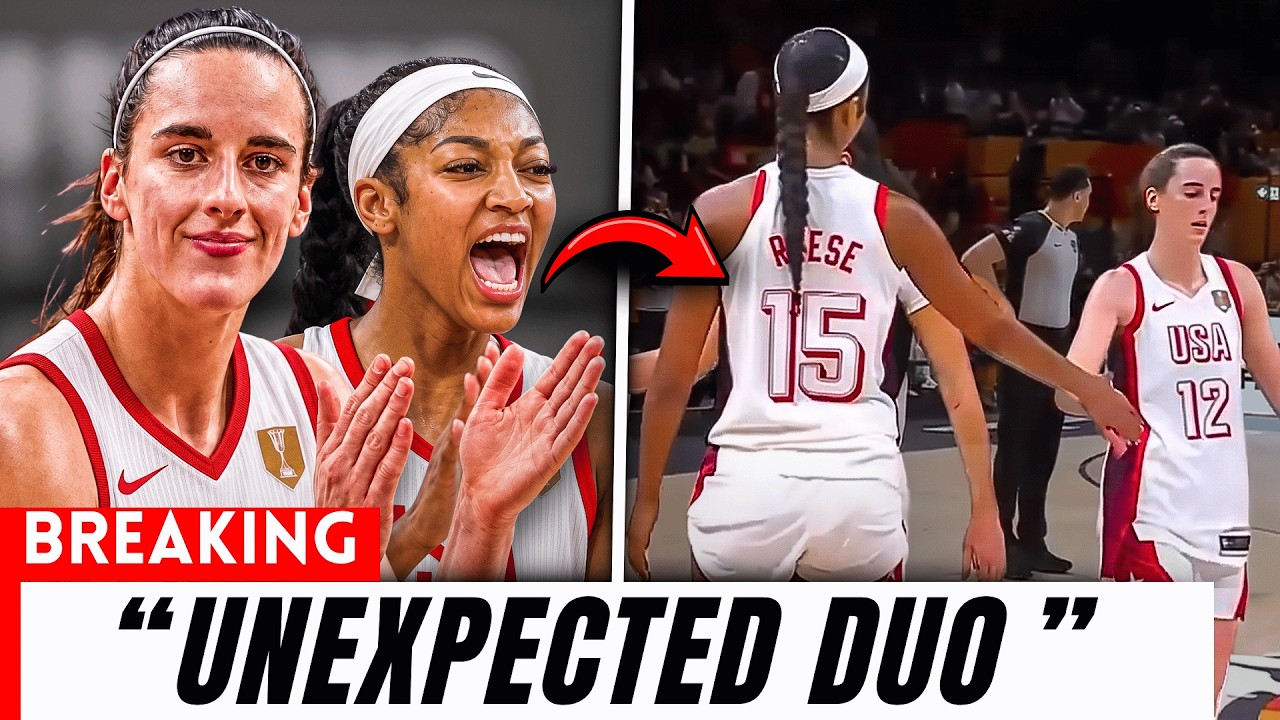
Against Hungary, something very different happened.
They stopped looking like rivals.
They started looking like partners.
And in Team USA’s overwhelming 108-56 quarterfinal victory, the Clark-Reese connection suddenly became one of the most fascinating developments of the entire FIBA Women’s Basketball World Cup.
Clark repeatedly found Reese around the basket.
Reese returned the favor in transition.
Their timing looked natural.
Their pace looked dangerous.
And the longer they shared the court, the harder Hungary found it to survive Team USA’s speed.
This may have been one dominant game.
It may also have revealed something much bigger.
Team USA may have discovered a backcourt-frontcourt partnership capable of becoming extremely important during the medal rounds.
TEAM USA STARTS FAST WITHOUT CLARK.
The United States did not struggle early.
That is important.
Breanna Stewart helped establish the tone.
Kahleah Copper attacked.
Napheesa Collier found scoring opportunities.
The American defense immediately pressured Hungary into difficult possessions.
USA built an 18-9 first-quarter advantage.
Nothing about the opening suggested disaster.
But Caitlin Clark was still sitting on the bench.
Then she entered.
And the game accelerated.
THE SCORE EXPLODES FROM 18-9 TO 36-12.
Clark’s entrance did not simply add another scorer.
It changed the pace.
Team USA began attacking before Hungary could organize.
Passes arrived earlier.
Cutters moved harder.
Transition lanes opened.
Suddenly, an 18-9 advantage became 36-12.
USA closed the quarter with an 18-3 surge after Clark entered.
That stretch became one of the most revealing sequences of the game.
Clark did not need to score ten points herself.
She controlled the environment.
CLARK CREATES EASY BASKETBALL.
That may be the most important part of her game with this American roster.
Team USA already possesses tremendous scoring talent.
Clark does not need to dominate shot attempts.
She can dominate decisions.
She sees a cutter.
The pass arrives.
She recognizes a defender leaning toward the wrong side.
The basketball moves immediately.
She sees a teammate sprinting before the defense understands the transition opportunity exists.
That kind of playmaking turns difficult offense into simple offense.
ALIYAH BOSTON BENEFITS FIRST.
One early sequence showed Clark finding Aliyah Boston outside.
Boston converted the three-pointer.
It was another example of how Clark can activate different types of players.
Boston is usually associated with interior scoring.
But when the defense collapses around movement created by Clark, perimeter opportunities appear too.
That matters.
The more threats Team USA can create, the harder it becomes for opponents to protect the paint.
THEN CLARK FINDS REESE.
Near the end of the opening quarter, another important connection appeared.
Clark pushed the offense.
Reese ran.
The pass arrived.
Reese finished in transition.
The play looked almost too easy.
That is precisely why it mattered.
Great offensive chemistry often makes complicated basketball appear simple.
Clark recognized the lane.
Reese recognized the opportunity.
Neither hesitated.
The result was another easy basket.
THEIR GAMES FIT MORE NATURALLY THAN MANY EXPECTED.
Clark and Reese have spent years competing against each other.
That history may actually help them now.
They already understand tendencies.
Clark knows Reese attacks the glass relentlessly.
She knows Reese runs hard.
She knows Reese wants the basketball near the rim.
Reese knows Clark wants to advance the ball quickly.
She knows Clark sees openings other guards may ignore.
They have studied each other as opponents.
Now that knowledge can become a weapon for the same team.
REESE DOES NOT NEED THE BALL FOR LONG.
This is another reason the pairing works.
Reese is most dangerous when she can react.
Rebound.
Sprint.
Cut.
Seal.
Finish.
Clark can deliver the basketball before Reese has to manufacture her own scoring opportunity.
That keeps possessions efficient.
There is no unnecessary dribbling.
No waiting.
No forcing Reese into uncomfortable perimeter creation.
Clark simply places the ball where Reese can do damage.
That is point guard basketball.
THE SECOND QUARTER MAKES THE CONNECTION EVEN CLEARER.
Clark began the second quarter on the floor.
Again, she did not force the action.
She rebounded.
She organized.
She allowed Team USA’s pressure to create opportunities.
Then Reese jumped a passing lane.
The Americans pushed.
Clark found Reese underneath.
Another layup.
Another simple finish.
Another possession where Hungary could not get organized quickly enough.
The sequence looked remarkably similar to the first quarter.
That repetition is important.
Chemistry becomes meaningful when it can be repeated.
CLARK ALSO TAKES HER OWN SHOT.
Playmaking becomes even harder to defend when the passer can become the scorer.
Clark eventually created a shot for herself.
She stepped back from three.
She made it.
Now Hungary faced a different problem.
If defenders backed away, Clark could shoot.
If they pressed forward, she could pass.
If help came, Reese could become available behind it.
That is the kind of decision tree elite point guards create.
THEN CLARK FINDS REESE AGAIN.
After making the three, Clark returned immediately to playmaking.
She found Reese near the rim for another finish.
That sequence perfectly summarized why the duo looked so dangerous.
Clark did not become obsessed with scoring after making a shot.
She read the next possession.
The defense changed.
She passed.
Reese finished.
The best offensive players understand that the correct decision changes constantly.
Clark repeatedly made the correct one.
TEAM USA’S DEPTH REMAINS OVERWHELMING.
The Clark-Reese story should not erase what everyone else accomplished.
Team USA dominated Hungary with virtually every lineup.
Boston contributed.
Copper scored.
Jackie Young attacked.
Chelsea Gray hit shots.
Rhyne Howard turned defense into transition.
Paige Bueckers created.
Collier remained outstanding.
The Americans led 59-30 at halftime.
This was not one duo carrying Team USA.
It was one duo emerging inside an already devastating roster.
THAT MAY MAKE THEM EVEN MORE DANGEROUS.
Clark and Reese do not need to carry the entire offensive burden.
That changes everything.
Clark can pass instead of forcing shots.
Reese can rebound instead of creating isolation offense.
Bueckers can handle secondary possessions.
Howard can space.
Boston can screen.
Collier can score.
Stewart can create from almost anywhere.
Every player can stay within her strongest role.
That makes Team USA difficult to solve.
THE THIRD QUARTER SHOWS THE CONNECTION WORKS BOTH WAYS.
The most important Clark-Reese moment may not have been another Clark assist.
It came when Reese created for Clark.
Reese forced a turnover.
She pushed the break.
Clark sprinted ahead.
Reese found her.
Clark finished at the rim.
That matters because chemistry cannot be one-directional.
Clark cannot simply become the player who feeds Reese.
Reese also has to recognize Clark’s movement.
Against Hungary, she did.
DEFENSE BECOMES OFFENSE IN SECONDS.
That sequence represented modern transition basketball perfectly.
Steal.
Look ahead.
Sprint.
Pass.
Finish.
No wasted motion.
Hungary barely had time to react.
This is exactly the style that maximizes both Clark and Reese.
Reese’s motor generates turnovers and rebounds.
Clark’s speed creates immediate pressure.
Either player can start the transition.
Either player can finish it.
That flexibility makes the pairing difficult to contain.
RIVALRY HAS BECOME FAMILIARITY.
Clark and Reese have played against each other on major stages repeatedly.
College basketball.
Professional basketball.
National attention.
Every matchup generated headlines.
But familiarity has value.
Reese understands where Clark likes to attack.
Clark understands how Reese moves without the ball.
The things they once studied to stop each other can now help them cooperate.
That transformation is one of the most interesting stories on Team USA.
THE FOURTH QUARTER BECOMES ABOUT DECISION-MAKING.
By the final quarter, the result was no longer in doubt.
USA entered with an enormous advantage.
Clark still continued making productive decisions.
She attacked.
She drew contact.
She passed.
She rebounded.
She found cutters.
She did not begin hunting meaningless statistics simply because the game had become a blowout.
That restraint matters.
Great point guards understand when the correct play is spectacular.
They also understand when the correct play is ordinary.
SONIA CITRON GETS THE NEXT EASY LOOK.
Clark found Sonia Citron cutting toward open space.
The pass arrived.
Citron finished.
Again, the assist was less important than the read.
Clark recognized where Hungary’s defense had shifted.
She recognized the opening created by that movement.
Then she delivered the basketball.
That ability becomes even more valuable on Team USA because virtually every player can punish a defensive mistake.
Clark only has to identify it.
CLARK CREATES FOR REESE AGAIN.
Another possession developed toward Reese.
Clark created the advantage.
Reese drew contact.
The sequence did not necessarily end with a Clark assist, but it still showed the same offensive relationship.
One player forces the defense to react.
The other attacks the space produced by that reaction.
That is chemistry.
It is not always reflected perfectly in the box score.
Sometimes the basketball tells the story better.
CLARK FINISHES FOR HERSELF TOO.
Eventually Clark attacked the rim and finished a driving layup.
Team USA moved beyond 100 points.
Again, Hungary had to choose between protecting against the pass and protecting against Clark herself.
That is why she becomes so difficult to defend once the offense starts flowing.
Take away the pass.
She attacks.
Take away the drive.
She can shoot.
Pressure her aggressively.
Another teammate becomes open.
THE FINAL SCORE IS OVERWHELMING.
USA 108.
Hungary 56.
A 52-point quarterfinal victory.
The game became a demonstration of American depth, defensive pressure, shooting, transition basketball and playmaking.
Clark was one part of that machine.
But her influence stood out.
She contributed scoring.
She rebounded.
She created.
She defended.
Most importantly, she repeatedly made the game easier for teammates.
That may be her greatest value on this roster.
CLARK DID NOT NEED A SCORING EXPLOSION.
This distinction deserves emphasis.
Players with Clark’s popularity are often judged according to points.
How many did she score?
How many threes?
How many highlight shots?
But Team USA does not necessarily need that version of Clark.
It may need the facilitator.
The player who creates eight or nine easy baskets.
The player who forces defensive attention 30 feet from the rim.
The player who turns Reese into a transition target.
That version may be even harder to defend.
REESE MAY BE ONE OF THE BIGGEST BENEFICIARIES.
Reese’s offensive game thrives on activity.
She wants rebounds.
She wants interior touches.
She wants transition opportunities.
Clark is naturally inclined to reward all three.
A rebounder who runs becomes extremely valuable to Clark.
A passer who looks ahead becomes extremely valuable to Reese.
Their games create a feedback loop.
Reese’s effort creates possibilities.
Clark’s vision converts those possibilities into scoring opportunities.
Then the defense becomes exhausted trying to cover both.
THEIR POSTGAME COMMENTS MAKE THE CHEMISTRY EVEN MORE INTERESTING.
Reese has spoken about how familiar the two players are with each other.
They know each other’s games extremely well.
That should not be surprising.
Years of competition created an extensive scouting report.
What changes now is the purpose.
Instead of predicting each other to defend, they can anticipate each other to create.
That turns rivalry knowledge into teammate chemistry.
And Reese clearly appeared to enjoy it.
“SHE KNOWS MY SPOTS” IS AN IMPORTANT IDEA.
A great passer does more than know where a teammate is.
She knows where that teammate wants to be.
Those are different things.
Reese has preferred finishing areas.
Clark can identify them.
Instead of making Reese adjust awkwardly to the pass, Clark can place the basketball where the next action becomes natural.
That eliminates wasted time.
It also increases efficiency.
The best passes frequently make the receiver’s job almost effortless.
REESE UNDERSTANDS CLARK’S SPOTS TOO.
The relationship works both ways.
Reese can recognize Clark’s transition lanes.
She can screen.
She can deliver outlet passes.
She can find Clark running ahead.
The third-quarter fast-break sequence demonstrated exactly that.
This is how a partnership develops.
Not through one player serving another.
Through mutual recognition.
Clark helps Reese.
Reese helps Clark.
The defense must account for both.
TEAM USA MAY HAVE FOUND SOMETHING FOR THE FUTURE.
Perhaps the most intriguing element is that this partnership is still young.
They have not spent years together on the same professional roster.
They do not have hundreds of games of shared experience.
Yet the connection already looks comfortable.
That creates possibilities beyond this World Cup.
Future international competitions could feature Clark and Reese as established pieces of the same American core.
The Hungary game may have been an early preview.
PAIGE BUECKERS MAKES THE YOUNG CORE EVEN MORE DANGEROUS.
Bueckers also fits naturally into this style.
She can handle.
She can shoot.
She can attack the middle.
She can make the next pass.
Put Clark, Bueckers and Reese together and defenders face multiple problems.
Pressure Clark.
Bueckers can create.
Help toward Bueckers.
Reese can finish.
Collapse toward Reese.
Clark becomes available outside.
The possibilities continue multiplying.
Rhyne Howard Adds Another Layer.
Howard’s shooting stretches the defense even farther.
That creates additional room for the Clark-Reese partnership.
A defender cannot simply abandon Howard to protect the rim.
That means Reese may face fewer bodies inside.
Clark receives cleaner passing windows.
Every shooter makes every cutter more dangerous.
Every cutter makes every shooter more dangerous.
That is modern basketball.
THE LINEUP QUESTION WILL NOT DISAPPEAR.
Clark’s performance also creates an obvious coaching discussion.
Should she start?
The transcript repeatedly emphasizes that Clark came from the bench despite producing every time she entered.
That frustration is understandable.
But Team USA was already winning before Clark entered.
The starting group built the initial lead.
The younger group then expanded it dramatically.
Both things can be true.
The question is which approach becomes best against stronger opponents.
COMING OFF THE BENCH MAY ACTUALLY CREATE A TACTICAL SHOCK.
There is an argument for Lawson’s current approach.
Opponents prepare for one style.
Then Clark arrives.
The pace increases immediately.
The floor stretches.
Transition becomes more aggressive.
Passing becomes faster.
That sudden shift can overwhelm a second unit.
Hungary certainly struggled with it.
Clark essentially entered as a change-of-pace weapon.
The effect was devastating.
BUT THE COUNTERARGUMENT IS JUST AS OBVIOUS.
Why wait?
If Clark creates this much offensive pressure, why not use it immediately?
Why allow an opponent to settle into the game?
Why not force defensive discomfort from the opening possession?
That question becomes more important against stronger opponents.
Hungary could not punish Team USA’s choices.
A semifinal opponent may be much less forgiving.
The margin for experimentation continues shrinking.
THE GOOD NEWS FOR TEAM USA IS THAT THIS IS A LUXURY PROBLEM.
The Americans are not searching desperately for a competent point guard.
They have several.
They are not searching for scoring.
They have scoring everywhere.
They are not searching for rebounding, shooting or athleticism.
They possess all of it.
The challenge is optimization.
Which five players create the greatest collective advantage?
That is a far better problem than lacking talent.
CLARK AND REESE HAVE GIVEN LAWSON ANOTHER OPTION.
Before Hungary, the partnership may have been primarily theoretical.
After Hungary, there is evidence.
Transition connections.
Interior passes.
A Reese-to-Clark fast break.
Clark repeatedly finding Reese near the basket.
Shared defensive pressure.
Natural timing.
This does not guarantee the duo will dominate every opponent.
But it gives Lawson another combination worth exploring.
THE WORLD CUP MAY BE REWRITING THEIR PUBLIC STORY.
For years, the Clark-Reese relationship was sold as conflict.
One wins.
One loses.
One says something.
The other responds.
Every interaction becomes evidence of rivalry.
Team USA changes the frame.
They now have the same objective.
Gold.
The same uniform.
The same scoreboard.
The same opponents.
That can transform how the basketball world understands both players.
COMPETITORS CAN BECOME EXCELLENT TEAMMATES.
This happens throughout sports.
Players battle for years.
Then an All-Star team or national team brings them together.
Suddenly, the qualities that made them difficult opponents become complementary strengths.
Clark hated defending Reese’s relentless activity.
Now she can reward it.
Reese hated defending Clark’s vision and range.
Now she can benefit from them.
That is the beauty of national-team basketball.
HUNGARY PROVIDED THE FIRST MAJOR GLIMPSE.
Maybe it was only one game.
Maybe the matchup was favorable.
Maybe the enormous final margin made everything easier.
Those possibilities should be acknowledged.
But chemistry still has to appear before it can grow.
Against Hungary, it appeared.
Clark knew where Reese was going.
Reese trusted Clark to find her.
Reese returned passes.
Clark trusted Reese to finish.
That foundation matters.
TEAM USA’S NEXT OPPONENT WILL TEST IT MORE SERIOUSLY.
A stronger defense may stop transition.
It may force Clark into half-court possessions.
It may put more physical defenders on Reese.
It may trap Clark aggressively.
That will reveal whether the connection can evolve beyond easy fast-break baskets.
Can they execute pick-and-roll actions?
Can Reese short-roll and find shooters?
Can Clark create after the first option disappears?
Those answers will determine how dangerous the pairing truly becomes.
THE POTENTIAL IS OBVIOUS.
Clark sees the floor.
Reese attacks space.
Clark rewards effort.
Reese supplies endless effort.
That is an excellent basketball formula.
Neither player has to become something she is not.
Clark does not have to become a post scorer.
Reese does not have to become a perimeter isolation player.
They can remain themselves.
Their strengths naturally intersect.
That is what coaches search for.
THE BIGGEST SURPRISE MAY BE HOW EASY IT LOOKED.
There was no visible adjustment period.
No hesitation.
No sense that Clark and Reese were learning basic tendencies.
The timing already existed.
Competition may have created that familiarity before they ever became teammates.
Now Team USA gets to benefit.
The rest of the tournament may reveal whether this was simply a quarterfinal curiosity.
Or the beginning of something much more important.
TEAM USA WON 108-56, BUT THE SCORE MAY NOT BE THE LASTING STORY.
A 52-point victory is memorable.
But dominant Team USA victories are not unprecedented.
What may last longer is the image of Clark and Reese feeding each other instead of fighting each other.
One runs.
The other passes.
One creates a steal.
The other finishes.
Then the roles reverse.
That image contradicts years of simplistic rivalry narratives.
Basketball provided a better story.
THE DUO NOBODY EXPECTED MAY BE EXACTLY WHAT TEAM USA NEEDS.
Not because Clark and Reese must become the two biggest stars.
Not because veterans suddenly no longer matter.
Not because one quarterfinal determines the entire future.
Because their games fit.
And championship basketball depends heavily on fit.
Team USA possesses enormous individual talent.
The teams that ultimately win gold are usually the ones that transform individual talent into combinations.
Against Hungary, Clark and Reese looked like one of those combinations.
NOW THE QUESTION BECOMES IMPOSSIBLE TO IGNORE.
How much can this partnership grow?
Can Clark continue creating easy interior opportunities for Reese?
Can Reese’s rebounding create more transition chances for Clark?
Can Bueckers, Howard and Boston make the spacing around them even more dangerous?
Can Lawson give the group enough meaningful minutes to discover its ceiling?
Those questions are suddenly relevant.
Hungary provided the evidence.
THE RIVALRY STORY MAY HAVE FINALLY BECOME TOO SMALL.
Clark versus Reese created unforgettable moments.
It created attention.
It created debate.
But Team USA has revealed another possibility.
Clark with Reese.
That may ultimately become the more interesting basketball story.
Two fierce competitors do not have to stop being competitive.
They simply have to direct that competitiveness toward the same opponent.
Against Hungary, that is exactly what happened.
Team USA destroyed Hungary 108-56.
Clark created.
Reese finished.
Reese created.
Clark finished.
They ran together.
They defended together.
And for one quarterfinal night in Berlin, the two players everyone was told to view as permanent rivals looked like teammates who had been playing together much longer than they actually had.
Maybe it was only one great game.
Maybe the biggest challenges are still ahead.
But if Caitlin Clark keeps seeing Angel Reese before the defense does, and Reese keeps running as though she knows that pass is coming, Team USA may have stumbled into something extremely dangerous.
The duo nobody expected might become the combination nobody else wants to defend.


