Team USA is one victory away from another Women’s World Cup championship, but its 76-66 semifinal victory over Spain created almost as many questions as answers.
The Americans survived.
They advanced.
But they did not dominate.
For long stretches, Spain controlled the rhythm, disrupted the American offense, and forced Kara Lawson’s star-filled roster into uncomfortable possessions.
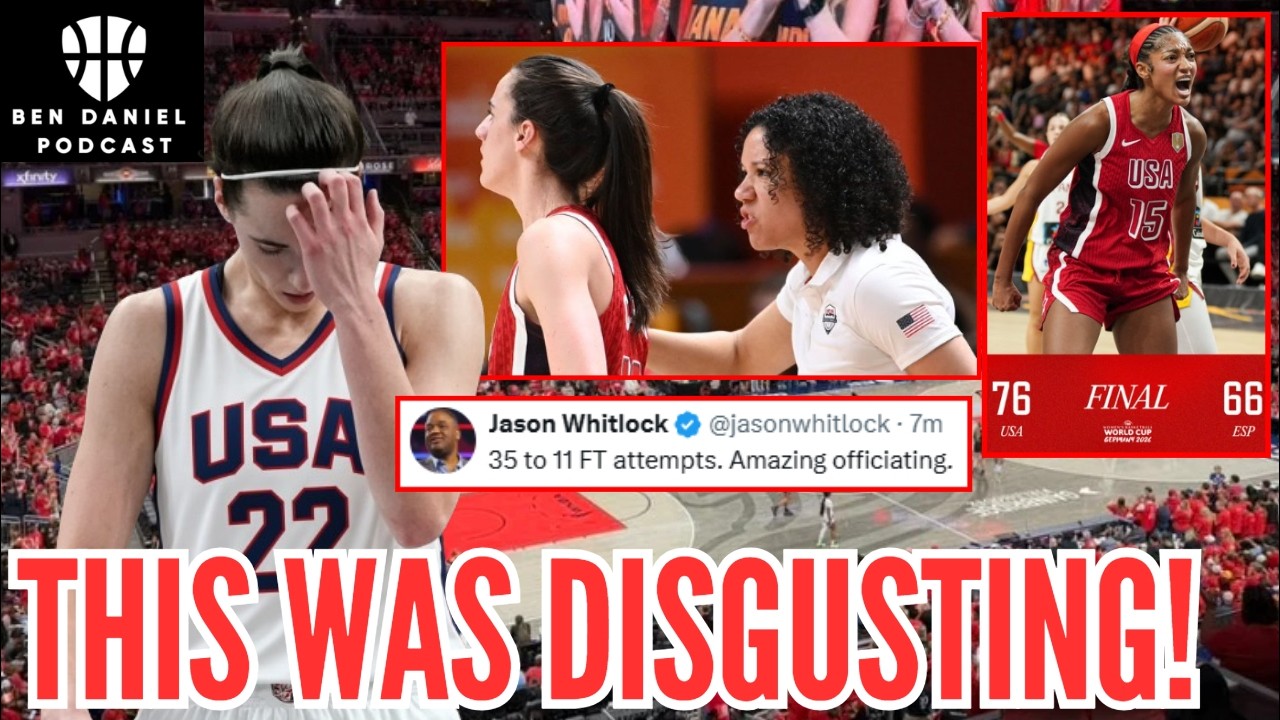
Then there was Caitlin Clark.
She played only 16 minutes.
She finished with one point, one assist, one rebound, one steal, two turnovers, and no made field goals.
Those numbers look terrible without context.
The context changes everything.
Clark finished plus-16, meaning the United States outscored Spain by 16 points while she was on the floor.
Only Aliyah Boston finished with a better plus-minus for Team USA.
That does not mean Clark secretly dominated the semifinal.
She did not.
But it raises an obvious question about Lawson’s rotation.
Why did one of Team USA’s most successful on-court stretches include Clark, yet she still played fewer minutes than several veterans?
That question became especially difficult to avoid after the first half.
Spain opened aggressively and quickly established that this would not resemble one of Team USA’s comfortable victories earlier in the tournament.
The Americans needed something different.
Clark eventually entered.
So did Paige Bueckers, Rhyne Howard, Aliyah Boston, and other members of the younger group.
The energy changed.
The pace changed.
The scoreboard changed.
Then Clark went back to the bench.
She finished the entire first half with approximately five minutes of playing time.
For her supporters, that was the moment frustration became anger.
Clark is not a conventional reserve guard.
She is not someone whose full value can be evaluated through three isolated possessions and one catch-and-shoot opportunity.
Her game depends heavily on rhythm.
She wants to read defenses.
She wants repeated pick-and-roll possessions.
She wants to identify where the help is coming from and punish the next rotation.
That process takes possessions.
It takes touches.
It takes trust.
A five-minute first-half window is an extremely difficult environment for that kind of point guard.
One mistake can consume a significant percentage of the opportunity.
One missed shot suddenly becomes the defining offensive event of the stretch.
Then the player returns to the bench.
The box score eventually says she produced almost nothing.
That is technically correct.
It may not tell the entire story.
This is where criticism of Lawson becomes legitimate without resorting to conspiracy theories.
There is no credible evidence that Lawson is intentionally sabotaging Caitlin Clark.
There is no verified evidence that Team USA selected Clark merely to attract television viewers.
Those are accusations requiring evidence.
But rotation decisions can still be questioned.
Lawson entered the World Cup showing considerable trust in her veterans.
Chelsea Gray remained the starting point guard.
Jackie Young, Kahleah Copper, Napheesa Collier, and Breanna Stewart also carried substantial responsibilities.
Their résumés explain that trust.
Gray has championship experience and years of international basketball behind her.
Young is one of the best two-way guards in the sport.
Copper has delivered in enormous games.
Stewart remains one of basketball’s elite players.
Experience matters.
But experience cannot become immunity.
Tournament basketball is supposed to reward what works during the game being played.
If a bench group changes the momentum, the coach has to recognize it.
That is where the Spain semifinal became uncomfortable.
Team USA’s starting group did not overwhelm Spain.
The Americans entered the fourth quarter tied at 58.
Spain had every reason to believe an upset was possible.
Eventually, the Americans’ superior depth became decisive.
Stewart led the United States with 16 points.
Copper added 13.
Young scored 12.
The veteran group delivered crucial fourth-quarter production when Team USA finally pulled away.
That has to be acknowledged.
Lawson trusted veterans late, and Team USA won.
There is no honest analysis in which that fact disappears.
But winning does not automatically mean every earlier rotation decision was optimal.
That is the difficult distinction.
A great roster can survive questionable stretches.
Team USA possesses enough talent to overcome offensive problems that would eliminate almost any other national team.
That luxury disappears against the strongest opponents.
France is next.
France is not Spain.
Gabby Williams and company defeated host Germany 86-64 to reach the championship game and will enter the final believing they can finish what France almost accomplished at the Paris Olympics.
That makes every American rotation decision more important.
Lawson cannot assume talent will eventually solve everything.
The Clark debate therefore matters beyond fandom.
Clark entered the semifinal averaging seven assists per game through the first four World Cup contests.
That led Team USA.
She recorded 11 assists in her World Cup debut against China.
She followed that with seven assists against Czechia and nine against Hungary.
Those numbers reveal what she offers this roster.
Passing.
Tempo.
Creation.
Yet against Spain, she recorded only one assist.
Did Spain suddenly erase her playmaking?
Possibly.
But another explanation deserves examination.
Team USA did not consistently place the offense in her hands.
That difference matters.
Playing Caitlin Clark and using Caitlin Clark are not necessarily the same thing.
Clark can stand on the wing and provide spacing.
Defenders still respect her shooting range.
That has value.
But it represents only a fraction of her offensive skill set.
The most dangerous version of Clark is making decisions.
She is bringing the ball forward.
She is calling for a screen.
She is forcing two defenders to communicate.
She is reading the roll defender before the defense realizes the passing window exists.
Team USA already has excellent scorers.
What Clark potentially adds is easier scoring opportunities for everyone else.
That is why some possessions against Spain attracted so much attention.
Fans circulated clips showing Clark appearing open while teammates chose different passing options.
Jackie Young became a particular target.
Some commentators claimed Young was deliberately refusing to pass Clark the basketball.
There is no evidence establishing that intent.
A missed pass is not proof of hostility.
Players process information in fractions of a second.
Defenders obscure passing lanes.
Television angles make openings look easier than they sometimes are.
Still, the tactical pattern deserves examination.
If Clark repeatedly becomes a secondary option while playing alongside certain lineups, Lawson needs to ask whether those combinations make sense.
Not because Clark needs every possession.
Because Team USA should maximize every unique skill available.
A roster this talented should produce synergy.
It should not force elite abilities to compete for oxygen.
Young does not need fewer opportunities merely because Clark is popular.
Copper does not need to disappear.
Gray should not lose her role automatically.
The challenge is creating combinations where everyone becomes more dangerous.
Clark’s playmaking could help accomplish that.
This is also why plus-minus became such a major talking point after the semifinal.
Clark finished plus-16 despite scoring only one point.
A player can influence a game without filling the scoring column.
Spacing can matter.
Pace can matter.
Passing decisions can matter before an assist is recorded.
Defensive possessions matter.
Lineup chemistry matters.
But plus-minus needs caution.
It is not a perfect measurement of individual performance.
A player can stand on the floor while teammates make several difficult shots and receive statistical credit for the entire run.
Small samples are particularly noisy.
Sixteen minutes is a small sample.
So Clark’s plus-16 should not be interpreted as proof that she was secretly the best American player.
It should be interpreted as information.
Team USA played very well during her minutes.
A championship coach should care about that information.
The same principle applies to Boston and Bueckers.
Boston’s impact was significant.
Bueckers provided another creator capable of handling pressure.
Team USA’s younger players repeatedly showed that experience is not the only path to effective international basketball.
That creates a fascinating problem for Lawson.
She has almost too many options.
Most national-team coaches spend tournaments searching for five reliable players.
Lawson can look down the bench and find WNBA stars who would be central offensive options on almost any other roster.
Managing abundance is still coaching.
Sometimes it is harder.
The temptation is to preserve a predetermined hierarchy because changing roles can affect chemistry.
Veterans expect responsibility.
Young stars expect opportunity.
Everyone believes they can help.
The coach has to disappoint somebody.
Lawson has generally chosen continuity.
The Spain game showed the cost of that approach when the starting structure does not immediately work.
There was another major issue.
Free throws.
Team USA attempted 35.
Spain attempted 11.
The Americans made 27 free throws while Spain made 10.
That is an enormous disparity.
Stewart alone attempted 11 free throws, exactly matching Spain’s entire team total.
Spain noticed.
Spanish forward María Conde publicly pointed toward the free-throw difference afterward.
Spanish coach Miguel Méndez also referenced the 35-to-11 disparity, although he stopped short of directly accusing officials of favoring Team USA.
The numbers deserve discussion.
They do not prove corruption.
A free-throw disparity can happen legitimately.
One team may attack the basket more aggressively.
Another may commit more physical fouls.
Game situations matter.
Individual calls must be reviewed before declaring that referees decided a contest.
Still, the final margin was 10 points.
Team USA outscored Spain 27-10 from the free-throw line.
Anyone analyzing the game has to acknowledge how important that advantage became.
Without it, the semifinal looks dramatically different.
That should concern Team USA more than anger it.
The Americans shot only 40 percent from the field and allowed Spain to remain tied entering the fourth quarter.
France will not arrive assuming the United States is unbeatable.
France remembers Paris.
The Americans escaped the 2024 Olympic gold-medal game against France 67-66.
One point separated gold from silver.
The World Cup final now offers France another opportunity.
That brings the conversation back to Clark.
What happens if Sunday’s final is tied with five minutes remaining?
Who runs the offense?
Who handles the basketball?
Who creates the first advantage?
Does Lawson trust Gray?
Does she trust Young?
Does she turn toward Clark?
Those decisions will define this debate far more clearly than social-media arguments.
Clark does not deserve championship minutes because she has the largest fan base.
She does not deserve them because people buy tickets to watch her.
Popularity is not the argument.
Her basketball case is stronger.
She has already shown that she can create at an elite level in this tournament.
Seven assists per game through four contests demonstrate that.
The question is whether Lawson believes that creation translates to the most important moments.
Perhaps the answer remains no.
Coaches see details fans do not.
Defense matters.
Ball security matters.
Matchups matter.
Experience matters.
Practices matter.
Clark has also struggled with her shot during stretches of the tournament.
Before the Spain semifinal, she was shooting 32.3 percent from the field and 26.3 percent from three across four games.
That cannot be ignored.
She entered Spain already experiencing inconsistent shooting.
Then she went 0-for-3.
If Lawson believed other guards gave Team USA a more dependable scoring option, there is basketball logic behind that decision.
But shooting percentage is only one dimension.
Clark’s value has never depended exclusively on making threes.
Her 28 assists through the first four games compared with only seven turnovers demonstrated another form of offensive efficiency.
That is excellent creation.
And against elite competition, creating easy baskets becomes increasingly valuable.
France will pressure ball handlers.
France will defend physically.
France will attempt to disrupt American rhythm.
Team USA may need somebody willing to make the pass before the opening looks obvious.
That is Clark’s specialty.
Lawson now faces the most important challenge of the tournament.
She does not need to abandon the veterans.
She needs to remain flexible.
If Stewart dominates, keep feeding Stewart.
If Copper attacks successfully, keep Copper on the floor.
If Young controls the perimeter defensively, extend her minutes.
If Gray stabilizes the offense, trust Gray.
But if Clark changes the tempo, Lawson must recognize that too.
If Bueckers produces, recognize it.
If Boston changes the interior battle, recognize it.
The championship should not be governed by seniority.
It should be governed by the game.
That is ultimately where the strongest criticism of Lawson sits.
Not in insults.
Not in claims that she hates Clark.
Not in theories that USA Basketball is secretly exploiting Clark exclusively for ratings.
The serious question is whether Lawson reacts quickly enough when the evidence on the court challenges her preferred hierarchy.
Spain provided one warning.
Team USA survived.
France may not provide another opportunity.
Clark’s semifinal was statistically poor.
That is true.
Her minutes also coincided with some of Team USA’s strongest stretches.
That is true too.
Both realities can exist simultaneously.
Basketball is complicated enough to allow that.
The next game may finally determine which side of the argument matters more.
If America wins comfortably with its existing veteran structure, Lawson will have the ultimate answer.
Gold medals end many rotation debates.
If France exposes the same offensive problems Spain exposed, however, every Clark minute will become enormous.
Every possession she spends standing away from the basketball will be questioned.
Every successful run involving younger players will pressure Lawson to adjust.
There will be nowhere left to hide behind future games.
That is what makes Sunday fascinating.
Caitlin Clark does not need to be “freed.”
She needs a clearly defined basketball role.
Team USA does not need to become the Caitlin Clark show.
It needs to determine whether one of the best passers on its roster should control more possessions.
Kara Lawson does not need to satisfy Clark’s enormous fan base.
She needs to identify which five players give the United States its best chance to beat France.
And if those five players change during the game, she needs the courage to change with them.
That is championship coaching.
Spain pushed America to the edge.
The free-throw line helped.
The veterans eventually delivered.
The younger group created important momentum.
Clark struggled individually but still finished plus-16.
Now all of those contradictions travel into the final.
One game remains.
One gold medal remains.
And one question surrounding Caitlin Clark has become impossible to avoid.
When Team USA desperately needs its offense to create something against France, will Kara Lawson finally put the ball in Clark’s hands and let her run the game?
Or will the United States continue asking one of basketball’s most creative point guards to prove her value without consistently allowing her to play like one?
Sunday will provide the answer.


