A supposed $45 million Caitlin Clark endorsement deal with Adidas has been circulating as the latest seismic moment in women’s basketball, complete with alleged reactions from coaches, teammates, union figures, and executives.
It is an extraordinary story.
It would also represent one of the most significant athlete-brand developments in the history of women’s team sports.
But there is one major problem.
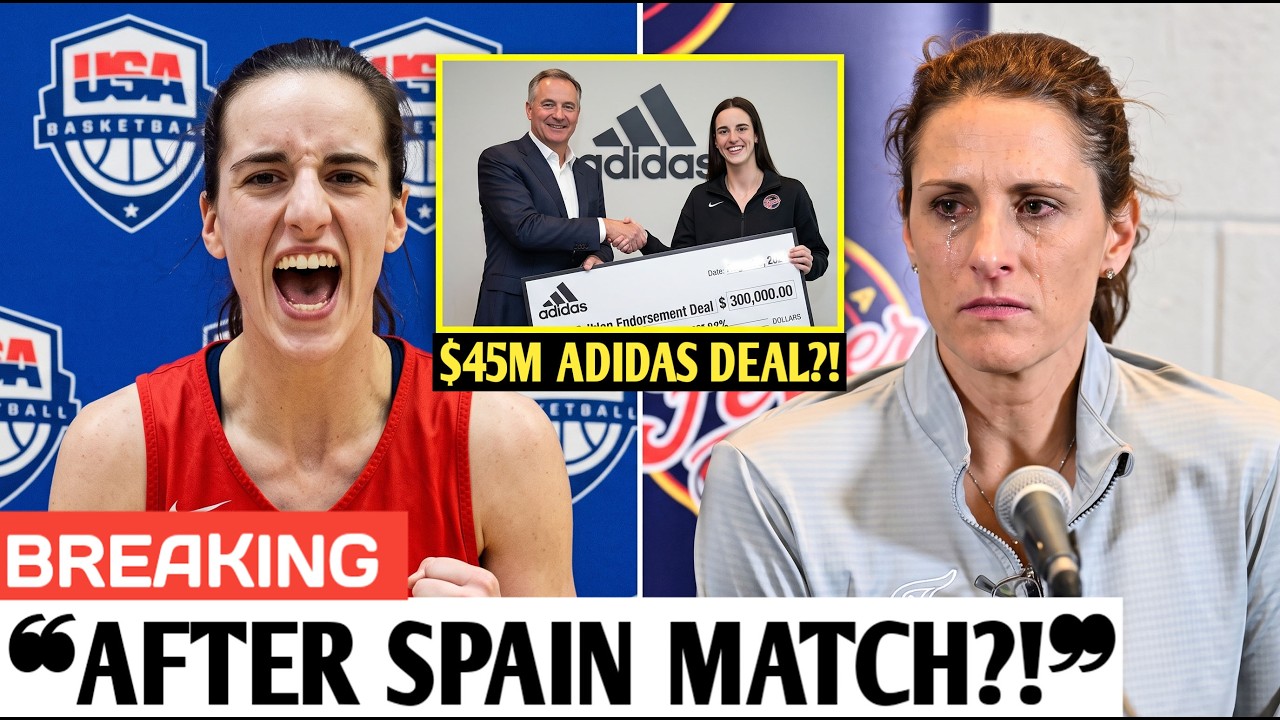
As of September 13, the reported Adidas agreement cannot be independently verified through the major outlets supposedly responsible for breaking it.
The confirmed commercial story surrounding Clark remains her relationship with Nike, and that relationship is not disappearing quietly into the background.
Nike officially identifies Clark as one of its signature basketball athletes and is preparing to release the Nike Caitlin 1, her first signature shoe, globally on October 1.
The company is also launching an 18-piece apparel collection around Clark, making the idea that Adidas simultaneously acquired broad apparel rights especially difficult to accept without substantial additional documentation.
Clark’s existing Nike agreement has widely been reported at approximately $28 million over eight years and includes her signature shoe.
That is the verified foundation.
The alleged $45 million Adidas package is not.
Yet the reason the viral story feels believable tells us something important about Caitlin Clark’s position in modern women’s basketball.
Even without a new Adidas contract, Clark has already reached a level of commercial power that makes enormous numbers sound plausible.
Sportico estimated that Clark earned approximately $16.1 million in 2025, with roughly $16 million coming from endorsements rather than basketball salary and bonuses.
Her sponsors have included Nike, Gatorade, State Farm, Wilson, Panini America, Hy-Vee, Xfinity, Gainbridge, Lilly and several additional partners.
That commercial portfolio is why a fabricated or unverified $45 million story can travel so quickly.
The number does not sound impossible anymore.
Clark has already made the impossible-looking numbers feel normal.
That is the real economic revolution.
The original viral narrative claims ESPN, The Athletic, and Boardroom simultaneously reported the Adidas deal.
I could not verify such reports from those outlets.
That matters because attribution gives a story credibility.
When audiences hear ESPN, The Athletic, and Boardroom mentioned together, they naturally assume multiple independent organizations have confirmed the same information.
Without those reports, the entire chain of supposed reactions becomes unstable.
The transcript claims Stephanie White learned of the deal alongside everyone else and responded by declaring that “the market has decided.”
That would be a powerful quote.
It would also perfectly fit the wider debate surrounding Clark’s popularity.
But no credible source surfaced confirming White made that statement.
What is confirmed is that White is currently part of the Team USA coaching staff in Berlin.
USA Basketball selected White, Natalie Nakase, and Nate Tibbetts to serve as assistants under head coach Kara Lawson for the 2026 Women’s World Cup.
That distinction is worth correcting because the transcript repeatedly refers to “Carol Lawson.”
The Team USA head coach is Kara Lawson.
Stephanie White’s position also creates an interesting real-world dynamic without requiring fabricated quotes.
White coaches Clark in Indiana while assisting Lawson on the national team.
That means she observes Clark in two very different environments.
With the Fever, Clark is the central engine.
With Team USA, she is one superstar among an extraordinary collection of talent.
Through the World Cup group stage, Lawson continued using an experienced starting lineup while Clark came off the bench.
Yet Clark still led the Americans in assists at 6.3 per game through the first three contests.
Her role therefore illustrates the difference between status and impact.
She did not need to start to become one of Team USA’s most important offensive creators.
By September 10, Clark was averaging 8.5 points, seven assists, and 2.8 rebounds while playing more minutes than any other American through four World Cup games.
Her debut against China included 14 points, 11 assists, and no turnovers.
That is actual evidence of influence.
No Adidas rumor is necessary.
Clark’s international profile was already expanding before Berlin.
She won MVP honors at the San Juan qualifying tournament earlier in 2026 and entered the World Cup carrying substantial expectations.
The tournament itself has only intensified them.
Meanwhile, the viral story claims Lawson responded coldly to Clark’s supposed Adidas announcement while refusing even to say Clark’s name.
Again, no credible evidence surfaced confirming that press-conference exchange.
But the claim works rhetorically because it plugs directly into an existing argument among Clark supporters.
Many fans believe established basketball institutions hesitate to embrace Clark’s popularity as aggressively as the marketplace does.
That belief is far more interesting than an invented quote.
There is an undeniable tension between collective sports marketing and individual superstardom.
Leagues want stars.
They also do not want the entire economic identity of the competition attached to one person.
Clark makes that balance unusually difficult.
Her popularity drives audiences at a scale that can overshadow ordinary league-wide storytelling.
For a commissioner, television partner, coach, teammate, or sponsor, that creates opportunity and risk simultaneously.
The opportunity is obvious.
A superstar brings people through the door.
The risk is dependence.
If one athlete becomes responsible for a disproportionate amount of casual interest, what happens when that athlete is injured, retires, or simply stops performing at an extraordinary level?
Professional leagues therefore have legitimate reasons to build multiple stars.
But building multiple stars does not require pretending the biggest star is not the biggest star.
Michael Jordan offers the most obvious historical comparison.
The NBA did not become healthier by hiding Jordan’s popularity.
His visibility expanded the league’s audience.
That larger audience eventually created more opportunities for other franchises, players, television partners, sponsors, and international markets.
The crucial lesson is not that Clark is already Jordan’s equivalent.
The comparison concerns economic strategy.
When an athlete attracts people who otherwise would not watch the sport, the smartest institution usually finds a way to convert that attention into long-term growth.
Clark clearly possesses that ability.
Her estimated 2025 endorsement earnings alone demonstrate how aggressively outside companies value access to her audience.
Nike’s investment provides another example.
The company is not merely placing its logo on Clark’s shoes.
It has built a signature identity around her.
Nike developed a specific “CC” logo, a dedicated apparel collection, and the Caitlin 1 basketball shoe around Clark’s style and playing characteristics.
Nike says Clark worked closely with designers on the shoe’s performance goals, including a quicker first step, faster step-back movement, and quicker shot release.
That is a significant long-term brand commitment.
It makes the alleged Adidas arrangement even more important to verify before repeating.
Two global sportswear giants do not casually divide a signature basketball athlete’s apparel categories without complex contractual consequences.
If Adidas truly entered with $45 million, the agreement would almost certainly produce substantial reporting throughout the sports-business industry.
Until such reporting appears, the responsible conclusion is simple.
Treat the Adidas story as unverified.
The transcript also attributes a reaction to Kelsey Mitchell.
According to the narration, Mitchell supposedly celebrated Clark while admitting frustration that her own phone was not receiving similar endorsement interest.
It is a compelling quote because it captures a real economic question.
But I could not verify the alleged Instagram Live comments.
Mitchell’s actual accomplishments do make the hypothetical tension understandable.
She is an elite scorer and one of Clark’s most important teammates.
She has produced enormous performances alongside Clark, including a 30-point game when Clark scored 37 against Chicago in August.
Yet elite basketball ability does not automatically produce equal commercial value.
That reality can feel uncomfortable because sports culture often teaches athletes that performance should determine reward.
Advertising markets operate differently.
Sponsors purchase attention, identity, reach, emotional connection, and cultural relevance alongside athletic achievement.
Two teammates can be similarly important to winning and dramatically different commercially.
That is not necessarily evidence of unfairness.
It is evidence that basketball value and marketing value are not identical currencies.
Clark currently has an unusual amount of both.
That distinction also explains why the broader discussion about WNBA compensation matters.
In 2025, almost all of Clark’s estimated earnings came from endorsements rather than league compensation.
That gap naturally invites larger questions about how women’s basketball distributes the revenue created by its stars.
But those questions should not be built around invented comments from players or union officials.
The transcript attributes another dramatic quotation to Chiney Ogwumike, describing her as a union vice president openly questioning whether the league’s economic system can handle Clark’s off-court value.
I could not verify that specific television quote either.
Again, however, the underlying economic question is legitimate.
Women’s basketball has entered a new commercial era.
Clark is part of that transformation, but she is not alone.
A’ja Wilson, Angel Reese, Paige Bueckers, Breanna Stewart, Sabrina Ionescu, Kelsey Mitchell, and other stars are helping create a deeper marketplace.
The challenge is ensuring Clark’s gravitational pull expands that marketplace instead of becoming a permanent substitute for it.
That requires thoughtful league marketing.
It requires better storytelling around rival players.
It requires competitive teams.
It requires internationally recognizable personalities.
And it requires converting temporary curiosity into habitual viewing.
That is where Team USA becomes important.
The World Cup introduces American stars to viewers who may not follow the WNBA regularly.
Clark arrived in Berlin already carrying an enormous audience.
The tournament gives other players access to that same attention.
After defeating Spain 76-66 in the semifinal on September 12, Team USA advanced to the World Cup final for the fifth consecutive tournament.
That also exposes another problem with the viral transcript.
It speaks about an upcoming qualifying game against Belgium as though the tournament were at an earlier stage.
The current situation has already moved beyond that timeline.
The United States is playing for the championship.
Clark’s international story is therefore no longer theoretical.
She has played meaningful World Cup minutes.
She has created at a high level.
She has helped Team USA reach the final.
And the commercial spotlight has followed.
Those are the facts worth analyzing.
The most powerful version of this story does not require a fictional Adidas contract.
It does not require Kara Lawson refusing to say Clark’s name.
It does not require Kelsey Mitchell confessing jealousy on Instagram Live.
It does not require a union executive publicly declaring the league economically obsolete.
Reality is already dramatic.
Clark is preparing to launch a Nike signature shoe at 24 years old.
She earned an estimated $16 million from endorsements in 2025.
She is playing major international basketball for Team USA.
She is simultaneously one of the most discussed athletes in the WNBA and one of the most commercially valuable women athletes in the world.
The league now has to determine how to turn that phenomenon into durable growth.
That means the most important question is not whether Adidas suddenly offered Clark $45 million.
The more important question is what happens when the existing numbers continue growing.
What happens if the Caitlin 1 becomes a major retail success?
What happens if Clark reaches another level in the WNBA?
What happens if Team USA wins gold with Clark becoming one of the central figures of the tournament?
What happens if her annual endorsement earnings move from $16 million toward $20 million, $25 million, or higher?
Those possibilities do not require speculation about secret contract clauses.
They follow naturally from the commercial trajectory already visible.
There is also a lesson here for basketball media.
Clark generates clicks so reliably that exaggeration becomes tempting.
Add a giant dollar figure.
Invent a private reaction.
Describe normal institutional caution as panic.
Turn a brand partnership into a political battle.
The algorithm rewards that approach.
But Clark’s real career is already dramatic enough.
The numbers are already extraordinary.
The audience is already enormous.
The international stage is already watching.
Fabrication actually makes the genuine story smaller because it forces audiences to spend time separating reality from fiction.
The verified story deserves more attention.
Nike has invested heavily in Clark.
Her first signature shoe is about to reach stores.
Her endorsement earnings already dwarf her historical WNBA compensation.
She is helping Team USA pursue another world championship.
Her passing continues translating internationally.
And every business connected to women’s basketball is studying what her audience means for the sport’s future.
That is the economic earthquake.
It is happening without Adidas.
It is happening without a secret $45 million package.
And perhaps that is the most revealing part of the entire situation.
A fictional number went viral because Caitlin Clark has reached a point where $45 million no longer sounds absurd.
That tells us more about her commercial position than the rumor itself.
The marketplace has unquestionably recognized Clark.
Nike has recognized her.
Sponsors have recognized her.
Television audiences have recognized her.
Ticket buyers have recognized her.
International basketball audiences are recognizing her now.
The remaining question is how effectively the institutions surrounding women’s basketball convert that attention into something bigger than one player.
Because Clark’s greatest economic legacy may not ultimately be the value of any single endorsement contract.
It may be the moment women’s basketball discovers what happens when one superstar expands the ceiling of the entire marketplace.
That story is real.
And it is already bigger than the rumor.


