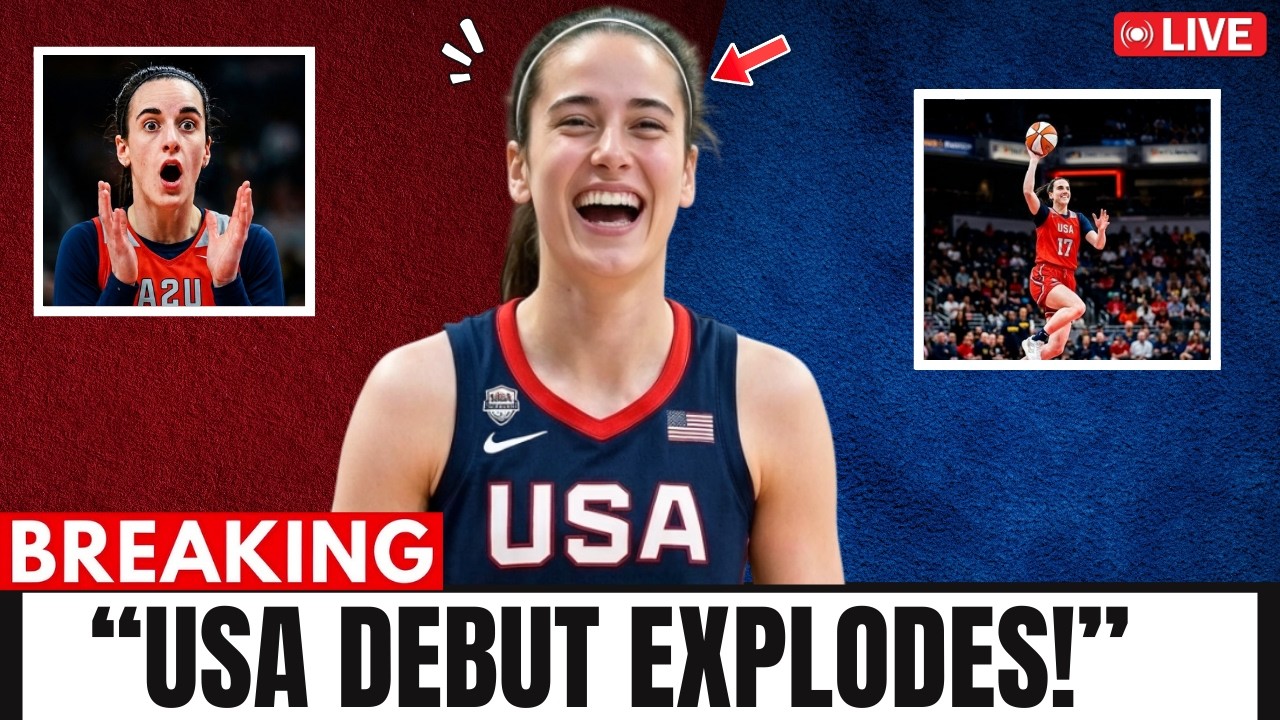
A new video examining Caitlin Clark’s first four Team USA games is making a provocative claim about how the Americans are using one of their most productive playmakers.
According to the supplied transcript, the creator reviewed every possession from all four games and concluded that Clark frequently went long stretches without receiving the ball from veteran teammates.
The video’s argument is not simply that Clark should start.
It goes much further.
The narrator claims that even when Clark finally enters the game, Team USA sometimes uses forwards or other players to initiate the offense instead of allowing Clark to operate naturally at point guard.
That distinction matters because Clark’s strongest skill may be her ability to organize possessions and create opportunities for everyone around her.
If she is standing away from the ball while another player brings it up, the video argues that Team USA is reducing the value of having her on the floor.
The criticism begins with the basic structure of the offense.
According to the transcript, Clark repeatedly signals for the basketball while teammates continue possessions without involving her.
The narrator specifically highlights Breanna Stewart handling the ball and initiating sets while Clark waits for a pass.
In several clips, the video describes Clark cutting directly into obvious passing windows.
The ball still reportedly goes somewhere else.
The narrator interprets these moments as more than normal missed reads.
He argues that the pattern happens too frequently to ignore.
One sequence draws particular frustration.
Clark is reportedly open and signaling for the basketball, yet the possession ends with another decision rather than a pass to her.
The video claims some players would seemingly rather risk a turnover than reset the offense through Clark.
That is an aggressive interpretation.
The clips themselves, according to the narrator, are meant to allow viewers to judge whether the pattern is intentional, strategic, or simply the product of unfamiliarity.
The transcript then focuses on Paige Bueckers and Stewart.
The narrator describes one possession as Bueckers and Stewart effectively playing “keep away,” repeatedly exchanging the basketball while Clark waits to become involved.
The video also claims Bueckers behaves differently depending on which teammates are sharing the floor.
That interpretation is not independently established by the transcript.
However, it becomes part of the video’s larger argument that existing WNBA and college relationships may influence where players instinctively send the basketball.
The narrator points toward teammates who have played together professionally or collegiately.
He suggests those familiar relationships could produce passing habits that leave Clark outside the action.
Kiki Iriafen is also mentioned.
According to the transcript, one possession shows Iriafen choosing Sonia Citron rather than handing the basketball to Clark.
Again, one isolated decision would mean little.
The video’s argument depends on the claim that these possessions repeat across four games.
The frustration becomes sharper when the narrator discusses Kahleah Copper.
According to the transcript, the creator argues that Copper rarely looks toward Clark and often attacks individually.
The narrator portrays this as part of a larger style problem.
Players put their heads down.
They attack.
They search for their own opportunity.
Clark, by contrast, is presented as constantly searching for the open teammate.
That contrast becomes the central theme of the video.
Clark may not receive the same number of return passes, the narrator argues, but she continues distributing the basketball when she controls it.
The transcript describes the difference as almost philosophical.
One style holds the basketball.
The other moves it.
One style begins with individual creation.
The other begins with identifying the easiest available opportunity.
The narrator clearly favors Clark’s approach.
The statistical claims presented in the transcript are used to strengthen that argument.
The video claims Clark accumulated 28 assists through four games.
It says Bueckers was next with 14.
According to the narrator, Clark therefore doubled the assist total of the next player.
The transcript also references a plus-98 figure across Clark’s minutes.
Those numbers are presented by the video and are not independently verified here.
Still, within the source’s argument, they create an obvious question.
How is Clark producing that level of playmaking if she is allegedly being ignored during large portions of her minutes?
The narrator believes the answer is simple.
Clark maximizes the possessions when the offense actually runs through her.
The video estimates that approximately half of Clark’s minutes are spent with lineups that do not consistently return the basketball to her.
The creator therefore argues that Clark effectively has only a fraction of each game to play in her preferred style.
Even within those limitations, the transcript says she continues to lead Team USA in assists.
That leads into one of the video’s most striking complaints.
Clark can be visibly open without receiving a pass.
The narrator repeatedly points toward moments where she appears ready to shoot or initiate the next action.
Instead, another player holds or redirects the ball.
One late-clock possession receives particular attention.
The transcript argues that Clark frequently excels in these situations, especially when the offense needs a quick attempt.
Yet Stewart reportedly receives the basketball instead.
The narrator cannot understand why Team USA would choose another player to initiate when Clark is available.
This criticism becomes especially intense because of Clark’s reputation as a playmaker.
If a traditional point guard were struggling to create, experimenting with alternate initiators might be understandable.
But the video claims Clark is producing more assists than anyone else on the roster.
That makes the choice appear contradictory.
The narrator also connects the issue to audience interest.
According to the transcript, Clark is a major reason fans are watching these Team USA games.
The video points toward record-breaking interest and argues that keeping her on the bench already frustrates viewers.
Using her as an off-ball spectator after she enters creates an additional layer of criticism.
However, the strongest section of the video arrives when the narrator stops showing possessions where Clark does not receive the ball.
Instead, he shows what Clark does when she finally controls it.
The tone changes immediately.
The transcript describes pass after pass to different teammates.
Aliyah Boston receives the basketball.
Jackie Young receives it.
Rhyne Howard receives it.
Bueckers receives it.
Stewart receives it.
Reese receives it.
Citron receives it.
Collier receives it.
Iriafen receives it.
The narrator’s point is straightforward.
Clark does not appear to punish teammates for failing to involve her.
She continues looking for them.
One possession features a half-court pass to Boston.
Another reportedly finds Bueckers through two defenders on a backdoor cut.
The video highlights a pass to Howard as a particularly impressive “dime.”
Then Stewart becomes part of the argument again.
The narrator claims Stewart had rarely passed to Clark during the World Cup.
Yet Clark still repeatedly created opportunities for Stewart.
The contrast is used to frame Clark as an unusually unselfish star.
Rather than responding to limited touches by hunting shots, she continues distributing.
The transcript also praises Clark’s full-court passing.
One sequence allegedly finds Stewart down the floor.
Another creates an easy opportunity for Reese.
The narrator repeatedly describes these possessions as “beautiful basketball.”
The phrase matters because the video is not simply arguing for Clark to get more shots.
It is arguing for Team USA to play differently.
The creator wants faster ball movement.
He wants transition passing.
He wants multiple players touching the ball.
He wants teammates rewarded for running the floor.
Clark becomes the symbol of that style.
The video specifically contrasts her approach with possessions where another player slowly dribbles the ball up and attacks individually.
From the narrator’s perspective, Clark turns every rebound or outlet opportunity into a search for an advantage.
That can mean a long pass.
It can mean an immediate hit-ahead.
It can mean finding a cutter.
It can mean creating a so-called hockey assist, where Clark initiates the sequence even if she does not receive the official assist.
The transcript argues these possessions make her statistical production even more impressive.
Official assists capture only the final pass before a basket.
They do not capture every pass that breaks the defense.
The narrator suggests Clark would appear even more dominant if those secondary creations were tracked.
The strongest philosophical statement comes near the end.
 The video asks how many superstar scorers consistently surrender the basketball this willingly.
The narrator compares Clark’s scoring ability with her desire to involve teammates.
That combination, he argues, is what separates her.
Many elite scorers dominate possessions.
Clark appears willing to give the ball away almost immediately when another player has a better opportunity.
That is why the narrator believes Team USA’s usage makes so little sense.
If Clark were merely a high-volume shooter, limiting her touches might be defensible.
But the transcript presents her as the opposite.
The more she touches the basketball, the more teammates become involved.
The video also makes historical claims about Clark’s passing.
It says she is already first in Team USA tournament history for assists per game and mentions Dawn Staley while discussing the record.
Again, those statistics are presented by the transcript rather than independently verified here.
But within the video’s argument, they make the central contradiction even sharper.
Clark is supposedly generating historic assist production while not consistently functioning as the primary point guard.
If that description is accurate, what would happen if Team USA fully committed to letting her run the offense?
That is the question driving the entire video.
The narrator does not merely want Clark to start for symbolic reasons.
He wants the offense structured around the skill that Clark demonstrably brings.
The final minutes are effectively a highlight reel of that philosophy.
Clark pushes the basketball quickly.
She rewards runners.
She finds post players.
She searches the opposite side.
She makes long passes before defenses organize.
She passes to veterans.
She passes to younger teammates.
The ball keeps moving.
The narrator describes that as the Team USA basketball he wants to see.
The larger concern is not about one missed pass.
Basketball players miss open teammates constantly.
A single possession proves almost nothing.
The significance comes only if the pattern shown by the video truly repeats over all four games.
If Clark regularly spends stretches on the court without being allowed to initiate the offense, the coaching staff may eventually have to explain what role it actually wants her to play.
That does not require assuming teammates intentionally dislike Clark.
Familiarity, coaching assignments, existing chemistry and predetermined actions can all create situations where another player handles the basketball.
International teams also have limited preparation time.
Veterans may naturally fall back on relationships and habits developed over years.
But those explanations do not eliminate the tactical question.
Team USA has a player whose greatest strength is creating advantages with the ball.
If the offense frequently removes the ball from her hands, is the team maximizing her?
The transcript’s answer is clearly no.
Its evidence is presented through side-by-side contrast.
First, viewers are shown Clark waiting.
Calling for the basketball.
Cutting.
Standing open.
Watching another teammate initiate.
Then the video flips the sequence.
Clark receives the ball.
Immediately, teammates begin receiving passes.
The pace changes.
Players run.
The basketball advances before the defense can settle.
That contrast is much stronger than simply arguing Clark deserves more shots.
It asks whether Team USA understands what makes Clark valuable in the first place.
Her scoring attracts attention.
Her long-range shooting stretches defenses.
But her passing is what can turn that defensive attention into opportunities for everyone else.
That is why the narrator repeatedly returns to the assist totals.
Clark does not need to dominate the ball forever.
She needs to touch it early enough to make the defense react.
The video concludes with a simple vision of what Team USA should become.
Everyone touches the basketball.
Everyone runs.
Everyone gets involved.
Clark initiates.
The defense moves.
The pass finds the open player.
That is the style the narrator believes gives Team USA its highest ceiling.
Whether the alleged lack of passes toward Clark is deliberate cannot be established from the supplied transcript alone.
But the film-based argument creates a legitimate basketball question.
If Caitlin Clark is already creating more assists than anyone else on the roster, why would Team USA repeatedly place her on the floor without allowing her to function as the point guard?


