Team USA defeated Czechia 105–64, but the biggest argument after the 41-point victory had almost nothing to do with the final score.
Instead, Caitlin Clark became the center of another national-team controversy.
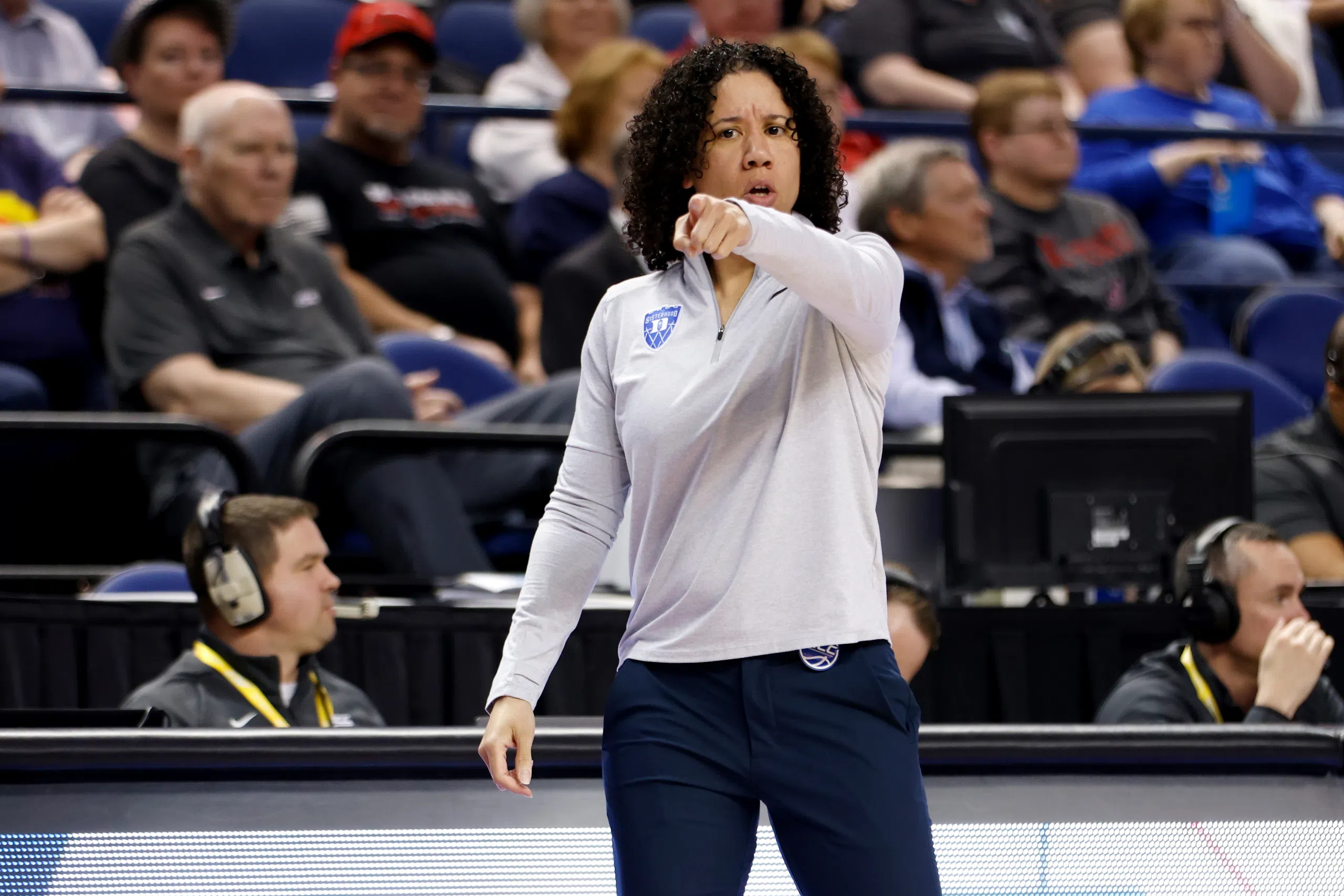
Head coach Cara Lawson described Clark as a young player who was “still feeling her way” through her first World Cup.
That sentence immediately attracted attention because it appeared difficult to reconcile with Clark’s production earlier in the tournament.
According to the source, Clark had already produced 11 assists without a turnover against China.
She had also recorded a plus-30 rating and earned player-of-the-game recognition.
The transcript additionally claims Clark broke eight tournament records during that performance.
Those claims come from the supplied source and should be treated accordingly.
Whatever the precise historical significance, Clark’s game against China was clearly presented as one of the strongest performances of Team USA’s opening stretch.
That is why Lawson’s wording became controversial.
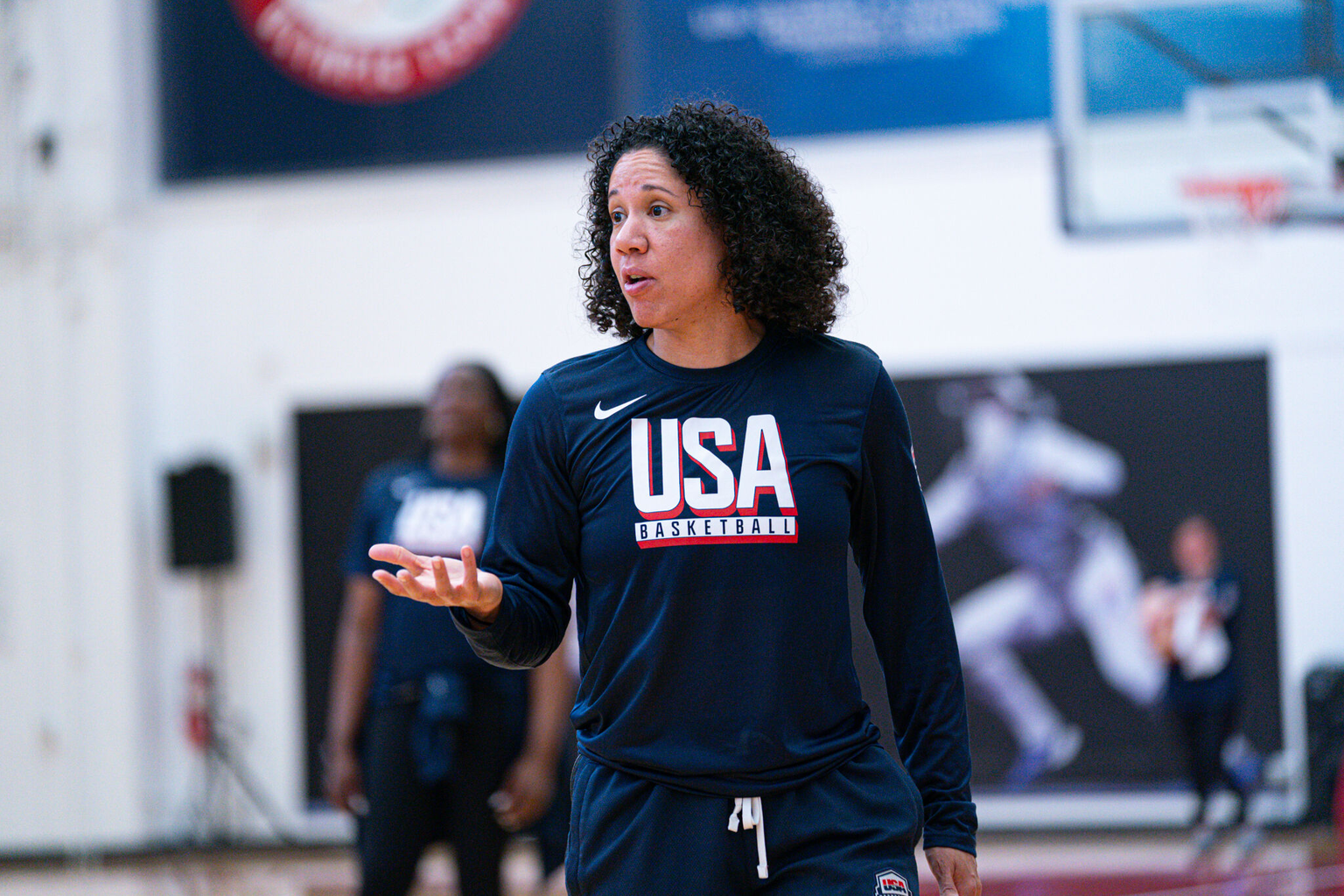
“Still feeling her way” normally suggests uncertainty.
It suggests a player learning timing, adjusting to pressure, or becoming comfortable with a new level of competition.
Clark’s China numbers suggested something different.
Eleven assists suggested control.
Zero turnovers suggested decision-making.
A plus-30 rating suggested Team USA dominated during her minutes.
Those are not typical indicators of a player overwhelmed by the moment.
Lawson complicated the discussion further by praising Clark elsewhere in the same press conference.
According to the transcript, the coach said Clark changed the tempo when she entered the game.
Lawson also acknowledged relying on Clark at point guard when she was on the floor.
That created the contradiction fans immediately noticed.
How can Clark simultaneously be trusted to run the team and still be framed as someone tentatively finding her way?
Those ideas are not necessarily mutually exclusive.
A player can perform brilliantly while still adjusting to a new roster.
Clark is surrounded by stars who have different tendencies from her WNBA teammates.
She must learn where they prefer the ball.
She must learn defensive responsibilities.
She must understand Lawson’s terminology and rotations.
That takes time.
But the phrase becomes harder to defend when it is used in a conversation about playing time.
The central issue is not whether Clark still has things to learn.
Every player does.
The question is whether that adjustment justifies limiting a player who appears to be producing immediate results.
The Czechia box score intensified that debate.
According to the source, non-starters generated a plus-minus rate of approximately 1.18 points per minute.
The starting group reportedly generated approximately 0.81 points per minute.
The transcript presents Paige Bueckers at plus-1.45 per minute and Aaliyah Boston at plus-1.42.
It places Clark at approximately plus-1.0 per minute.
The source uses those numbers to argue that Team USA’s bench was outperforming the starting unit significantly.
That interpretation requires caution.
Plus-minus in a single blowout can be influenced by matchups, substitutions, opponent strength, and game context.
It is not a perfect individual measure.
Still, it can highlight lineup trends worth examining.
The trend described in the source is straightforward.
When younger, faster combinations entered, Team USA accelerated.
Possessions became shorter.
Transition chances increased.
The margin expanded more quickly.
When veteran-heavy units returned, the game allegedly became slower and more methodical.
That does not necessarily mean the veterans played badly.
It may mean the younger unit offered a better stylistic fit against that particular opponent.
Breanna Stewart provides an important example.
The source reports that Stewart scored 19 points on eight-of-11 shooting.
She reportedly thrived within the faster style.
That weakens any simplistic argument that the controversy is merely young players versus veterans.
The more useful distinction is pace.
Some players operate comfortably in transition.
Others are more valuable when possessions become deliberate.
Team USA must determine which approach gives the entire roster its highest ceiling.
Clark naturally pushes toward speed.
She advances the ball rapidly.
She looks for passes before defenses organize.
She stretches the floor with shooting range.
Her presence encourages teammates to run because they know she can find them early.
That style was particularly visible against China.
The source describes Clark, Bueckers, Boston, Angel Reese, and Rhyne Howard producing a 17–5 run together.
The significance of that combination was not merely scoring.
It was how quickly the scoring happened.
The ball moved before China could establish its defensive structure.
That is one of Clark’s strongest qualities.
She can transform defensive rebounds into scoring opportunities within seconds.
Traditional half-court offenses often ask defenses to solve one problem at a time.
Clark’s preferred style creates several problems almost simultaneously.
A defender must decide whether to pick her up early.
Another defender must track a runner.
A big must protect the rim.
Someone must account for shooters.
One late decision creates an open opportunity.
Against weaker teams, Team USA may not need that speed.
Superior talent can eventually create separation.
Against stronger opponents, the difference becomes much more important.
Italy provided that warning.
The Americans escaped 55–52 in a game the source describes as stagnant and uncomfortable.
Clark struggled individually.
The entire team struggled offensively.
That performance cannot be blamed entirely on rotations.
Shooters missed.
Italy defended well.
Clark herself failed to produce normal scoring efficiency.
But the game showed what happens when Team USA loses offensive rhythm.
The source argues that Clark helped increase the pace before being removed during stretches when momentum was developing.
That claim has become part of the broader fan frustration.
Again, motive should not be assumed.
Lawson may have been following planned rotations.
She may have prioritized defensive matchups.
She may have wanted veteran experience late.
Those are legitimate coaching considerations.
The controversy comes from the pattern across multiple games.
China showed the young group producing rapidly.
Italy showed the offense struggling when the game became slower.
Czechia again showed faster combinations building separation.
That is why fans are asking whether Lawson is learning from the evidence.
The strongest criticism does not require claiming she dislikes Clark.
It simply asks whether the rotation matches performance.
That question became even louder because of the phrase “still feeling her way.”
The source argues that the description undersells Clark’s control.
There is some logic to that criticism.
A point guard producing 11 assists with zero turnovers is not merely surviving.
She is making correct decisions repeatedly.
Clark herself offered a far less confrontational explanation after the Czechia victory.
According to the transcript, she said chemistry was gradually improving.
She praised Team USA’s offensive pace and transition play.
She described playing with so many talented teammates as enjoyable.
That answer matters.
Clark did not publicly accuse Lawson of holding her back.
She did not attack veterans.
She did not demand a starting position.
She presented the situation as a team still learning how to play together.
That may be the most reasonable interpretation.
National teams have limited preparation time.
Players arrive from different systems.
They must develop chemistry quickly.
Lawson may believe the group stage is the correct time to test combinations before elimination games begin.
That is a legitimate coaching philosophy.
The source acknowledges this defense.
Lawson has reportedly said she is trying different ways to win and developing depth for later rounds.
There is nothing inherently suspicious about that strategy.
The harder question is how long experimentation should continue when one group repeatedly produces better results.
At some point, evaluation must become decision.
The knockout stage creates that deadline.
A coach can afford to experiment during a comfortable group game.
She cannot afford to discover her best lineup after elimination.
That is why the upcoming stronger opponents matter.
The transcript focuses heavily on France as a potential test.
It describes France as disciplined, deep, and capable of punishing slow possessions.
Whether every scouting characterization proves accurate is less important than the larger point.
Better teams reduce Team USA’s margin for error.
A 41-point victory can hide awkward rotations.
A one-possession game cannot.
If the Americans become stagnant against an elite defense, Lawson must have an immediate solution.
Clark and Bueckers together are presented by the source as one potential answer.
Clark creates the initial pressure.
Bueckers can process the second action.
That pairing could make it difficult for defenses to dictate pace.
The source also introduces a more controversial theory surrounding Lawson and Chelsea Gray.
Fans have pointed toward their Duke connections.
Lawson coaches Duke.
Gray played college basketball at Duke.
Some supporters have interpreted that connection as evidence of favoritism.
That conclusion is not established.
Shared institutional history does not prove biased lineup decisions.
Coaches frequently trust veterans because veterans have experience.
Gray has a decorated career and has played in enormous games.
Lawson may simply value what she provides.
The transcript also notes that Clark has surpassed records associated with Lawson’s playing career.
Again, fans have used that detail to speculate about personal motives.
There is no evidence proving resentment.
A record being broken does not establish jealousy.
Those theories are more emotionally powerful than they are evidentially strong.
The basketball argument is stronger.
If Clark is producing better pace and more efficient offense, her role should increase regardless of personal history.
If Gray provides advantages Clark does not, Lawson should be able to demonstrate that through performance.
That is how the controversy should be evaluated.
Napheesa Collier’s comments added another layer.
According to the transcript, Collier emphasized the importance of veterans leading Team USA and bringing calm during difficult games.
That is a reasonable leadership perspective.
Veterans have experienced pressure.
They understand elimination basketball.
They can stabilize teams when emotions rise.
But fans interpreted the timing differently.
Lawson had just described Clark as a younger player finding her way.
Collier then emphasized veteran leadership.
Placed together, the statements sounded like a defense of hierarchy.
That interpretation may or may not reflect the speakers’ intent.
But optics matter.
When younger units appear to be producing at a high level, emphasizing veteran status naturally creates questions.
Leadership should not become entitlement.
Experience should matter.
Performance should matter more.
The best Team USA rotation probably requires both.
Clark does not need veterans removed for her influence to increase.
Stewart’s performance already demonstrates how veteran excellence can thrive beside faster basketball.
Collier can benefit from additional spacing.
Gray could potentially share minutes with Clark in certain combinations.
The roster is deep enough to avoid turning the debate into a binary choice.
That may be the biggest mistake in the public conversation.
This does not need to become Clark versus the veterans.
It should be about building combinations where everyone’s strengths multiply.
Clark’s pace can create easier baskets for experienced players.
Veteran defenders can cover weaknesses around younger guards.
Stewart can provide finishing.
Boston can screen and run.
Bueckers can attack rotating defenses.
That is what championship roster construction should accomplish.
Lawson’s challenge is identifying those relationships before one bad elimination game ends the tournament.
The source’s plus-minus comparison should be treated as evidence to investigate rather than an automatic verdict.
One game is not enough.
Three games begin forming a pattern.
Additional games will determine whether that pattern is meaningful.
Lawson should examine transition efficiency.
She should examine turnovers.
She should examine half-court shot quality.
She should compare lineups defensively.
She should evaluate which combinations survive physical pressure.
Those measurements provide better answers than speculation about personal loyalty.
Clark’s 11-assist, zero-turnover game remains particularly difficult to ignore.
Those numbers indicate exactly what a coach wants from a point guard.
Creation without wasted possessions.
The question is whether that version of Clark can survive against stronger defenses.
If it can, her role should grow.
If it cannot, Lawson will have legitimate reasons to rely on different combinations.
That evaluation must happen on the court.
The same principle applies to the “still feeling her way” comment.
Perhaps Lawson meant Clark is still learning teammates rather than learning international basketball.
If so, future performances should clarify the point.
Clark should become increasingly connected with the starters.
Her minutes in meaningful stretches should increase.
Her role should become clearer.
If that happens, the quote will quickly become irrelevant.
If Clark continues producing efficiently but remains secondary during important moments, the controversy will intensify.
Then fans will keep returning to the same question.
What exactly does she still need to prove?
The knockout stage will make that question impossible to avoid.
Group games provide safety.
Elimination games provide consequences.
One poor rotation can end a championship run.
One slow quarter can undo a tournament.
One stubborn decision can become the only decision anyone remembers.
Team USA has extraordinary talent.
The challenge is organizing that talent correctly.
The source argues strongly that Clark and the younger group provide the best offensive answer.
That conclusion may be overstated.
But the evidence described is substantial enough to demand serious consideration.
Lawson does not need to surrender authority to social media.
She does need to respond to what happens on the floor.
That is the responsibility of coaching.
If the fast group keeps producing superior basketball, use it.
If the veterans provide the better matchup, trust them.
If Clark changes the tempo, give her opportunities to change it when the game matters most.
The solution should be flexible rather than ideological.
That is ultimately what makes Lawson’s controversial wording so important.
Calling Clark a young player “still feeling her way” created a standard.
Now every rotation decision will be measured against Clark’s actual performance.
If she looks hesitant, Lawson’s explanation will make sense.
If she continues producing assists, pace, efficiency, and positive margins, the explanation becomes harder to defend.
The next stage of the tournament will provide the answer.
Not Duke connections.
Not online theories.
Not legacy debates.
Basketball.
And for Team USA, that answer needs to arrive before the margin for experimentation disappears completely.


