Team USA’s roster has undergone a major transformation just before the 2026 FIBA Women’s Basketball World Cup in Berlin, creating an opening that could redefine Caitlin Clark’s role.
A’ja Wilson and Kelsey Plum were originally included on the 12-player roster announced by USA Basketball on August 6, but both later withdrew because of health concerns.
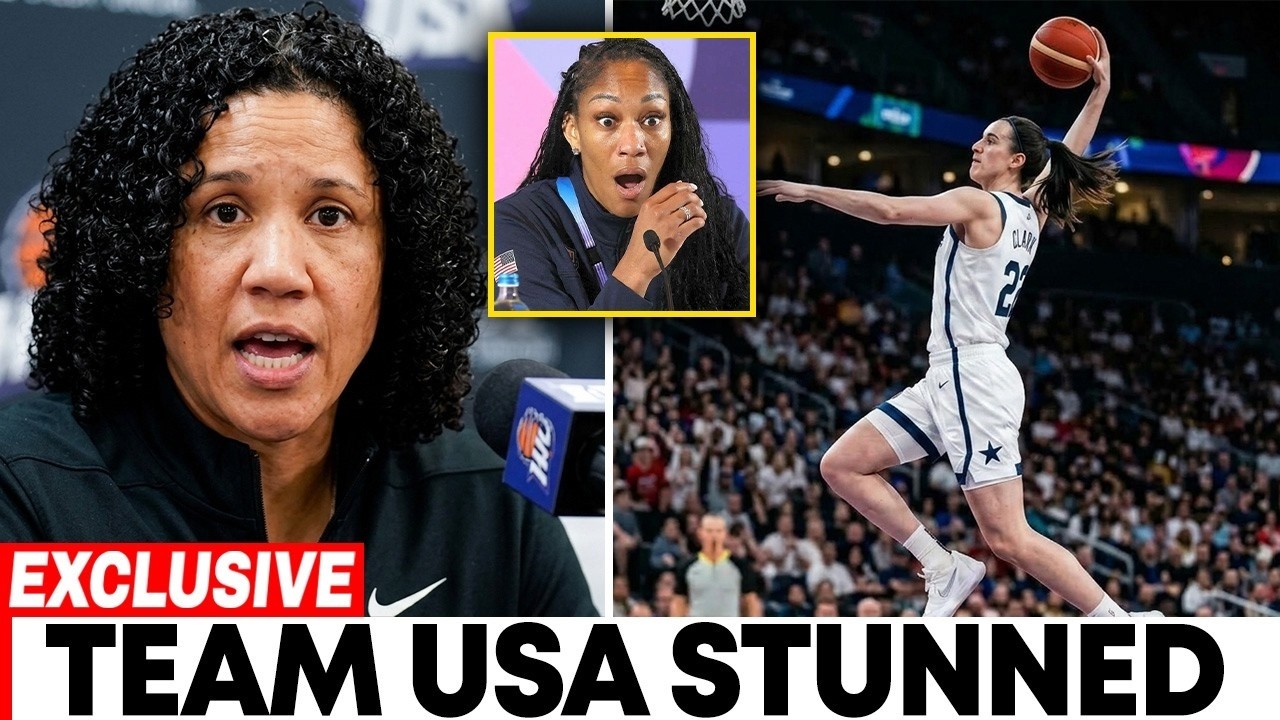
Their departures generated immediate speculation online, especially among commentators attempting to connect Wilson’s absence to Clark’s rapidly expanding influence within the national program.
The most sensational version suggested Wilson had somehow been pushed aside after an internal confrontation involving Clark, veteran teammates, or a supposedly explosive closed-door practice.
There is no verified evidence supporting that story, and nobody from USA Basketball has publicly described a dispute between Wilson and Clark.
The confirmed explanation is far less theatrical but considerably more important for understanding what Team USA must now accomplish in Berlin.
Wilson, one of the most dominant interior players of her generation, withdrew for health reasons while producing another MVP-caliber WNBA season.
Plum, another experienced guard with championship credentials, also left the roster for health reasons before the tournament began.
USA Basketball responded by adding Washington Mystics teammates Kiki Iriafen and Sonia Citron, giving the final roster a younger and noticeably different identity.
That sequence represents the verified roster shakeup: two established veterans became unavailable, and two rising players were asked to help defend America’s world championship.
It does not require an invented feud, secret ultimatum, or dramatic confrontation to become one of the tournament’s most consequential stories.
Wilson’s absence matters because she was never simply another high-profile name on a roster already overflowing with talent.
She was the interior anchor Team USA could trust when possessions slowed down, perimeter actions failed, or an opponent forced the Americans into a physical half-court battle.
At her best, Wilson gives an offense a reliable solution that requires almost no complicated preparation: deliver the ball inside and allow her to overpower the matchup.
She also protects the rim, controls the glass, and demands enough defensive attention to create easier opportunities for every teammate positioned around her.
Removing that combination from any lineup changes more than the scoring column, even when the available replacements are exceptionally talented.
Without Wilson, Team USA cannot depend on the same overwhelming post advantage whenever a disciplined opponent disrupts its preferred actions.
The Americans must manufacture efficient shots differently, relying more heavily on speed, spacing, rapid decisions, ball movement, and pressure created from the perimeter.
That is precisely why Clark’s importance could grow dramatically as the tournament moves from pool play into more demanding elimination games.
Clark does not replace Wilson positionally, physically, or defensively, and presenting the roster change as a direct exchange would misunderstand both players.
What Clark can replace is the dependable source of offensive creation that Team USA loses whenever Wilson is unavailable to rescue a difficult possession.
Instead of solving problems through power in the post, Clark solves them by forcing defenders to process the entire floor at an uncomfortable speed.
Her shooting range stretches coverage, her passing punishes delayed rotations, and her willingness to advance the ball immediately turns defensive rebounds into scoring chances.
Those qualities were already visible long before Wilson’s health-related withdrawal created additional responsibility within the roster.
Clark earned her place through performance, not rumor, beginning with the qualifying tournament that secured Team USA’s position in the World Cup.
During the March 2026 qualifying competition in Puerto Rico, Clark joined Paige Bueckers and Angel Reese in helping the senior national team complete its central objective.
She did more than contribute to qualification, because tournament organizers selected her as the event’s most valuable player during her first meaningful senior international competition.
That award matters because it provides independent evidence of Clark’s influence against experienced international opponents in games carrying genuine consequences.
It was not a fan vote, a social-media campaign, or an unofficial honor created to capitalize on her enormous popularity.
It was recognition produced by an actual tournament after evaluators watched her control games in a national-team environment.
Clark then returned to the WNBA and continued building the statistical case that her qualifying performance was not an isolated achievement.
Her 2026 season began unevenly as a persistent back problem limited her rhythm and contributed to the Indiana Fever’s inconsistent 4-4 opening.
Once healthier, she produced one of the strongest stretches of her professional career and helped Indiana establish itself among the Eastern Conference’s leading teams.
Across three games against Washington, Chicago, and Connecticut, Clark scored 76 combined points while collecting 20 assists and 13 rebounds.
She also recorded 32 points and 10 assists during an overtime victory over Chicago, securing the 22nd double-double of her WNBA career.
By the end of July, she had appeared in 24 games, scored 515 points, and delivered 189 assists.
Those numbers helped push the Fever toward an 18-10 record and third place in the Eastern Conference during the season described in the original report.
Clark also reached 10 career games containing at least 25 points, five three-pointers, and five assists, entering rare statistical territory associated with Diana Taurasi.
That résumé explains why an expanded role in Berlin would not represent special treatment or a decision based entirely on commercial attention.
Clark had already proven she could command meaningful international games, produce against WNBA defenses, and elevate teammates through pace and passing.
She is also entering the tournament alongside an unusually gifted debut class rather than attempting to carry an inexperienced group by herself.
Bueckers arrives after a breakout professional season, while Reese continues developing into one of basketball’s most physical and persistent rebounders.
Together, the three newcomers give Team USA youth, energy, and contrasting skills that can change the character of a game within a few possessions.
Clark nevertheless holds a unique distinction within that group because she left the qualifying tournament with its MVP trophy.
That context strengthens her case without diminishing Bueckers or Reese, both of whom remain capable of becoming central figures during the World Cup.
The coaching structure surrounding Clark makes the situation even more intriguing, especially when speculation is replaced by an examination of who will design Team USA’s offense.
Cara Lawson has led the senior women’s national team since September 2025, with a mandate extending through the 2028 Los Angeles Olympics.
Before accepting the head-coaching position, Lawson served as an assistant on two gold-medal national teams and developed extensive experience within USA Basketball’s system.
She then won the 2025 FIBA Women’s AmeriCup with a roster largely composed of college players facing more experienced international competition.
That achievement demonstrated Lawson’s willingness to trust young talent and adapt tactically instead of relying exclusively on established reputations.
Her World Cup staff also includes three active WNBA head coaches: Natalie Nakase, Nate Tibbetts, and Indiana Fever coach Stephanie White.
White’s presence may be especially significant because she has spent an entire WNBA season studying how Clark affects defenses on a nightly basis.
She has coached through Clark’s injuries, shooting fluctuations, explosive scoring performances, transition attacks, and the difficult process of building chemistry around an unconventional playmaker.
Nobody else on the national-team staff possesses the same recent, detailed experience constructing an offense around Clark’s particular combination of range, vision, and speed.
That familiarity does not guarantee Clark will start, dominate the ball, or receive unlimited freedom throughout the tournament.
It does guarantee that Team USA’s coaches have direct access to someone who understands which actions best unlock Clark and which lineup combinations maximize her influence.
If the offense increasingly shifts toward Clark, the most logical explanation will be roster construction and tactical necessity rather than an internal power struggle.
Wilson’s withdrawal removes the team’s premier interior safety valve, requiring Lawson and her assistants to identify another dependable method for creating offense under pressure.
Clark’s ability to generate advantages from the perimeter offers the clearest alternative because it can produce efficient opportunities without requiring a dominant post matchup.
She can pull defenders several feet beyond the three-point line, attack the resulting space, and deliver passes before the defense completes its rotation.
That style becomes particularly valuable against international teams whose coordination and physicality can neutralize basic isolation basketball.
Instead of waiting for a late-clock mismatch, Team USA can use Clark’s movement and passing to force opponents into repeated decisions across the entire possession.
Every screen becomes more dangerous because defenders must respect her shooting range, and every hard cut becomes more valuable because she searches for it immediately.
Reese, Iriafen, Citron, and the roster’s other energetic young players could benefit enormously from playing beside a guard who consistently rewards movement.
Veterans including Breanna Stewart, Napheesa Collier, Chelsea Gray, Jackie Young, and Kahleah Copper still provide the championship experience necessary for difficult tournament moments.
The challenge for Lawson is not choosing youth over experience, but creating combinations that preserve veteran stability while allowing Clark’s pace to reshape the offense.
That balance will become increasingly important if Team USA encounters France, Belgium, Australia, or another opponent capable of making the game slow and uncomfortable.
Against weaker competition, America’s depth may eventually produce separation regardless of which lineup starts or controls the first quarter.
Against a genuine championship challenger, several stagnant possessions can create a deficit, energize the opposing crowd, and transform a manageable game into a psychological battle.
Wilson normally reduces that danger because her post scoring gives Team USA somewhere reliable to turn when the offense loses its rhythm.
With that option unavailable, Clark’s creativity may become the mechanism that prevents those dry stretches from developing in the first place.
That possibility is more compelling than the false claim that Wilson abandoned the tournament because she feared Clark’s popularity or resented her expanding role.
Wilson was producing a season worthy of another MVP award, averaging roughly 26 points and nearly 10 rebounds while leading the league in blocked shots.
She had also extended her game beyond the paint by adding a more dependable three-point threat to an already devastating offensive arsenal.
Nothing in that performance suggests a player retreating from competition or protecting herself from another star’s arrival.
Her withdrawal should therefore be treated as a legitimate health matter, not converted into evidence for an unsupported personal conflict.
Respecting that distinction does not make the story less dramatic; it directs attention toward the basketball consequences that will actually determine Team USA’s tournament.
The Americans have lost an irreplaceable interior superstar and must now discover whether a younger, faster offensive identity can compensate for that absence.
Clark enters that experiment carrying international MVP recognition, exceptional WNBA production, and the support of a coaching staff containing her own professional head coach.
Reese and Bueckers bring their own strengths, while Iriafen and Citron arrive with an unexpected opportunity created by circumstances nobody originally anticipated.
The resulting roster may not resemble the one USA Basketball announced in August, but it remains deep enough to compete for a fifth consecutive gold medal.
Its path to that title, however, could look completely different from the formula Team USA expected to use with Wilson controlling the interior.
The defining question is no longer whether Clark deserves to be in Berlin, because her qualifying performance and WNBA résumé have already answered that.
The question is how much responsibility Lawson will place in Clark’s hands when the Americans encounter a defense capable of removing their easiest options.
If Clark becomes the engine of a faster system, it will not mean she defeated Wilson in a hidden battle or seized control through celebrity influence.
It will mean the roster changed, the original offensive structure lost its most powerful centerpiece, and the coaches adapted around the strongest remaining creator.
That is the real Team USA shakeup, and it carries consequences far more meaningful than any fabricated confrontation circulating online.
Wilson’s absence created the opening, but Clark’s performances created the opportunity to fill it long before anyone knew that opening would exist.
Berlin will now reveal whether those two developments combine to produce the Caitlin Clark takeover that supporters have been anticipating.


