Team USA defeated Hungary 108-56 in a commanding World Cup quarterfinal, but the 52-point victory produced a difficult new question for head coach Kara Lawson.
Was the Americans’ most effective combination already sitting on the bench when the game began?
According to the supplied transcript, Caitlin Clark entered during the first quarter and immediately transformed the pace, movement, and efficiency of Team USA’s offense.
Clark reportedly finished with 10 points, nine assists, and a team-leading plus-36 rating in approximately 20 minutes.
Angel Reese became one of her most effective partners, repeatedly converting passes into easy baskets before Hungary’s defense could establish its position.
After the game, Reese publicly praised the developing chemistry between them.
Her comments were not a direct attack on Lawson or Team USA’s veterans.
However, they strengthened the growing argument that the Americans’ younger lineup may offer the best offensive identity for the remaining medal games.
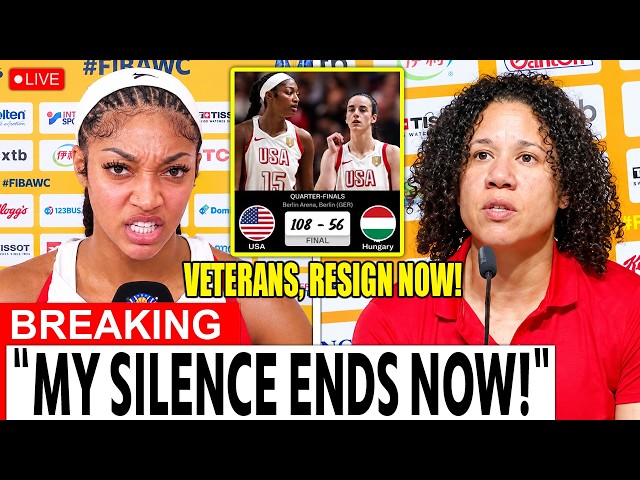
Hungary Remains Competitive During the Opening Minutes
Team USA reportedly led Hungary 18-9 when Clark entered approximately four minutes into the first quarter.
A nine-point advantage represented a solid beginning, but the veteran starting unit had not completely separated from the underdog.
The opening offense appeared slower and more deliberate.
Players occasionally remained stationary while possessions developed through one pass and a difficult attempt.
Hungary was still able to organize its defense, protect the paint, and challenge Team USA’s initial actions.
That changed dramatically after Clark entered.
The transcript claimed the Americans produced an 18-3 run during the following four minutes.
Instead of merely protecting the early lead, the second unit reportedly turned a competitive opening into the beginning of a rout.
The contrast immediately attracted attention because Clark had remained outside the starting lineup for another important game.
Clark Accelerates the Entire Offense
Clark’s greatest influence did not come only through scoring.
Her willingness to advance the ball forced every teammate to recognize transition opportunities immediately.
When she collected possession, wings began running toward open lanes and interior players attacked the basket before Hungary could organize.
The game reportedly became faster within moments.
Passes moved from side to side, players cut without the ball, and shots arrived earlier in the possession.
Hungary’s defense no longer had time to establish comfortable matchups.
The opposing coaches reportedly used early timeouts in an attempt to slow Team USA’s momentum.
Those stoppages did not completely solve the problem.
Clark continued creating advantages through transition passes, pick-and-roll decisions, and movement around the three-point line.
Her presence required Hungary to defend a larger portion of the court while also accounting for every American runner.
Reese Becomes Clark’s Perfect Transition Target
The most encouraging development involved Clark’s chemistry with Angel Reese.
According to the transcript, three of Clark’s nine assists directly produced baskets for Reese.
The connection appeared simple because both players recognized the same opportunities at the same moment.
Clark looked forward immediately after collecting the ball.
Reese sprinted toward the basket with confidence that the pass would arrive in rhythm.
One sequence reportedly began after Clark secured a defensive rebound and quickly pushed the ball ahead.
She located Reese running through the middle and delivered a pass that allowed her teammate to finish without slowing down.
The play required no complicated isolation move.
It depended on recognition, trust, timing, and a shared commitment to attacking before Hungary recovered.
That simplicity made the partnership look surprisingly natural.
Their Rivalry Becomes an Advantage
Clark and Reese have faced each other repeatedly throughout their college and professional careers.
Those matchups created public comparisons, intense fan debates, and a rivalry that often attracted attention beyond basketball.
Playing together for Team USA changed the meaning of that history.
Their experience as opponents may have helped them understand each other’s habits faster than unfamiliar teammates normally would.
Clark already knew how Reese attacked the glass, moved through traffic, and pursued every loose ball.
Reese understood Clark’s willingness to attempt difficult passes and reward teammates who continued running.
Instead of allowing their rivalry to create distance, they appeared to transform it into useful knowledge.
That development could become important for Team USA’s future.
Both players may remain central figures throughout the next Olympic cycle and several international tournaments.
Reese Publicly Praises Clark
Following the victory, Reese was asked about playing alongside Clark.
She reportedly explained that their many previous matchups had helped them understand each other’s tendencies.
Reese said Clark could find her easily and recognized where she preferred to receive the ball.
She also described playing together as enjoyable.
The most forward-looking part of her response concerned their future with Team USA.
Reese suggested they understood they could remain national-team partners for a long time and wanted to continue developing their chemistry.
That statement represented meaningful praise.
It showed that Reese viewed the partnership as more than a temporary quarterfinal success.
However, the comments should not be exaggerated into a direct criticism of Lawson or Chelsea Gray.
Reese did not publicly demand a new starting lineup.
She described a connection that was already producing effective basketball.
Team USA Produces a Historic Passing Display
The Americans reportedly recorded 31 assists on 40 made field goals against Hungary.
The transcript described that total as a Team USA World Cup record.
If confirmed through official tournament records, the figure would demonstrate an extraordinary level of unselfish basketball.
Most American baskets were created through passing rather than individual isolation.
That distribution made Team USA significantly more difficult to defend.
Hungary could not concentrate on one scorer because the ball continued reaching different players in favorable positions.
Clark’s nine assists represented an important part of that total.
Chelsea Gray also reportedly contributed six assists while scoring six points in 18 minutes.
Those numbers reflected productive basketball from the veteran starter.
The argument for Clark was not that Gray performed poorly.
It was that Clark appeared to produce an even greater offensive impact during a similar amount of time.
Collier Thrives Beside the Faster Attack
Napheesa Collier reportedly earned player-of-the-game recognition after scoring 19 points on nine-of-13 shooting.
Her success complicated any simple argument about veterans and younger players.
Collier started the game but also performed extremely well alongside the faster combinations.
That detail suggests the real issue is not age or bench status.
The question concerns which five-player groups create the strongest balance of pace, spacing, defense, and finishing.
Clark’s passing allowed Collier to receive the ball in rhythm instead of waiting for a difficult opportunity to develop.
That difference can improve the efficiency of even the most accomplished scorer.
A strong point guard does not diminish elite teammates.
She makes their responsibilities easier by delivering possession at the correct time and location.
Collier’s performance offered an example of how Clark’s style could support the veterans rather than replace them.
Three-Point Shooting Reflects Better Shot Creation
Team USA reportedly made 12 of its 23 three-point attempts, converting more than 52 percent from beyond the arc.
That accuracy represented a dramatic improvement from the Americans’ earlier struggles.
A strong shooting percentage can result from temporary hot shooting, but shot quality also matters.
The transcript argued that Team USA’s shooters received the ball while already prepared to release.
They did not need to create every attempt through individual dribbling.
Rapid ball movement forced Hungary’s defenders into longer rotations.
By the time the pass reached the perimeter, the shooter often had additional space and better balance.
Clark influenced those opportunities even when she did not receive an official assist.
Her initial pass could force a defensive rotation that created an opening two actions later.
That type of influence cannot always be measured through one box-score category.
Plus-Minus Numbers Strengthen the Debate
The transcript placed significant emphasis on plus-minus production.
Clark reportedly recorded a plus-36 rating, compared with Gray’s plus-21.
It also claimed Clark produced approximately plus-2.57 points per minute, while Gray generated approximately plus-0.74.
Those calculations would indicate a substantial difference in team performance.
However, single-game plus-minus statistics require careful interpretation.
A player’s number depends on teammates, opposing lineups, game situations, and the timing of substitutions.
Clark may have benefited from playing with a particularly effective group against certain Hungarian combinations.
Gray may have faced a different set of tactical responsibilities.
The figures still deserve attention, especially when they support what viewers observed.
They do not independently prove that Clark should replace Gray in every situation.
Why Clark Still Comes Off the Bench
Lawson has reportedly said she likes the current rotation.
That preference may reflect her trust in Gray’s experience, control, and history of performing during high-pressure games.
International tournaments provide little preparation time.
Coaches frequently depend on veterans who already understand defensive terminology, late-game execution, and the emotional demands of elimination basketball.
Starting Gray therefore has a clear basketball explanation.
The controversy develops when Clark repeatedly creates greater pace and separation after entering.
If the reserve guard becomes the primary engine of Team USA’s strongest runs, Lawson must consider whether the starting arrangement remains optimal.
Maintaining a familiar rotation can provide stability.
Refusing to adjust after repeated evidence would become rigidity.
The Duke Connection Is Not Proof of Favoritism
The video highlighted a connection between Lawson and Gray through Duke University.
Lawson serves as Duke’s head coach, while Gray is one of the most accomplished players associated with the school.
The transcript suggested that relationship could influence Lawson’s loyalty to the veteran guard.
That conclusion remains speculative.
A shared institutional connection does not prove favoritism.
Gray’s experience and professional accomplishments provide independent reasons for a national-team coach to trust her.
The rotation should be evaluated through basketball performance rather than assumptions about personal relationships.
If evidence shows Clark’s combinations are consistently more effective, Lawson should adjust regardless of the Duke connection.
If Gray provides advantages during specific matchups, she should continue receiving important minutes.
The relevant standard is function, not biography.
Lawson’s Own Playing Career Is Also Irrelevant
The video further suggested that Clark had surpassed records previously associated with Lawson’s playing career.
It implied that such achievements could create personal discomfort for the coach.
No evidence in the transcript established that Lawson resented Clark’s accomplishments.
Coaches regularly work with athletes who exceed their own playing achievements.
That development does not automatically create jealousy.
Assigning personal motives without proof weakens the stronger tactical argument.
Clark’s performance against Hungary can be evaluated through assists, pace, spacing, and lineup efficiency.
Those basketball facts provide enough material for legitimate criticism.
There is no need to claim Lawson limited Clark because of threatened personal records.
Reese’s Comments Should Not Be Misrepresented
The video’s title claimed Reese “destroyed” Lawson and the veteran players.
Her actual comments, as presented in the transcript, were much more positive and measured.
Reese praised Clark’s ability to understand her game.
She celebrated their chemistry and expressed excitement about continuing their partnership.
Nothing in the quoted response directly insulted Lawson, Gray, or another veteran.
Interpreting the praise as an attack creates unnecessary conflict inside a team preparing for the semifinals.
Reese can appreciate Clark without disrespecting Gray.
She can enjoy a fast transition partnership without rejecting the veteran lineup.
Positive comments about one teammate should not automatically become negative comments about everyone else.
The Young Lineup Deserves More Opportunities
Although the title exaggerated Reese’s words, the performance still creates a reasonable argument for testing the younger unit.
Clark, Reese, Paige Bueckers, and Rhyne Howard reportedly ranked among Team USA’s strongest players in per-minute impact against Hungary.
Their collective speed challenged the defense immediately.
Clark provided passing, Bueckers added versatility, Howard supplied perimeter pressure, and Reese attacked the interior.
Collier’s inclusion among the most effective performers showed that the lineup does not need to become a strict generational division.
The best group may combine emerging stars with established veterans.
Lawson’s responsibility is to identify those combinations rather than treating starters and reserves as permanent political categories.
A flexible rotation can preserve veteran leadership while rewarding the groups producing the strongest basketball.
Spain and Australia Present Greater Challenges
A 52-point victory allows Team USA to recover from slow stretches without serious consequences.
Future opponents may not provide the same margin for error.
The transcript specifically mentioned Spain and Australia as teams capable of punishing a sluggish American start.
Those opponents possess shooting, experience, and tactical discipline.
If Team USA allows them to establish an early rhythm, a reserve-unit rescue may arrive too late.
Lawson must determine whether Clark’s faster approach should be used from the opening tip or introduced strategically after the game begins.
The decision should reflect matchup analysis rather than a general rule about seniority.
Some opponents may struggle against Gray’s deliberate control.
Others may become vulnerable when Clark immediately stretches the floor and creates transition pressure.
Starting and Closing Are Different Decisions
The public debate has focused heavily on whether Clark should start.
The more important question may be whether she closes competitive games.
A starting position guarantees an appearance during the opening minutes, but it does not necessarily determine who receives the decisive possessions.
Lawson could continue starting Gray while giving Clark extended minutes whenever her lineup creates momentum.
She could also play the two guards together during important stretches.
Gray can manage difficult half-court situations, while Clark threatens from long range and creates secondary actions.
That combination would prevent opponents from concentrating on a single creator.
It could also remove the false choice between honoring experience and embracing a faster future.
Clark Must Continue Earning the Role
Clark’s performance against Hungary strengthened her case, but no national-team position should become permanent after one game.
She must continue defending, protecting the ball, taking quality shots, and adapting to different opponents.
Her nine assists demonstrated excellent creation.
Her chemistry with Reese showed that she could quickly build effective partnerships.
The remaining medal games will test whether those qualities survive greater pressure.
Opponents will study her preferred passes and attempt to disrupt transition opportunities.
They may trap her farther from the basket or force her toward uncomfortable areas.
Clark’s response will determine whether she can become Team USA’s primary long-term point guard.
Team USA Needs Unity Before the Semifinal
The Americans should not allow an online debate to divide veterans and younger players.
Every member of the roster contributes a different advantage.
Gray provides experience.
Clark supplies pace and creative passing.
Collier offers efficient scoring and versatility.
Reese delivers energy and rebounding pressure.
Bueckers adds another intelligent creator capable of adapting to several roles.
Lawson must combine those strengths into a cohesive system rather than allowing public arguments to define the team.
The players also need to avoid interpreting lineup decisions as judgments of personal worth.
Tournament success depends on responding collectively when different combinations are required.
A Victory That Creates a Necessary Question
Team USA’s 108-56 victory over Hungary demonstrated overwhelming depth and offensive potential.
Clark’s reported 10 points, nine assists, and plus-36 rating made her one of the game’s most influential players.
Reese’s praise confirmed that their partnership already feels natural and productive.
Her comments did not attack Lawson or the veterans, but they highlighted a connection the coaching staff should continue developing.
The question facing Lawson is no longer whether Clark can organize Team USA’s offense.
She has repeatedly demonstrated that ability.
The question is how much meaningful responsibility the coach will give her when the next opponent can match the Americans’ talent and discipline.
If Lawson expands the successful young combinations while preserving the veterans’ strengths, Team USA may become even more dangerous.
If she follows a fixed hierarchy despite clear performance differences, criticism will intensify with every difficult possession.
Hungary could not punish the Americans for their slower start.
A stronger semifinal opponent might.
The path to gold may depend on whether Lawson recognizes that Clark and Reese are not merely an entertaining reserve partnership.
They could become the foundation of Team USA’s next great international era.


