BERLIN — Caitlin Clark has become the central figure in one of the loudest debates surrounding Team USA at the 2026 FIBA Women’s Basketball World Cup.
The argument is simple.
Should Clark be starting?
The internet has offered a much more dramatic version.
A viral video claims basketball legend Larry Bird personally entered the controversy and publicly attacked head coach Kara Lawson over Clark’s role.
The same narrative later claims NBA commissioner Adam Silver privately pressured USA Basketball officials because Clark was being marginalized on the international stage.
Those allegations would represent enormous developments if verified.
At this point, credible public evidence supporting either claim is lacking.
The basketball evidence, however, is very real.
And it may be powerful enough without celebrity intervention.
CAITLIN CLARK’S WORLD CUP HAS ALREADY BECOME HISTORIC.
Clark entered the tournament without a guaranteed starting role.
Lawson instead opened with a veteran-heavy lineup featuring Chelsea Gray at point guard.
That decision immediately attracted attention.
Clark is one of the most recognizable players in women’s basketball.
She is also one of its most aggressive playmakers.
Yet Team USA chose experience to begin games.
Clark was asked to provide impact from the bench.
Against China, she did considerably more than that.
CLARK ENTERED AGAINST CHINA AND CHANGED THE GAME.
The United States defeated China 94-61 in its tournament opener.
Clark finished with 14 points.
She made three three-pointers.
She collected three rebounds.
Most importantly, she recorded 11 assists without committing a turnover.
FIBA later confirmed that the performance carried genuine historical significance.
Clark became the first player in Women’s World Cup history to record at least 10 assists without a turnover.
That achievement immediately changed the conversation.
ELEVEN ASSISTS WITHOUT A TURNOVER IS NOT NORMAL.
International point guards operate under enormous pressure.
Passing lanes close quickly.
Defenders are physical.
Zone defenses can create unusual angles.
Transition opportunities disappear within seconds.
Clark still produced 11 assists.
She did it without surrendering possession once.
That is not merely spectacular passing.
That is control.
It is also exactly the type of performance that makes supporters question why Clark should wait on the bench before influencing a game.
LAWSON HERSELF PRAISED CLARK’S IMPACT.
After the China victory, Lawson did not attempt to minimize Clark’s contribution.
FIBA quoted the coach describing Clark as “terrific” and highlighting how she changed the tempo while creating 11 assists.
That matters.
The verified public comments do not resemble a coach openly attempting to sabotage a player.
They resemble a coach recognizing what worked.
The disagreement begins with how Lawson chooses to use that weapon.
THE STARTING QUESTION REMAINED UNANSWERED.
Despite the historic performance, Clark continued to come from the bench.
Chelsea Gray remained the starting point guard.
That became increasingly controversial because the two players represent dramatically different styles.
Gray brings control.
Experience.
Half-court organization.
Championship pedigree.
Clark brings acceleration.
Deep shooting gravity.
Transition playmaking.
And an almost immediate desire to move the basketball forward.
Neither style is inherently wrong.
The question is which style makes Team USA most dangerous.
ITALY TURNED THAT QUESTION INTO A NATIONAL DEBATE.
The Americans’ second game looked nothing like the China victory.
Team USA barely survived Italy, 55-52.
The offense became slow.
Shots stopped falling.
Italy successfully turned the contest into a half-court battle.
Clark struggled too.
She scored only one point.
She went 0-for-6 from the floor.
She recorded one assist and committed two turnovers.
That game demonstrated an important truth.
Clark is not immune to difficult nights.
BUT TEAM USA’S ENTIRE OFFENSE STRUGGLED AGAINST ITALY.
It would be misleading to isolate Clark’s poor performance.
The Americans collectively experienced one of their worst offensive outings in recent World Cup history.
Spacing disappeared.
Three-point shooting collapsed.
Italy controlled tempo for long stretches.
The United States survived through defense and free throws rather than offensive brilliance.
That performance fueled criticism of Lawson’s rotations.
Fans wanted more speed.
They wanted more movement.
They wanted Clark handling the basketball.
THEN CZECHIA PROVIDED ANOTHER RESPONSE.
Team USA quickly rebounded.
The Americans defeated Czechia 105-64.
Clark again came from the bench.
She finished with nine points and seven assists in 22 minutes.
Her plus-minus was plus-22.
Once again, Clark influenced the game primarily through distribution rather than individual scoring.
That distinction is central to understanding her role on this roster.
Team USA does not need Caitlin Clark to become a 30-point scorer every night.
It needs her to create advantages.
CLARK’S COURT VISION MAY BE HER MOST VALUABLE INTERNATIONAL WEAPON.
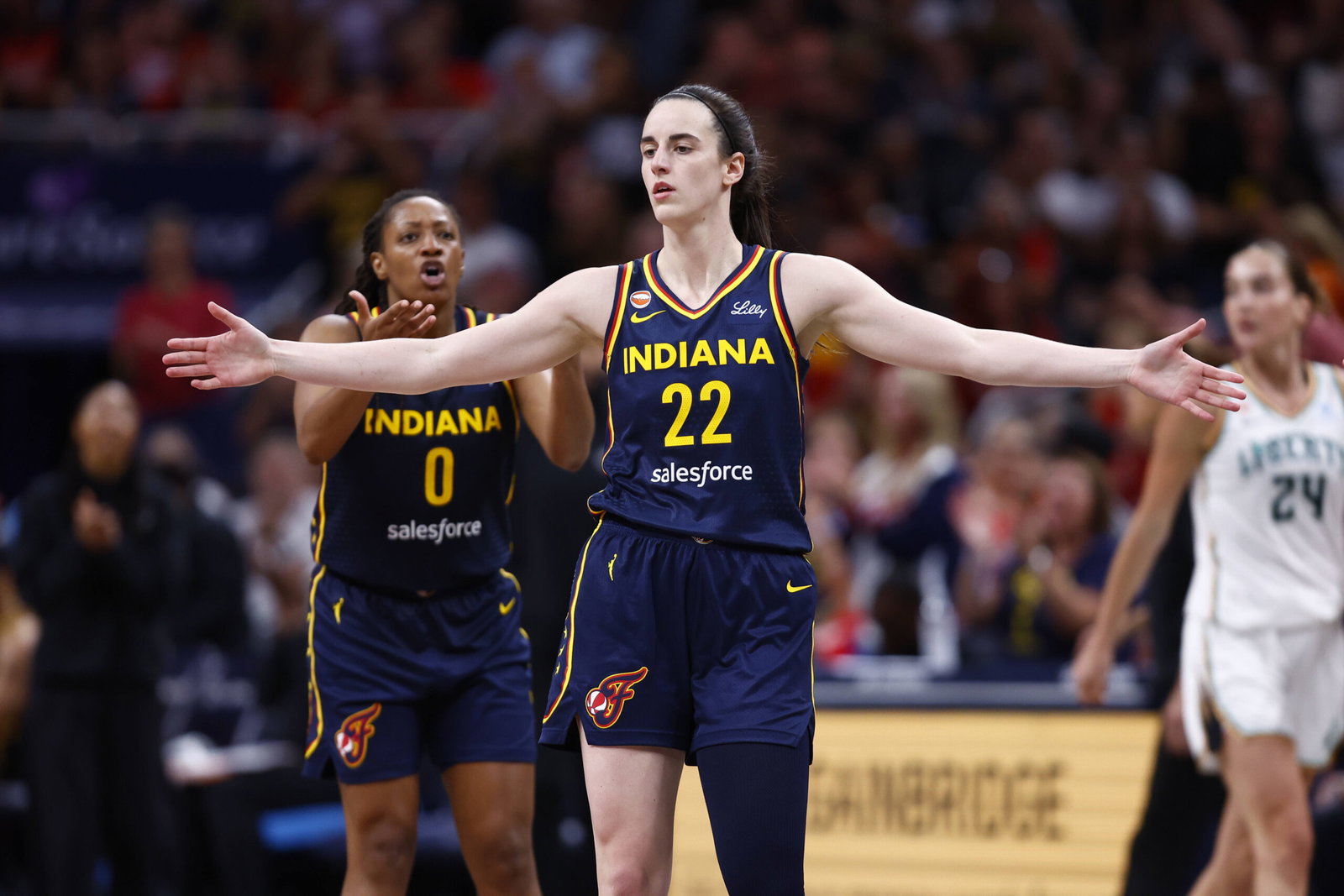
The American roster is filled with elite scorers.
Breanna Stewart can finish.
Napheesa Collier can finish.
Paige Bueckers can finish.
Rhyne Howard can shoot.
Aliyah Boston can attack inside.
That means Clark’s greatest responsibility may be finding the correct player at the correct moment.
Her passing converts talent into structure.
That is different from simply accumulating assists.
Clark can alter how defenders position themselves before the pass even occurs.
HER SHOOTING RANGE CHANGES THE GEOMETRY.
Defenders cannot treat Clark like an ordinary guard.
She can shoot several feet beyond the traditional three-point line.
That forces defensive coverage outward.
Once a defender moves farther from the basket, additional space appears behind her.
That space can become a driving lane.
It can become a cutting lane.
It can become room for Boston to roll.
It can become an open three for Howard.
This is why Clark influences possessions without touching the ball.
THE LARRY BIRD STORY SOUNDS EXPLOSIVE.
The source video claims Bird publicly questioned Lawson’s treatment of Clark.
It even portrays Bird as confronting the coach over her decision to keep Clark in a reserve role.
That would be extraordinary.
Bird remains one of the most respected players in basketball history.
His connection to Indiana makes the story even more emotionally powerful.
But a powerful narrative is not automatically a verified one.
No reliable report reviewed for this article establishes that Bird publicly attacked Lawson over the World Cup rotation.
BIRD HAS TALKED ABOUT WATCHING CLARK BEFORE.
There is nothing unusual about linking Bird and Clark in a basketball discussion.
Both are iconic figures associated with Indiana basketball culture.
Bird has previously acknowledged watching Clark play.
Clark has also frequently been compared with transformative figures who changed how audiences followed the sport.
But those general connections do not prove the specific confrontation described in the viral video.
That distinction is essential.
THE SAME CAUTION APPLIES TO ADAM SILVER.
The transcript goes further.
It claims Silver became angry over Clark’s minutes and privately intervened with USA Basketball.
Again, such a development would be enormous.
But the verified record shows something different.
Silver has publicly discussed Clark.
In July, he called her an “incredible player” and said it was unfair that she had become a “political football” in broader debates surrounding the WNBA.
Those comments were real.
SILVER’S VERIFIED COMMENTS WERE ABOUT THE WNBA, NOT LAWSON’S WORLD CUP ROTATION.
Silver was discussing physical play, officiating controversies and the politicization surrounding Clark.
He was not publicly criticizing Lawson.
He was not discussing Chelsea Gray.
He was not directing Team USA’s starting lineup.
That matters.
A real quote from Silver cannot be stretched into evidence of an unrelated private confrontation without additional reporting.
No such reporting has been established here.
THE REAL ROTATION CONTROVERSY DOES NOT NEED AN NBA COMMISSIONER.
Clark’s basketball gives critics plenty to discuss.
Through group play, she averaged 6.3 assists.
That ranked third in the tournament at the time.
Her China performance produced 11.
Her Czechia performance produced seven.
Those numbers made her one of the World Cup’s most productive distributors despite coming from the bench.
That is the legitimate argument.
LAWSON HAS CONTINUED TO TRUST HER STARTERS.
The coach has defended the veteran starting unit.
Gray provides international experience.
Jackie Young brings two-way ability.
Kahleah Copper attacks aggressively.
Stewart and Collier provide extraordinary versatility.
Lawson clearly believes that group creates stability to begin games.
Clark then enters and changes the rhythm.
That may be intentional.
Using an explosive playmaker as a change-of-pace weapon is a legitimate coaching strategy.
THE COUNTERARGUMENT IS OBVIOUS.
Why wait?
If Clark can change the tempo, why not establish that tempo immediately?
If her shooting gravity opens space, why not create that space from the first possession?
If her passing creates easy opportunities, why spend several minutes playing without it?
Those are legitimate tactical questions.
They do not require accusations about jealousy or political agendas.
They can be answered using basketball.
THE QUARTERFINAL AGAINST HUNGARY PROVIDED NEW EVIDENCE.
Team USA entered the knockout stage facing Hungary.
The result was devastating.
USA won 108-56.
The Americans scored 36 points in the first quarter.
They led 59-30 at halftime.
They finished with 31 assists.
FIBA confirmed that several World Cup quarterfinal records fell during the performance.
Suddenly, the conversation changed again.
TEAM USA DID NOT LOOK STAGNANT AGAINST HUNGARY.
The Americans overwhelmed Hungary with pace, shooting and defensive pressure.
They shot nearly 59 percent from the field.
They made 12 three-pointers.
They forced 27 turnovers.
Every player scored.
Five Americans reached double figures.
That was not a one-player performance.
It was collective dominance.
And it demonstrated exactly why Lawson continues emphasizing depth.
CLARK STILL FOUND A WAY TO CONTROL THE GAME.
Clark did not need to dominate scoring.
Instead, she nearly produced another double-double through passing.
She recorded nine assists.
FIBA’s own tournament feature showed her assist progression clearly.
Eleven against China.
One against Italy.
Seven against Czechia.
Nine against Hungary.
That totals 28 assists across four games.
Her identity as Team USA’s most dynamic facilitator continues to grow.
THE HUNGARY GAME ALSO DESTROYS THE SIMPLE “VETERANS VERSUS YOUTH” NARRATIVE.
Napheesa Collier led the Americans with 19 points.
She earned Player of the Game honors.
Stewart remained productive.
Younger players contributed.
The bench contributed.
Clark distributed.
Everyone scored.
That is what Team USA is supposed to look like.
The strongest version of the Americans does not require one generation defeating another.
It requires integration.
PAIGE BUECKERS HAS BECOME PART OF THAT INTEGRATION.
Bueckers provides another modern playmaking option.
Her game differs from Clark’s.
Clark creates extreme pressure from distance.
Bueckers manipulates intermediate spaces.
Clark wants early offense.
Bueckers can patiently attack after the defense shifts.
Together, they give Lawson multiple ways to break an opponent.
That pairing may become increasingly important in the semifinals.
ANGEL REESE HAS ALSO FOUND A ROLE.
Reese entered the tournament carrying enormous public attention because of her history with Clark.
Inside Team USA, the focus has been more practical.
Rebound.
Defend.
Run.
Finish.
Reese and Clark have publicly emphasized that they enjoy playing together.
That undercuts another popular online narrative suggesting the American locker room is divided into hostile camps.
Competition does not automatically equal personal warfare.
TEAM USA HAS NOW WON FOUR STRAIGHT WORLD CUP GAMES.
China fell by 33.
Italy nearly produced a historic upset.
Czechia lost by 41.
Hungary lost by 52.
Four games.
Four victories.
The Americans are now in the semifinals.
The result against Hungary also extended their World Cup winning streak and produced one of the strongest knockout performances in tournament history.
That context matters when evaluating Lawson.
CRITICIZING LAWSON IS FAIR.
Fans can dislike the starting lineup.
They can believe Clark should replace Gray.
They can prefer Bueckers alongside Clark.
They can question why the offense sometimes becomes slower with certain groups.
That is legitimate sports analysis.
Lawson’s decisions should be judged.
Every elite coach’s decisions should be judged.
But criticism becomes weaker when it relies upon unsupported stories.
CLAIMING LAWSON IS DELIBERATELY SABOTAGING CLARK REQUIRES EVIDENCE.
The source repeatedly suggests intentional suppression.
It portrays Clark’s bench role as proof of a larger hierarchy protecting veterans.
That conclusion is not established by the verified facts.
Clark has received substantial minutes.
She leads important possessions.
Lawson has publicly praised her.
Clark continues producing assists.
Team USA continues winning.
One can argue the role should be larger without claiming the current role is malicious.
CLARK HERSELF HAS NOT PUBLICLY DECLARED WAR ON THE COACHING STAFF.
This may be the most important detail.
Clark’s public comments have generally focused on teammates, chemistry and representing Team USA.
She has not used press conferences to demand a starting position.
She has not publicly attacked Gray.
She has not accused Lawson of sabotage.
The emotional temperature surrounding Clark is frequently created around her rather than by her.
That difference should not be ignored.
THE SEMIFINALS WILL CREATE AN EVEN HARDER TEST.
Team USA’s 108-point explosion against Hungary was impressive.
The next opponent will be stronger.
Knockout basketball becomes increasingly unforgiving.
Defenses become more sophisticated.
Possessions become more valuable.
The Americans may need both Gray’s experience and Clark’s speed.
That is not a contradiction.
It is roster depth.
CLARK’S NINE ASSISTS AGAINST HUNGARY MAY BE A PREVIEW.
The scoring will fluctuate.
Passing may remain more consistent.
Clark can contribute even when she does not shoot efficiently.
That is enormously valuable on a roster with so many finishers.
A nine-assist quarterfinal performance illustrates the point perfectly.
She can influence a blowout without becoming the leading scorer.
She can make five teammates look dangerous at once.
THIS IS WHAT MAKES THE STARTING DEBATE SO INTERESTING.
Clark supporters see a player capable of making everyone better.
Lawson sees a roster where everyone must accept a role.
Those perspectives are not mutually exclusive.
Clark can deserve more responsibility while still embracing a bench role.
Lawson can trust veterans while increasingly using Clark in decisive stretches.
The important question is whether the rotation remains responsive to what happens on the floor.
LARRY BIRD DOES NOT NEED TO SETTLE THAT QUESTION.
Neither does Adam Silver.
The film can settle it.
The statistics can settle it.
The scoreboard can settle it.
If Team USA repeatedly plays better with Clark controlling possessions, the coaching staff will have to respond.
If the current starting group continues producing dominant openings, Lawson will have evidence supporting her strategy.
That is how basketball decisions should evolve.
THE HUNGARY VICTORY STRENGTHENS LAWSON’S POSITION.
USA did not merely win.
It produced a historically dominant quarterfinal.
FIBA confirmed the 108 points were the most ever scored by a team in a Women’s World Cup quarterfinal.
The Americans also became the first quarterfinal team to record at least 30 assists.
Those numbers make it difficult to argue that the entire system is fundamentally broken.
It clearly is not.
BUT CLARK’S PLAYMAKING ALSO STRENGTHENS HER CASE.
Both statements can be true.
Lawson’s team is winning.
Clark deserves enormous responsibility.
The debate does not have to produce one villain and one hero.
It can simply involve a championship coach deciding how to maximize one of basketball’s most unusual talents.
That is a far more realistic story.
THE VERIFIED FACTS ARE ALREADY DRAMATIC.
Caitlin Clark arrived at her first Women’s World Cup.
She immediately set an assist record.
She became the first player in tournament history with at least 10 assists and zero turnovers.
She struggled against Italy.
She recovered against Czechia.
Then she distributed nine assists in a record-breaking quarterfinal rout.
That is an exceptional international debut tournament.
No invented confrontation is necessary.
CLARK IS HELPING TEAM USA REDEFINE ITS OFFENSE.
Her deepest contribution may be structural.
Clark forces defenses to expand.
She makes transition more dangerous.
She rewards cutters.
She finds shooters.
She creates shots before opponents realize they are vulnerable.
Those qualities are not dependent upon starting introductions.
But the more consistently they work, the more difficult it becomes to limit her minutes in important games.
LAWSON NOW FACES A DIFFERENT PROBLEM.
It is a good problem.
Too many elite players.
Too many possible lineups.
Too many players deserving responsibility.
USA Basketball coaches have faced versions of this problem for decades.
The difference is the extraordinary attention surrounding Clark.
Every substitution becomes news.
Every bench stretch becomes a theory.
Every quote becomes evidence for somebody’s argument.
Lawson must coach through that noise.
THE SEMIFINAL WILL MATTER MORE THAN THE VIRAL STORIES.
The Americans are now two victories away from another world championship.
That is the reality.
Larry Bird’s


