Some basketball victories answer every question.
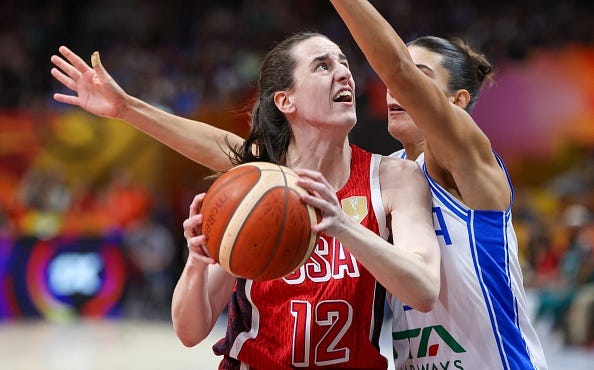
Team USA’s 55–52 escape against Italy did the opposite.
The Americans stayed undefeated and advanced, but the performance exposed vulnerabilities that the final score could not hide.
For a program accustomed to overwhelming international opponents, surviving by three points immediately changed the conversation.
The offense stalled.
The shooting disappeared.
The tempo slowed.
And suddenly, Team USA looked far more ordinary than its roster suggested.
That is why the Italy game matters.
It was not simply a bad night.
It was a warning about what can happen when an opponent removes Team USA’s preferred rhythm.
Just days earlier, the Americans looked nearly unstoppable against China.
Team USA opened the tournament with a 94–61 victory.
Caitlin Clark immediately looked comfortable on the international stage.
She finished with 14 points and 11 assists.
Paige Bueckers scored 14.
Rhyne Howard added 14.
Angel Reese attacked the glass.
The ball moved quickly, and the Americans repeatedly created opportunities before China could organize its defense.
That version of Team USA looked terrifying.
Then Italy forced the Americans into something completely different.
Instead of allowing transition basketball, Italy slowed everything down.
Possessions became physical.
Half-court execution became essential.
Every missed shot increased the pressure on the next possession.
Team USA scored 19 points in the opening quarter.
Over the final three quarters, the Americans produced only 36.
That decline tells the story better than any single player’s box score.
The three-point shooting became particularly ugly.
Team USA finished one-for-12 from beyond the arc.
Overall, the Americans reportedly shot 16-for-56 from the field.
That is roughly 29 percent.
For a roster filled with elite professional scorers, those numbers are startling.
Clark was part of the problem.
There is no reason to pretend otherwise.
She missed all six of her field-goal attempts.
She went zero-for-three from deep.
She finished with only one point.
She also recorded one assist, four rebounds, and two turnovers.
It was an extremely difficult offensive performance.
But focusing exclusively on Clark would completely miss the larger lesson.
She was not the only American struggling.
Breanna Stewart also had difficulty shooting.
The offense as a whole failed to consistently create clean opportunities.
That is the more important concern for Cara Lawson.
What happens when Team USA cannot simply overpower an opponent through talent?
Italy provided an answer.
Make the Americans play slowly.
Force them into the half court.
Eliminate easy transition opportunities.
Turn every possession into a difficult decision.
That strategy narrowed the talent gap.
It also increased pressure.
Italy did not need to become more talented than Team USA.
It simply needed to make the game uncomfortable long enough to begin believing an upset was possible.
That belief changed the atmosphere.
The Americans missed.
Italy attacked.
The lead disappeared.
With just over three minutes remaining, Italy reportedly moved ahead 50–49.
That moment should concern Team USA far more than Clark’s individual shooting line.
The defending international powerhouse was suddenly fighting to survive.
That is where Lawson deserves legitimate scrutiny.
There is no evidence presented here that she was intentionally trying to limit Clark.
The stronger question is tactical.
When the offense becomes that stagnant, what adjustment changes the game?
Maybe Clark creates it.
Maybe Bueckers does.
Maybe Jackie Young does.
Maybe the solution is simply faster ball movement.
But something must change.
Too many possessions against Italy appeared uncomfortable and predictable.
That was exactly the environment Italy wanted.
The slower the game became, the less Team USA’s athletic advantage mattered.
The fewer transition opportunities existed, the more every half-court decision carried weight.
That formula can be repeated.
Future opponents now have film.
They can study where Team USA hesitated.
They can see which actions created poor spacing.
They can identify how Italy disrupted the American guards.
That is what makes this performance strategically significant.
Italy lost.
But it may have provided the rest of the tournament with useful information.
France will watch.
Belgium will watch.
Spain will watch.
Australia will watch.
Every serious contender wants to know whether Team USA can be forced away from its preferred style.
Italy suggested the answer might be yes.
Clark becomes especially interesting because her value does not depend entirely on scoring.
Her shooting range stretches defenses even before she touches the ball.
Her passing can accelerate possessions.
Her transition instincts can prevent opponents from establishing their preferred defensive structure.
That was visible against China.
Clark did not simply score 14 points.
She manipulated the defense.
A defender stepping toward her could open a passing lane.
A big retreating toward the paint could create space outside.
A teammate running the floor could receive the ball before the defense recovered.
Those advantages can disappear when the game slows.
Italy found ways to reduce them.
That creates the central challenge for Lawson.
Can Team USA still use Clark’s creativity when an opponent successfully removes transition?
That may require different actions.
Clark can work through high pick-and-rolls.
She can relocate after passing.
She can operate through handoffs.
She can pull defenders away from the paint without dominating every possession.
Team USA should not need Clark to score 30 points.
It needs her to create stress.
That stress can produce opportunities for everyone else.
Bueckers can attack a rotating defense.
Reese can cut into open space.
Young can attack a closeout.
Stewart can receive the ball after help defenders have already moved.
The best offensive system uses Clark’s gravity rather than simply asking her to manufacture difficult shots.
Against Italy, too many possessions seemed to lose that structure.
The Americans survived anyway.
Cecilia Zandalasini helped keep Italy close until the final possession.
She reportedly finished with 14 points.
Italy eventually had an opportunity to tie the game with a three-pointer.
The shot missed.
Team USA escaped 55–52.
Escaped is the correct word.
The Americans did not cruise.
They did not dominate.
They survived.
That distinction matters because of Team USA’s extraordinary international history.
The program has created an expectation that close games should be rare.
When one occurs against an opponent viewed as a significant underdog, every weakness becomes magnified.
But the next game offered crucial context.
Against Czechia, Team USA responded with 105 points.
Stewart bounced back dramatically.
She scored 19 points while adding seven rebounds and six assists in fewer than 17 minutes.
The Americans reportedly shot 53 percent from the field.
They also made seven three-pointers.
Suddenly, the offense looked completely different.
That response prevents the Italy game from becoming proof that Team USA is fundamentally broken.
It was evidence of vulnerability.
Those are different conclusions.
Great teams can have terrible nights.
Great players can miss shots.
Great coaches can make questionable decisions.
One poor performance does not erase everything else.
The important question is what happens afterward.
Team USA answered with a 105-point performance.
That matters.
Clark’s tournament should be evaluated the same way.
Against China, she looked exceptional.
Against Italy, she struggled.
Against Czechia, she returned to productive playmaking.
That sequence is normal basketball.
Players fluctuate.
Opponents create different problems.
The ability to adjust matters more than maintaining a perfect stat line.
That is why blaming Clark for Italy would be too simplistic.
It would be equally simplistic to claim Lawson destroyed the offense by limiting Clark.
The entire team struggled.
The coaching challenge is building enough flexibility that one defensive approach cannot paralyze everyone simultaneously.
That is what knockout basketball demands.
Some opponents will run.
Others will slow everything down.
Some will switch screens.
Others will trap.
Some will protect the paint.
Others will dare Team USA to shoot.
The Americans need multiple answers.
Talent gives Lawson possibilities.
System determines whether those possibilities become useful.
Clark can provide pace.
Gray can provide control.
Bueckers can provide secondary creation.
Young can attack mismatches.
Stewart can score from multiple areas.
Reese can generate extra possessions.
The roster has solutions.
The challenge is using them quickly enough.
That is why the Italy game may ultimately become valuable.
It exposed problems before the medal rounds.
Team USA now knows how uncomfortable its offense can become when the pace disappears.
The players experienced real pressure.
The coaching staff saw what happens when outside shots refuse to fall.
Young players also experienced a type of game they may encounter repeatedly in international competition.
Clark learned something important as well.
International basketball creates different challenges from the WNBA.
Spacing can feel different.
Physicality can be different.
Defensive structures can be more compact.
Certain opponents will make every possession difficult.
That is not necessarily a negative.
Clark’s development will benefit from being forced to solve those problems.
Her first response may fail.
Her next one must improve.
That is what elite point guards do.
The same applies to Team USA.
The program cannot depend entirely on superior individual talent.
The strongest opponents will reduce the value of that advantage through structure.
Italy already demonstrated the concept.
Slow the game.
Stay disciplined.
Make the Americans shoot.
Keep the margin close.
Then allow pressure to become part of the defense.
Once a favorite begins thinking about the possibility of losing, every possession becomes heavier.
Underdogs feel the opposite.
They become freer.
They begin believing.
That psychological shift is dangerous.
Team USA cannot allow stronger opponents to reach that stage comfortably.
The Americans need to establish control earlier.
That does not necessarily mean changing every starter.
It means recognizing the game’s needs faster.
If pace is disappearing, increase pace.
If shooting is failing, create easier interior opportunities.
If the ball stops moving, introduce another creator.
If a lineup becomes stagnant, change it.
Those decisions become more important as the tournament progresses.
The knockout stage does not offer time for stubbornness.
One poor quarter can become elimination.
One missed adjustment can become the defining moment of an entire tournament.
Lawson therefore faces a different coaching challenge now.
She does not need to prove her original rotation was correct.
She needs to prove she can adjust when it is not working.
That distinction matters.
Coaches who become emotionally attached to their preferred structure can miss what the game is telling them.
The best coaches treat the original plan as a starting point.
The opponent provides new information.
Then the plan evolves.
Italy provided Team USA with significant information.
The Americans can be slowed.
They can be forced into difficult half-court offense.
Their shooting can collapse.
Their stars can become uncomfortable.
Those realities are not fatal weaknesses.
Ignoring them would be.
The Czechia response suggests Team USA understands that.
The ball moved better.
Shots fell.
Stewart looked sharper.
The offense regained confidence.
That was exactly what the Americans needed.
Now comes the more difficult test.
Can they maintain those principles when another strong opponent deliberately recreates Italy’s environment?
That is where Clark could become essential.
Her ability to create from unusual distances changes defensive geometry.
She can force defenders into uncomfortable decisions even in the half court.
But Team USA has to structure possessions that allow those strengths to matter.
Clark standing passively on the perimeter does little.
Clark receiving the ball with movement around her changes everything.
The same applies to Bueckers.
A talented secondary creator becomes much more dangerous when attacking a defense already compromised by the first action.
This is where Lawson can blend youth with experience.
The answer does not need to become young players replacing veterans.
It can become younger creativity surrounding veteran stability.
Gray’s experience can still matter.
Stewart’s versatility can still matter.
Collier’s two-way impact can still matter.
Young’s scoring can still matter.
Team USA has enough talent to create several different identities.
The key is knowing when each identity is necessary.
That may determine the medal.
The biggest danger is complacency.
For decades, the United States has entered international tournaments with an intimidating reputation.
Opponents know the history.
They know the championships.
They know the stars.
But reputation does not score.
Italy proved that.
For nearly forty minutes, the Americans had to earn every advantage.
Future opponents will enter with less fear because they saw that film.
They know Team USA can struggle.
They know the Americans can miss.
They know slowing the game can work.
That knowledge gives every underdog confidence.
The United States must respond by becoming more adaptable.
Clark does not need to become the hero every night.
Bueckers does not need to control every possession.
Stewart does not need 20 points.
Reese does not need a double-double.
Team USA needs something more sustainable.
Balance.
Spacing.
Movement.
Defense.
Rebounding.
Veteran composure.
Young energy.
And above everything else, flexibility.
The gold medal will not automatically belong to the roster with the biggest names.
It will belong to the team capable of staying organized when the game becomes ugly.
Italy gave Team USA an early version of that test.
The Americans survived.
Czechia showed they could respond.
Now the tournament becomes less forgiving.
The next opponent will have film.
The next coach will have a plan.
The next close game may not offer Team USA a final missed three to escape.
That is why 55–52 should remain in Lawson’s mind even after a 105-point bounce-back.
The score was not simply an ugly win.
It was information.
It showed exactly how a less talented opponent can shrink the gap.
And once that blueprint exists, every remaining contender will try to improve it.
Team USA is still the favorite.
It is still undefeated.
Its roster remains extraordinarily talented.
But dominance is no longer something the Americans can assume.
They must create it.
Possession by possession.
Adjustment by adjustment.
And the next time Team USA finds itself trapped inside a three-point game with the season hanging in the balance, the real question will finally be answered.
Was Italy simply one terrible shooting night?
Or was it the warning that taught the rest of the world exactly how to make Team USA vulnerable?


