Caitlin Clark’s performance in Berlin became the centerpiece of a much larger argument about basketball, leadership, physical play, and the changing power structure surrounding women’s basketball.
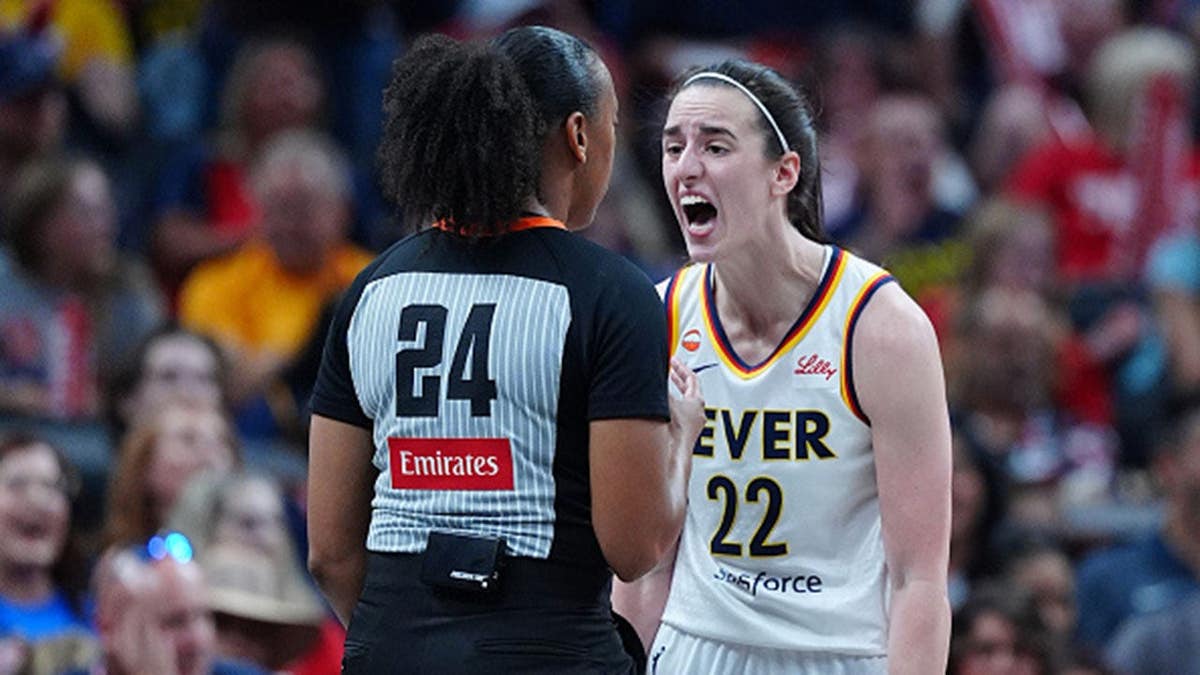
The supplied account portrays September 4, 2026, as a turning point.
According to that narrative, three separate developments collided within hours.
Clark delivered a major international performance against China.
A French television comment criticizing WNBA-style physicality reportedly spread widely online.
The source also connects the moment with news concerning WNBA commissioner Cathy Engelbert’s leadership.
Those developments are presented as interconnected in the source.
That connection should not automatically be treated as established causation.
Clark’s performance can be evaluated through basketball.
Claims that other institutional events occurred because of Clark require separate evidence.
Still, the narrative reveals why her international appearance generated such intense attention.
For months, Clark supporters had argued that the WNBA benefited enormously from her popularity while failing to adequately protect her from excessive physical contact.
The source takes that argument considerably further.
It describes repeated hard fouls as evidence of targeted hostility.
It also portrays veteran players as resisting Clark’s rise because of jealousy and internal hierarchy.
Those motives are not established by the material itself.
Physical basketball does not automatically prove a coordinated effort to suppress a player.
But the perception of unfair treatment became an important part of Clark’s public story.
That perception followed her to Berlin.
Her supporters were not simply watching another international game.
They were waiting to see what Clark might look like in a different basketball environment.
The source frames the World Cup as an opportunity for Clark to escape domestic controversies and demonstrate her value without the same WNBA narratives surrounding every possession.
That expectation intensified when Team USA’s starting lineup was announced.
Clark reportedly began the game against China on the bench.
The source interprets that decision as another example of veteran seniority taking priority over performance.
Chelsea Gray becomes the central comparison.
Gray is presented as an accomplished veteran whose experience made her a natural choice within traditional USA Basketball hierarchy.
Clark represented something different.
She brought pace, extraordinary passing vision, deep shooting range, and an enormous international audience.
The debate was therefore not simply Clark versus Gray.
It was continuity versus transformation.
Team USA could preserve the structure that had produced championships for years.
Or it could reorganize more aggressively around a younger guard whose style had already reshaped professional basketball.
The source strongly favors the second option.
Its argument becomes more compelling when it focuses on style rather than alleged politics.
China reportedly entered the matchup with significant interior size.
The supplied account describes a defense built around protecting the paint and forcing Team USA into slower half-court possessions.
That type of structure can make conventional offense uncomfortable.
Entry passes become difficult.
Driving lanes disappear.
Pick-and-roll actions encounter layers of size.
The source claims Team USA initially struggled against that structure.
Whether every dramatic description is accurate or not, the tactical question is easy to understand.
How should a team attack overwhelming interior size?
One solution is shooting.
Another is pace.
Clark potentially provides both.
A defense centered around a towering interior presence becomes less comfortable when the opposing point guard can threaten from extremely deep range.
The center must decide how far to leave the paint.
Perimeter defenders must decide whether to fight over screens or surrender space.
Those decisions create vulnerabilities.
Clark also attacks before the defense becomes fully organized.
That may be even more important.
A seven-foot center is extremely valuable when positioned correctly.
That same player becomes less dominant while sprinting backward during transition.
Clark’s passing can exploit those moments.
The supplied narrative describes her entering the game and immediately accelerating Team USA’s tempo.
Instead of allowing China to establish its half-court defense, Clark reportedly pushed the ball quickly after rebounds and inbound passes.
That stylistic change becomes the most persuasive part of the story.
Clark does not need every possession to end with her shot.
Her greatest influence may be forcing the defense to make decisions earlier than it wants.
One early pass can produce a layup.
One long outlet can eliminate several defenders.
One deep three can pull a big away from the basket.
The source dramatically describes a long-range Clark shot as the moment the game changed.
From there, the account portrays her as systematically attacking China’s defensive structure.
She reportedly used passing angles, transition reads, and shooting gravity to create opportunities for teammates.
That type of performance explains why assist totals can sometimes describe Clark better than scoring totals.
According to the supplied account, Clark finished with 14 points and 11 assists in Team USA’s 94–61 victory.
Those numbers immediately became central to the argument about her role.
Eleven assists in an international debut represents elite playmaking regardless of surrounding narrative.
The source further describes the total as historically significant for an American debutant.
The larger tactical meaning is equally important.
Clark did not need 30 points to control the game.
She could influence spacing.
She could create transition opportunities.
She could manipulate defensive help.
She could allow other elite players to finish possessions rather than manufacture them.
That is why Team USA’s Clark debate should not focus exclusively on scoring.
Her shooting creates fear.
Her passing converts that fear into opportunities elsewhere.
The best version of Clark basketball often involves four teammates benefiting from decisions made before they even receive the ball.
The supplied narrative depicts the Berlin crowd responding enthusiastically.
It describes international spectators chanting Clark’s name and treating the performance as a major moment.
The scale of those crowd claims would require independent verification.
But Clark’s ability to attract extraordinary attention is central to the source’s argument.
That popularity matters commercially.
It does not determine lineup decisions.
Those two ideas should remain separate.
Cara Lawson’s responsibility is winning basketball games.
She should not start Clark merely because television audiences want Clark.
But if Clark’s basketball style also solves tactical problems, popularity becomes irrelevant to the coaching argument.
Performance becomes enough.
That distinction becomes especially important in evaluating Lawson’s reported postgame remarks.
The source claims Lawson praised Clark’s court vision, passing, and unselfishness after the China victory.
It interprets those comments as a surrender.
That framing is unnecessarily adversarial.
A coach praising a reserve after an outstanding performance does not automatically mean the coach was forced to “bow.”
It can simply mean the player performed well.
The more useful question is whether Lawson’s rotation decisions changed afterward.
Coaches routinely start one group while giving another group critical minutes.
A player can come off the bench and still function as the team’s offensive engine.
That possibility complicates the narrative of suppression.
If Lawson gives Clark substantial responsibility, her official reserve status may be more symbolic than practical.
The source nevertheless treats the starting decision as evidence of a broader veteran hierarchy.
That argument reflects a long-running tension in national-team basketball.
International rosters frequently combine established champions with younger stars.
Experience carries legitimate value.
Veterans understand tournament pressure.
They recognize international defensive schemes.
They have played elimination games.
They know how quickly momentum can shift.
Young talent provides another advantage.
It can offer speed, creativity, and tactical possibilities an established system did not previously possess.
The coach’s challenge is integration.
A great roster should not require choosing one generation and rejecting another.
Clark can play with veterans.
Her passing can make experienced scorers more effective.
Her range can create additional space for established frontcourt stars.
The same veterans can provide defensive stability and late-game composure around her.
That combination may be more dangerous than either group alone.
The French television incident described in the source adds another layer to the story.
According to the account, a French broadcaster reacted to a display of sportsmanship during a game and contrasted it with the WNBA.
The phrase “This isn’t the WNBA” allegedly circulated widely afterward.
The source interprets those words as a global condemnation of the American league.
That is a much stronger conclusion than one commentator’s remark can establish.
Even if accurately quoted, one broadcaster does not represent all international basketball opinion.
But the reported comment would still be culturally significant because of what it reflects.
The WNBA’s physicality around Clark had already become a major online controversy.
International viewers were aware of it.
A joke or criticism referencing the league therefore carried immediate meaning.
That alone tells us something.
The WNBA’s internal debates were no longer confined to American audiences.
Clark had helped globalize the conversation.
International fans were discussing officiating.
They were discussing physical play.
They were discussing veteran reactions.
They were discussing how the league handled its biggest new attraction.
That attention creates pressure on league leadership.
The source directs much of that pressure toward Commissioner Cathy Engelbert.
It argues that the league profited from Clark’s popularity while failing to respond strongly enough to physical treatment she received.
That criticism can be debated.
League commissioners do not personally officiate games.
Disciplinary decisions involve rules, referees, basketball operations, and review processes.
Not every hard foul requires executive intervention.
But commissioners are responsible for the broader health and reputation of their leagues.
If fans increasingly believe officials cannot protect star players, that perception becomes a leadership problem.
The supplied account goes further by linking Engelbert’s reported departure directly to the Berlin developments.
That causal claim is not established by the narrative alone.
Executive departures can result from contracts, internal planning, ownership decisions, personal choices, or broader strategic considerations.
Timing can generate speculation.
Timing does not prove causation.
Clark’s performance should therefore not be presented as having personally forced Engelbert from office without stronger evidence.
The more defensible argument is that Clark’s rise increased scrutiny on every major WNBA decision.
Attendance became more visible.
Television numbers attracted greater attention.
Player safety became a mainstream conversation.
Officiating controversies reached audiences that previously ignored the league.
That changed the pressure environment around leadership.
The source also repeatedly argues that Clark rescued the WNBA financially.
That wording is rhetorically powerful but oversimplified.
A sports league depends on many players, owners, broadcasters, sponsors, employees, and previous generations of athletes.
Clark’s influence can be enormous without erasing everything that existed before her.
The more interesting development is acceleration.
She appears within the source as a force that dramatically accelerated existing growth.
More people watched.
More people discussed games.
More people traveled.
More media organizations followed the league closely.
That creates both opportunity and conflict.
Established players suddenly operate inside a much larger spotlight.
Every foul gets replayed.
Every quote becomes content.
Every perceived slight becomes a national debate.
The source interprets many veteran reactions as jealousy.
That motive cannot simply be assumed.
Players can dislike media narratives without disliking Clark personally.
They can play physically because competition is physical.
They can resent unequal attention without participating in a coordinated effort to harm another athlete.
Those distinctions matter.
Clark’s story remains compelling without converting every opponent into a villain.
Her Berlin performance provides enough drama by itself.
She entered an international tournament carrying enormous expectations.
She came off the bench.
She faced an opponent with imposing interior size.
Then she reportedly delivered 14 points and 11 assists while Team USA won by 33.
That is a powerful sporting narrative.
It also strengthens a specific argument about her role.
Clark’s value travels.
Her passing does not depend exclusively on WNBA spacing.
Her range does not disappear under international rules.
Her ability to create pace can become even more valuable against teams constructed around half-court defense.
Those lessons matter for Lawson going forward.
The coach does not need to surrender to fan pressure.
She does need to respond to evidence.
If Clark consistently generates the best offense, her role should reflect that.
If another combination performs better defensively or against a particular matchup, Lawson should use that combination.
Tournament basketball rewards adaptability.
Starting status should not become ideological.
The source’s biggest mistake is treating Clark’s success as proof that everyone who previously disagreed with her supporters has been defeated.
Basketball rarely works that cleanly.
One brilliant performance does not settle every debate.
It does not prove every critic was acting maliciously.
It does not prove every coaching decision was political.
What it can do is change the evidence available.
Before China, Lawson had a theory about how to structure Team USA.
After Clark’s performance, she had more information.
Clark demonstrated that she could create at an elite international level.
Now the coaching staff can test whether that impact remains consistent against different opponents.
That is how roles should evolve.
The same principle applies to the WNBA.
The league must learn from the Clark era without turning every issue into a referendum on one player.
Protecting player safety matters.
Consistent officiating matters.
Promoting stars matters.
Respecting veteran players matters.
Allowing intense competition matters.
Those goals can coexist.
The real challenge is balancing them while the audience expands faster than the league’s culture can comfortably adjust.
That may ultimately be what Berlin symbolizes.
Not the destruction of an establishment.
Not the coronation of one player over an entire sport.
Something more consequential may be happening.
The center of gravity in women’s basketball is shifting.
Clark is a major reason.
International audiences are watching.
Young stars are receiving responsibility earlier.
Media attention is growing.
Traditional hierarchies are being tested by performance and visibility simultaneously.
That transition will inevitably produce resistance, misunderstanding, and exaggerated narratives.
But it will also produce remarkable basketball.
Clark’s reported 14-point, 11-assist performance against China became one example.
She did not need to publicly attack anyone.
She did not need to demand validation.
She simply created possessions, stretched the floor, and helped Team USA win decisively.
That is ultimately the strongest part of the story.
Everything else remains open to argument.
Was the French broadcast comment truly representative of global opinion?
Did WNBA leadership mishandle Clark’s rise?
Was Team USA too committed to veteran hierarchy?
Did Lawson underestimate how quickly Clark could reshape an international game?
Those questions will continue.
What happened on the basketball court provides a more concrete foundation.
Clark received an opportunity.
She produced.
Now everyone around her must decide what that performance means.
For Lawson, it means another rotation decision.
For Team USA, it means another offensive weapon.
For the WNBA, it means the player driving so much attention continues to expand her influence beyond domestic basketball.
And for Clark, the path forward may remain remarkably simple.
Keep playing.
Because the louder the surrounding arguments become, the more powerful it is when the basketball itself provides the answer.


