Team USA walked away with gold.
France walked away with another painful defeat.
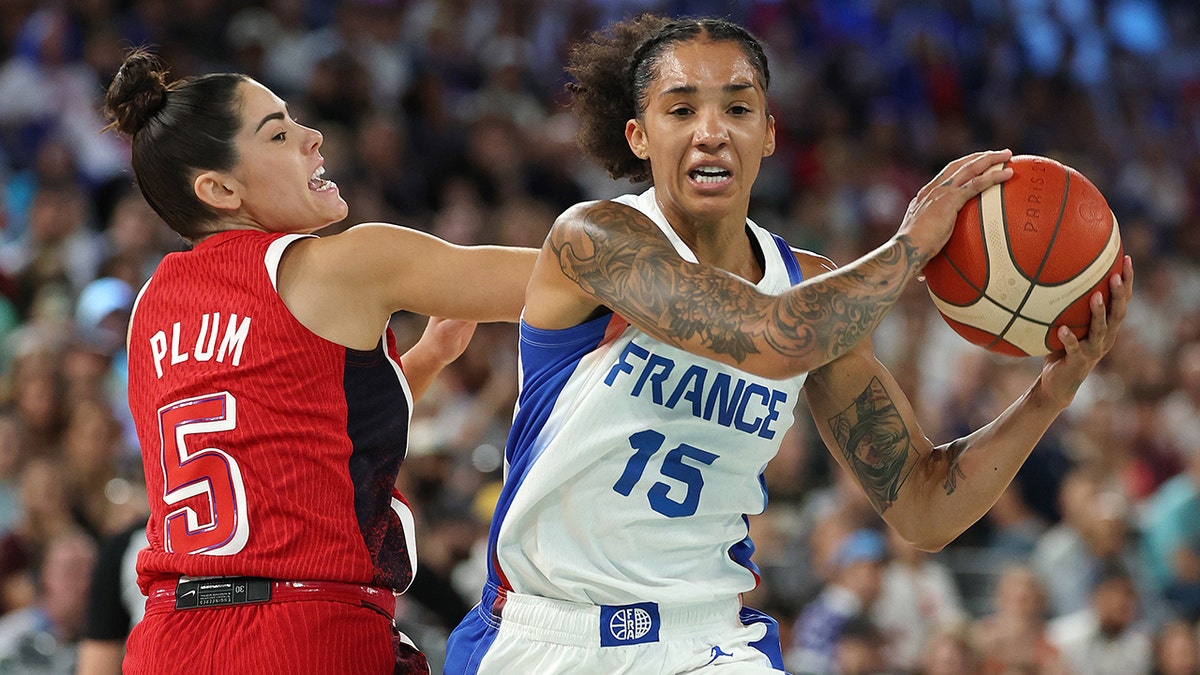
And according to the supplied video transcript, one brief postgame interaction between Gabby Williams and Caitlin Clark created almost as much discussion as the championship itself.
The United States defeated France 97-79 to capture its fifth consecutive World Cup title.
The final margin suggests control.
The game described by the video was considerably more complicated.
France reportedly built a 14-point advantage.
The French controlled stretches of the first half and forced Team USA into exactly the kind of game they wanted.
For a while, France believed an upset was possible.
Then the game changed.
Clark became one of the central figures in that transformation despite playing only 13 minutes, according to the transcript.
But before examining Clark’s impact, the video begins with Williams.
The French captain entered the postgame press conference wearing silver.
According to the source, she had produced 20 points, seven assists and three steals.
She had been one of France’s most important performers.
It still was not enough.
The disappointment carried additional history.
The transcript points back to the Olympic final two years earlier in Paris.
Williams had an opportunity late in that game as France attempted to catch the United States.
The source describes another narrow and painful ending.
Now she had another silver medal.
The video portrays Williams as emotionally controlled but clearly disappointed.
It attributes a revealing postgame statement to her.
Williams reportedly told her teammates not to lower their heads.
She emphasized that France had plenty to be proud of.
Then came the line that captured the emotional weight.
“We’re going to remember how this feels.”
That statement becomes the emotional foundation of the video.
France had not simply appeared in the championship.
The team believed it could win.
The Americans had been uncomfortable.
France had built the lead.
The game plan was working.
Then the opportunity disappeared.
According to the transcript, the United States produced a huge third-quarter swing.
What had been a competitive championship suddenly began moving decisively toward Team USA.
Williams was left processing another major international defeat.
Then came the postgame moment that generated the video’s headline.
According to the source, Clark approached Williams while cameras were still recording.
The transcript says Clark extended a hand and appeared to offer some words.
What those words were is unknown.
The narrator suggests several possibilities.
Congratulations.
Respect.
A simple acknowledgment between competitors.
Williams reportedly continued walking.
The source says she did not take Clark’s hand or visibly look toward her.
That visual sequence immediately invites a dramatic interpretation.
Was Williams deliberately ignoring Clark?
The video itself correctly acknowledges that the evidence cannot establish that conclusion.
There is no confirmed explanation from Williams presented in the transcript.
Camera angles can create misleading impressions.
Williams had just lost a championship.
Emotion was understandably high.
Therefore, describing the moment as a deliberate snub would go beyond what the supplied material establishes.
The uncertainty is actually what makes the sequence compelling.
A handshake would have created a simple story.
An obvious confrontation would have created another simple story.
Instead, viewers are left with ambiguity.
Williams had previously discussed the mentality necessary for international competition.
According to the transcript, she said France could not show weakness or doubt because opponents would exploit it.
That philosophy provides one possible context for her postgame demeanor.
Perhaps she was still emotionally locked into competition.
Perhaps she was simply devastated.
Perhaps she did not register Clark’s gesture in the way the camera angle suggests.
The video asks those questions but ultimately cannot answer them.
What it can examine more concretely is the basketball.
France’s first half was impressive.
According to the transcript, France led 47-45 at halftime.
The French had controlled the pace.
Their strategy was designed to prevent Team USA from creating easy transition opportunities.
Slow the Americans down.
Control the glass.
Force them into half-court possessions.
For 20 minutes, the video says that approach worked.
Then Clark became increasingly important.
According to the transcript, she checked into the game late in the second quarter.
Immediately before halftime, she connected on a three-pointer.
The shot reduced France’s advantage to two.
The video attributes a significant postgame description of that basket to Kara Lawson.
Lawson reportedly called it a “big momentum changing three.”
That description matters because it comes from the coach.
The shot did not give Team USA the lead.
It did not win the championship by itself.
But according to Lawson’s comments as presented in the transcript, it changed how the Americans felt entering halftime.
The source quotes Lawson saying Team USA believed it could push the accelerator down and pull away.
That is exactly what happened later.
Clark’s final statistical line is striking because of the limited minutes involved.
According to the transcript, she played only 13 minutes.
She scored 12 points.
She shot four-of-five from the field.
She made two of three attempts from three-point range.
She recorded three assists and one rebound.
The source also claims she finished with the team’s highest plus-minus.
The video uses those numbers to challenge the rotation.
Why did a player producing that efficiently receive only 13 minutes?
The transcript’s argument extends beyond the box score.
It says Team USA played differently with Clark on the floor.
 The pace increased.
The basketball moved more quickly.
Cuts became sharper.
The offensive energy changed.
Those observations connect directly to France’s strategy.
The French reportedly wanted to stop the Americans from running.
They wanted a slower contest.
According to the video, Clark helped create exactly the kind of pace France wanted to avoid.
That is where the story shifts from Williams’ disappointment to a broader coaching discussion.
The narrator argues Clark should have played more.
It questions why she did not start.
It questions why Lawson remained committed to the same rotation throughout the tournament.
But those are the narrator’s conclusions.
Winning the gold medal provides an obvious counterpoint.
Team USA ultimately succeeded.
Lawson’s rotations existed within a championship result.
The video itself eventually acknowledges that tension.
The medal says the strategy worked.
The difficult first half creates questions about whether it worked as efficiently as possible.
Then the narrator makes a much more speculative leap involving Williams.
The transcript claims Williams “knows the answer” to why Clark did not start.
It references basketball politics, seniority and what it calls the “sisterhood.”
But the source provides no direct statement from Williams establishing that she knows such an answer.
It also does not provide evidence that she refused to discuss Clark’s starting role.
That portion should therefore be understood as narrator speculation rather than Williams’ documented position.
Williams’ actual comments presented later in the transcript are much more focused on France.
She speaks about leadership.
She speaks about teammates.
She speaks about confidence.
According to the source, Williams described the French roster as easy to lead.
She said she wanted to pour confidence into her teammates because she continued believing in every player on the roster.
That response reveals a captain focused on what comes next.
A silver medal can become a burden.
It can also become motivation.
Williams appears, within the transcript, determined to push France toward the second possibility.
That becomes particularly important because France had shown it could challenge the United States.
The final score was 97-79.
But the first half demonstrated that France could create serious problems.
The Americans were not comfortable.
France’s strategy had worked.
The challenge was sustaining it.
The transcript attributes another revealing assessment to France’s coach.
The video says he described France as having played perhaps one half of good basketball.
That captures the championship.
One strong half was enough to threaten Team USA.
It was not enough to defeat them.
The United States eventually found another gear.
Clark’s three immediately before halftime became one visible turning point.
Then the Americans took control.
The narrator returns repeatedly to Clark’s playing time.
The source says she finished the tournament with 32 total assists.
It also claims she led Team USA in overall plus-minus while averaging 19.3 minutes per game.
Those figures are used to support the narrator’s argument that Clark should have started.
But statistics alone do not automatically determine a starting lineup.
Coaches consider combinations.
Defense.
Matchups.
Roles.
Continuity.
Possession distribution.
Lineups can succeed for reasons not captured by one statistic.
Still, Clark’s efficiency creates a reasonable basketball question.
Would Team USA have been even more effective with additional Clark minutes?
The video argues yes.
The gold medal means that question can never be answered definitively for this tournament.
The result already exists.
Team USA won.
Breanna Stewart was named tournament MVP according to the transcript.
Veterans delivered.
Clark contributed.
Lawson made the decisions.
France challenged them.
Then Team USA pulled away.
That complexity is more interesting than reducing the story to a single player.
Williams represents France’s side of that complexity.
She produced.
She led.
She competed.
She watched her team create a real opportunity.
Then she watched the opportunity disappear.
Her reported postgame message suggests she understood exactly how painful that was.
“Remember how this feels.”
That is not necessarily bitterness.
It can be motivation.
The alleged Clark interaction should be interpreted with the same caution.
Williams walking past Clark does not automatically establish disrespect.
Clark extending a hand does not automatically establish what she said.
Without additional context, the moment remains ambiguous.
That ambiguity makes the video’s headline provocative.
But the basketball provides the stronger story.
France proved it could make Team USA uncomfortable.
Williams showed why she was central to France.
Clark demonstrated substantial efficiency in limited minutes.
Lawson’s rotation produced a championship while simultaneously creating debate.
And Team USA once again finished with gold.
The next major international cycle will inevitably bring new questions.
Will Clark have a larger role?
Will France close the remaining gap?
Will Williams receive another opportunity against the United States?
Will Team USA maintain the same rotation philosophy?
The supplied video looks toward the 2028 Olympics in Los Angeles as the next major stage for those questions.
There is plenty of time before then.
Roles can change.
Rosters can change.
Players can improve.
Coaching decisions can evolve.
But the World Cup final has already supplied the foundation for another chapter.
Williams knows what silver feels like.
Clark now knows what gold feels like.
France knows it can create problems for the Americans.
Team USA knows that even championship victories can produce difficult rotation questions.
And one brief postgame interaction has become a symbol onto which viewers can project almost any interpretation.
Maybe Williams intentionally walked away.
Maybe she was simply devastated.
Maybe the camera captured an incomplete moment.
The transcript cannot settle that question.
What it does show is why emotions were so intense.
France believed.
Team USA responded.
Clark made an important shot.
Williams carried the disappointment.
And when the championship ended, gold and silver told only part of the story.


