Team USA defeated Italy 55–52, but the three-point victory has generated far more concern than celebration.
The Americans survived, yet the supplied account portrays the game as a warning about offensive identity, rotations, and Caitlin Clark’s role.
The most unforgettable image was not the final scoreboard.
It was Clark sitting on the bench during important fourth-quarter possessions while Team USA struggled to create separation against a team described as a massive underdog.
That image immediately became fuel for an already heated debate.
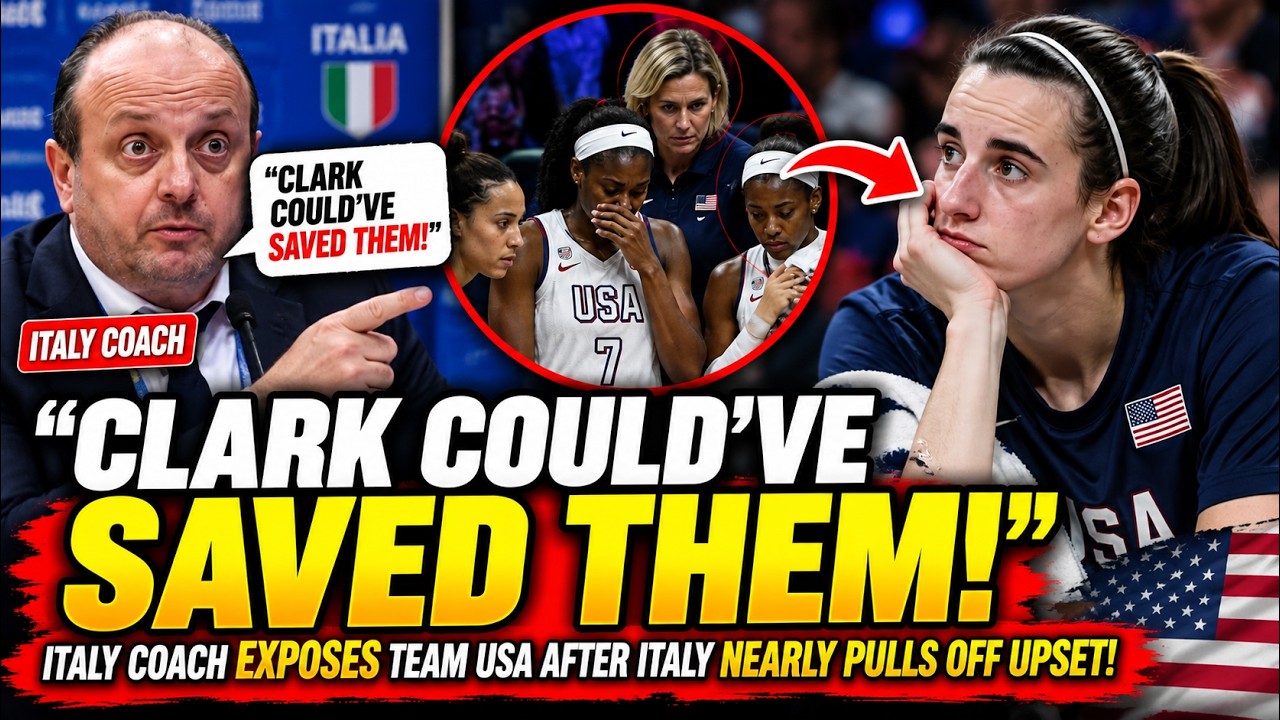
Was Cara Lawson simply making a difficult basketball decision after Clark struggled?
Or was Team USA failing to use the very skill set that had previously transformed its offense?
Those are legitimate questions.
The more explosive allegations surrounding the game require greater caution.
The source claims that Clark was deliberately isolated, that veterans intentionally refused to involve her, and that coaches wanted to “humble” her.
None of those motives is independently established by the material itself.
The basketball evidence is dramatic enough without assuming intent.
According to the source, Team USA shot only 29 percent from the field while Clark finished with one point, one assist, four rebounds, and two turnovers.
Those numbers illustrate how uncomfortable the night became.
Clark clearly did not play well offensively.
She failed to make a field goal.
Her outside shot never established rhythm.
That deserves straightforward criticism.
But Clark’s poor shooting does not fully explain why an American roster filled with elite talent struggled to reach 55 points.
The larger offensive structure also appeared broken.
The source contrasts the Italy game with Team USA’s earlier performance against China.
Against China, Clark allegedly helped create a fast, aggressive style built around early passes, transition attacks, and rapid decision-making.
Against Italy, that speed disappeared.
Possessions became slower.
The Americans increasingly worked through deliberate half-court actions.
The source portrays Lawson’s offense as isolation-heavy and post-centered.
That description matters because it reduces some of Clark’s greatest strengths.
Clark is especially dangerous before defenses become organized.
She can push the ball immediately after a rebound.
She sees passing windows developing before many guards even cross half court.
Her shooting range also forces defenders to guard farther from the basket.
When Team USA slows down, those advantages become smaller.
Italy gains time to organize.
Help defenders establish positions.
Passing lanes close.
The floor becomes more crowded.
That does not mean Team USA should abandon half-court basketball.
Championship teams must win in multiple styles.
But coaches should understand which players become less effective when the preferred tempo changes.
The source repeatedly argues that Clark attempted to accelerate possessions only for the offense to return to a slower structure.
If that description is accurate, Lawson should examine whether the system was working against her personnel.
That is a coaching question.
It does not require a conspiracy theory.
The source also describes possessions where Clark passed the basketball and never received it again.
Fans interpreted those sequences as deliberate exclusion.
There is a simpler basketball issue underneath that accusation.
Clark remains dangerous after she gives up the ball.
She can relocate toward open space.
Her defender may briefly lose contact.
A second touch can then create a completely different defensive problem.
If Team USA never returns the basketball, part of Clark’s offensive gravity disappears.
That is strategically inefficient regardless of motive.
A teammate does not need to dislike Clark to miss that opportunity.
Players can make poor reads.
They can become focused on their own drive.
They can fail to recognize an opening.
The coaching staff’s responsibility is identifying repeated mistakes and designing solutions.
The source says Italy eventually pressured Clark extremely far from the basket.
That strategy makes perfect sense.
If Clark is Team USA’s best transition organizer, slowing her down early can disrupt the entire possession.
Aggressive trapping also carries risk.
Two defenders committed to Clark should create an advantage somewhere else.
Teammates must move.
Someone should flash toward the middle.
A screener can create an escape route.
A quick pass can turn defensive pressure into an open opportunity.
The source argues that Team USA failed to provide Clark with enough of those solutions.
If true, that is a serious tactical problem.
Leaving any point guard trapped without a release valve makes the defense’s job easier.
Leaving a passer like Clark trapped can waste an opportunity to punish an aggressive scheme.
Italy reportedly became increasingly confident as the game progressed.
That should concern Team USA.
Underdogs become dangerous when favorites allow them to believe an upset is possible.
A missed shot becomes momentum.
A defensive stop becomes energy.
A close score becomes pressure.
Eventually, the more talented team starts thinking about the consequences of losing.
That appears to have happened here.
The source says Italy eventually took the lead in the second half.
Suddenly, Team USA’s overwhelming talent advantage mattered less than execution.
The Americans had to solve a real late-game problem.
That is where Lawson’s rotation became the central controversy.
Clark reportedly spent most of the fourth quarter on the bench.
According to the source, she received only a brief late appearance while Team USA remained in danger.
There is a defensible reason for that decision.
Clark was having a terrible shooting night.
A coach is not obligated to play a star simply because she is famous.
Winning must come first.
But the players on the floor were not producing clean offense either.
That changes the calculation.
When the primary lineup is struggling, a coach should ask which available player can change the conditions of the game.
Clark could potentially have done that without scoring.
She could push tempo.
She could create transition opportunities.
She could stretch defenders farther from the paint.
She could deliver passes before Italy established its preferred defense.
That is the strongest argument for questioning Lawson’s decision.
It is not that Clark deserved playing time because fans bought tickets.
It is that her particular strengths may have addressed Team USA’s specific problems.
The crowd reportedly became increasingly frustrated.
According to the source, fans began reacting loudly toward the American bench and demanding Clark return.
That atmosphere illustrates the unusual pressure surrounding Team USA.
Clark is not simply another talented player.
She attracts audiences that follow every substitution.
That popularity creates expectations coaches cannot completely ignore.
But popularity cannot become the primary basis for lineup decisions.
If Clark is playing badly and another combination is better, Lawson must choose the better combination.
The complication arises when the basketball and commercial arguments point in the same direction.
If Clark is both the biggest attraction and the player most capable of fixing the offense, keeping her out becomes increasingly difficult to explain.
Italy reportedly missed two potentially decisive three-point opportunities late.
Team USA survived.
The final score became 55–52.
The source interprets those missed shots as evidence that America escaped rather than solved the problem.
That is a useful warning.
Winning does not erase flaws.
Sometimes a close victory is more informative than a comfortable defeat.
It exposes where a team becomes vulnerable under pressure.
Lawson now has film showing exactly what happens when Team USA loses pace.
Players stop moving.
Defenses become comfortable.
Isolation increases.
Shot quality declines.
The Americans begin relying on individual talent instead of collective advantage.
Those problems become especially dangerous in elimination games.
A stronger opponent may make the late shots Italy missed.
That is why Team USA should treat the game as diagnostic information.
The source takes the story into more dramatic territory after the final buzzer.
It claims Clark exchanged sharp words with the Italian bench before later confronting Team USA’s coaching staff behind closed doors.
According to the account, Clark allegedly accused the staff of designing an offense around personal motives rather than competitive strategy.
Those are serious claims.
The source does not provide independently verifiable evidence establishing the confrontation as described.
There is no supplied audio.
There is no direct Clark confirmation.
There is no named witness presented in the transcript.
The alleged locker-room exchange should therefore remain an allegation rather than a confirmed event.
The same standard applies to claims about Stephanie White.
The source suggests White recognized that a supposed effort to limit Clark had backfired.
That conclusion depends entirely on interpretation.
Body language cannot reliably establish such a motive.
White can be questioned about basketball strategy without accusing her of participating in intentional humiliation.
This distinction matters because the people involved are real.
Criticism of coaching decisions is fair.
Claims of deliberate sabotage require evidence.
The source also argues that Clark’s popularity gives her unusual leverage within international basketball.
That broader point is easier to understand.
Clark generates enormous attention.
Fans travel to watch her.
Her highlights spread quickly.
Television coverage follows her closely.
Those realities give Team USA an opportunity.
The organization can use that attention to introduce millions of viewers to Stewart, Collier, Bueckers, Reese, Boston, Young, and the rest of the roster.
Clark’s popularity does not have to reduce anyone else’s importance.
It can expand the audience surrounding everyone.
That is why internal competition over attention would be counterproductive if it actually existed.
The smarter basketball and commercial strategy is integration.
Use Clark’s strengths to make veterans more dangerous.
Use veteran experience to stabilize Clark during difficult stretches.
Let Stewart sprint into open space.
Let interior players exploit defenders pulled toward Clark.
Let secondary guards attack rotating defenses.
That is how individual gravity becomes collective advantage.
Team USA possesses enough talent to create devastating combinations.
The problem against Italy was that the talent did not consistently function as a connected system.
That is what Lawson must fix.
The answer may include more Clark.
It may include different combinations.
It may include faster pace.
It may also require Clark to improve.
She must make shots.
She must handle physical pressure.
She must recognize when defenses are loading toward her.
A larger role brings greater responsibility.
Clark’s supporters should expect that accountability too.
The China performance and Italy performance can both be true.
Clark can look transformative one night and struggle badly the next.
That is basketball.
The coaching question is how to maximize her value even when her shot disappears.
Elite playmakers influence games in multiple ways.
If Clark cannot score, she can facilitate.
If she is trapped, she can create four-on-three opportunities.
If defenders chase her without the ball, teammates gain space.
Lawson should design an offense that preserves those benefits.
That is much more sustainable than depending on Clark making deep threes every night.
The controversy also reveals something about modern sports culture.
Fans now analyze everything.
Every substitution is clipped.
Every facial expression becomes a screenshot.
Every missed pass becomes evidence for somebody’s theory.
That environment can make ordinary team chemistry look sinister.
It can also expose genuine strategic problems faster than traditional coverage once did.
Coaches therefore operate under unprecedented scrutiny.
Lawson cannot simply point to a victory and declare the discussion finished.
Fans can see the offensive possessions.
Analysts can compare pace.
They can track which lineups create separation.
They can identify open players.
The best response is not defensiveness.
It is adaptation.
If faster lineups consistently perform better, play them more.
If Clark generates advantages, design possessions allowing those advantages to continue.
If veteran groups provide superior defense, use them when defense becomes the priority.
A championship rotation should be flexible.
It should not become ideological.
That principle matters more than any rumor about locker-room politics.
The source frames the conflict as a battle between an older hierarchy and a disruptive new superstar.
Reality may be less dramatic.
Team USA could simply be experiencing the familiar difficulty of integrating a uniquely talented player into a roster filled with other uniquely talented players.
That challenge is difficult enough.
Everyone is accustomed to touches.
Everyone has earned respect.
Everyone has accomplished something significant.
Someone must sacrifice.
The question is which sacrifices make the team better.
Clark may need fewer shots than she takes with Indiana.
That is reasonable.
She should not sacrifice the pace, range, and passing creativity that make her special.
Those qualities are exactly why she was selected.
If Team USA asks Clark to become an ordinary point guard, it risks wasting its most unusual offensive weapon.
If Lawson allows her complete freedom without structure, another problem could emerge.
The answer lies between those extremes.
Create organized freedom.
Give Clark actions that encourage fast decisions.
Use teammates as active participants rather than spectators.
Create second-side opportunities after she passes.
Build transition rules everyone understands.
That is coaching.
The Italy game should become valuable precisely because it exposed these weaknesses before a medal game.
Team USA escaped.
Its tournament remains alive.
The coaches still have time to adjust.
The next opponent may create different problems.
The next close game may require a completely different lineup.
But one lesson should remain.
Talent alone does not guarantee dominance.
Structure matters.
Pace matters.
Chemistry matters.
And when an offense loses all three simultaneously, even the deepest roster in the tournament can suddenly look ordinary.
The supplied account describes the Italy game as proof of an internal war.
The evidence presented does not establish that conclusion.
What it does establish within the story is a far more defensible warning.
Team USA nearly paid a heavy price for an offense that stopped functioning.
Clark struggled.
The veterans struggled.
The coaching staff faced difficult choices.
Italy exploited every hesitation.
That should be enough to force reflection.
The Americans do not need a public feud.
They need clarity.
Who initiates?
Who closes?
What happens when opponents trap Clark?
What happens when the half-court offense stalls?
Which lineups create the best balance between speed and defense?
Those answers will determine far more than online narratives.
If Lawson solves them, the controversy could disappear beneath another dominant championship run.
If she does not, the next close game will reopen every question with even greater force.
Because Italy already delivered the warning.
Team USA escaped once.
In elimination basketball, there is no guarantee the next opponent will let them escape again.


