Caitlin Clark left Berlin with a gold medal, a world championship, and another chapter in the growing debate surrounding her role on Team USA.
The United States defeated France 97–79 in the gold medal game, overcoming an early deficit before taking control in the second half.
According to the supplied transcript, Clark played only 13 minutes but finished with 12 points, three assists, and a plus-11 rating.
Those numbers became the centerpiece of a discussion that continued long after the final whistle.
The controversy was not about whether Team USA won.
The Americans won comfortably in the end, and Clark became a gold medalist.
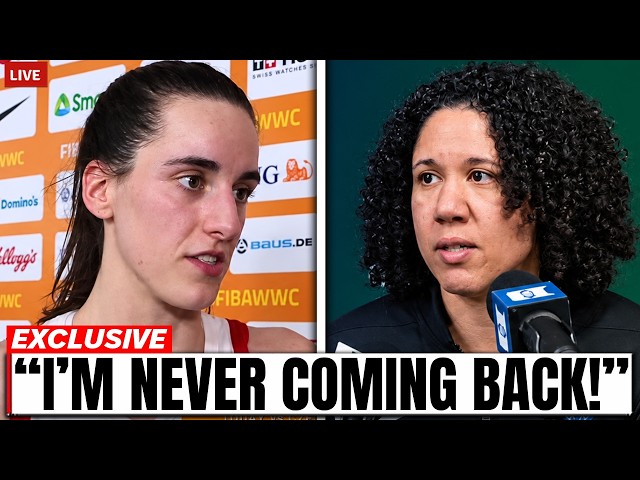
Instead, the argument centered on how much Clark was allowed to contribute before the game was already under control.
The transcript repeatedly questions why Clark received such limited playing time despite making an immediate offensive impact.
During the first half, France pushed the United States into an uncomfortable position.
France played aggressively, attacked the American defense, and built a lead of roughly 10 points.
The transcript says Clark reportedly played only four minutes during the opening half.
That became especially significant because the game was the gold medal contest, rather than an exhibition or low-stakes tournament game.
Team USA eventually fought back before halftime and reduced France’s advantage to two points.
After halftime, the Americans began asserting themselves more consistently.
Their defense tightened, France stopped finding the same clean opportunities, and Team USA’s depth began to show.
Yet Clark’s limited role remained one of the biggest talking points surrounding the game.
When she finally received extended enough opportunities to make an impact, she did not need a large number of possessions to become noticeable.
Clark made shots, created offense, and helped Team USA during her short stretch on the floor.
The supplied transcript emphasizes that she scored 12 points in only 13 minutes.
It also highlights her three assists and plus-11 rating during those minutes.
For Clark supporters, those numbers created an obvious question.
If she could produce at that level in such a limited window, what might she have done with substantially more playing time?
The transcript does not establish that Team USA’s coaching staff intentionally tried to limit Clark.
Instead, the video’s commentary interprets the rotation as difficult to understand and argues that Clark deserved a larger opportunity.
That distinction matters.
The United States won the game, so there is no question about the ultimate result.
But the transcript argues that a successful result does not necessarily settle every question about the decisions made during the tournament.
Clark’s performance against France gave supporters additional ammunition because she did not appear overwhelmed by the international stage.
She also made an important three-point shot before halftime.
In the interview excerpt included near the beginning of the source, Clark described seeing the shot go through the net as a positive moment.
She said she felt she should have been perfect from the field but accepted finishing two-for-three.
The interview also contains a brief exchange about Clark and another person being friends.
The commentator then pivots toward the larger question of how Team USA handled its young players.
The supplied video repeatedly contrasts Clark’s minutes with those of veteran players.
It notes that several other leading Team USA scorers played considerably more than Clark during the final.
Kalia Copper is described as scoring 15 points in roughly 30 minutes.
Chelsea Gray is described as recording 12 points and five assists in 27 minutes.
Brianna Stewart is highlighted as having a major performance with 22 points and 10 rebounds.
The transcript uses those comparisons to argue that Clark’s statistical production looked particularly striking given her limited court time.
At the same time, the source acknowledges that Team USA had an extremely talented roster.
The commentary specifically says that nobody was arguing every possession should run through Clark.
It also recognizes the contributions of veteran players and points to Stewart’s performance as an example of the depth available to the Americans.
The central disagreement therefore becomes less about whether Clark should have played every minute and more about whether her production justified a larger role.
Another major theme is the repeated “veterans versus young players” discussion.
The transcript questions the way some media coverage framed younger Team USA players as inexperienced compared with established veterans.
The commentary argues that the age difference between some players was not enormous.
It also acknowledges that veterans can bring valuable experience from previous international competitions.
Still, the source challenges the idea that younger players were automatically unready for the biggest moments.
According to the transcript, there were arguments that some younger lineups performed well during the tournament as a whole.
That perspective adds another layer to the Clark debate.
The discussion is not simply about one player’s popularity.
It is also about how a national team balances experience, current production, roster depth, and expectations in a championship game.
Clark’s popularity makes the issue even more visible.
The transcript claims that basketball fans were changing their schedules to watch the women’s international tournament because Clark was wearing the USA jersey.
The commentator describes her as a major attraction capable of drawing attention even during football season.
That observation is presented as evidence of Clark’s enormous audience appeal.
But the same popularity also raises expectations among viewers who tune in specifically to watch her play.
When those viewers see her spending long stretches on the bench, frustration can become part of the story.
The transcript argues that this was particularly noticeable because Clark’s opportunities often produced immediate results.
The source describes her as someone capable of stretching the defense with her shooting and creating difficult passing angles.
Those abilities are presented as reasons supporters wanted to see more of her against France.
However, the final score ultimately provided Team USA with a strong counterargument.
The United States did not merely survive the championship game.
It won 97–79 and secured the gold medal.
That result gave coach Kara Lawson the outcome she needed.
The transcript nevertheless maintains that winning does not automatically erase questions about individual rotation decisions.
In that framing, two things can be true at the same time.
Team USA can deserve full credit for winning the championship, while fans can still debate whether Clark should have played more.
That distinction is central to the source’s argument.
Clark also leaves the tournament with an achievement that cannot be taken away by any debate over minutes.
She is described throughout the transcript as a senior Team USA gold medalist and world champion.
The commentary suggests that the international experience will become another significant part of her career story.
It also argues that she accomplished it without receiving the kind of extended role her supporters expected.
Rather than responding to criticism through a public confrontation, the video’s narrator says Clark’s response came through her performance.
She entered the game, took her opportunities, made shots, created offense, and helped the United States.
The transcript therefore frames Clark’s performance as her strongest answer.
The source also looks ahead to Clark’s return to Indiana and the WNBA.
It predicts that she could return with additional confidence and motivation after winning gold.
The commentary repeatedly emphasizes the possibility that Clark could use the experience as fuel once she resumes her professional season.
Her return would also reunite her with her Indiana teammates and place the focus back on her WNBA career.
The video specifically mentions Kelsey Mitchell when discussing Clark’s return to Indiana.
The transcript suggests that Clark could benefit from returning to an offense where she knows her teammates, understands her spots, and feels comfortable operating as a point guard.
That is presented as a potential consequence of the tournament experience rather than an established prediction.
Ultimately, the final image presented by the source is not one of failure.
Clark leaves the tournament as a champion.
She was not exposed by international competition, according to the video’s commentary.
She was not unable to contribute against France.
Instead, she produced 12 points and three assists in 13 minutes while finishing plus-11.
Those statistics became the foundation for the criticism of her limited role.
The larger debate now moves beyond the gold medal game.
It touches on how Team USA should balance veterans and younger players, how coaches should manage an exceptionally talented roster, and how much weight should be placed on a player’s production when opportunities are limited.
For Clark supporters, the gold medal is the achievement.
The rotation controversy is the unresolved question.
The supplied transcript ultimately asks whether Lawson’s decision to give Clark only 13 minutes was disrespectful, or whether the rotation was justified because Team USA won comfortably.
That question remains the video’s central invitation to its audience.
And with Clark returning to the WNBA as a world champion, the next chapter of the conversation will unfold on the professional court.
The tournament ended with Team USA holding the gold.
It also ended with Caitlin Clark holding a stronger résumé and her supporters asking a question that may continue long after the celebration.
How much more could she have done if she had been given more time?


