Team USA finished the tournament with the result that matters most: a gold medal.
But according to the supplied video transcript, the championship did not settle the debate surrounding Kara Lawson’s rotations.
It may have made that debate even louder.
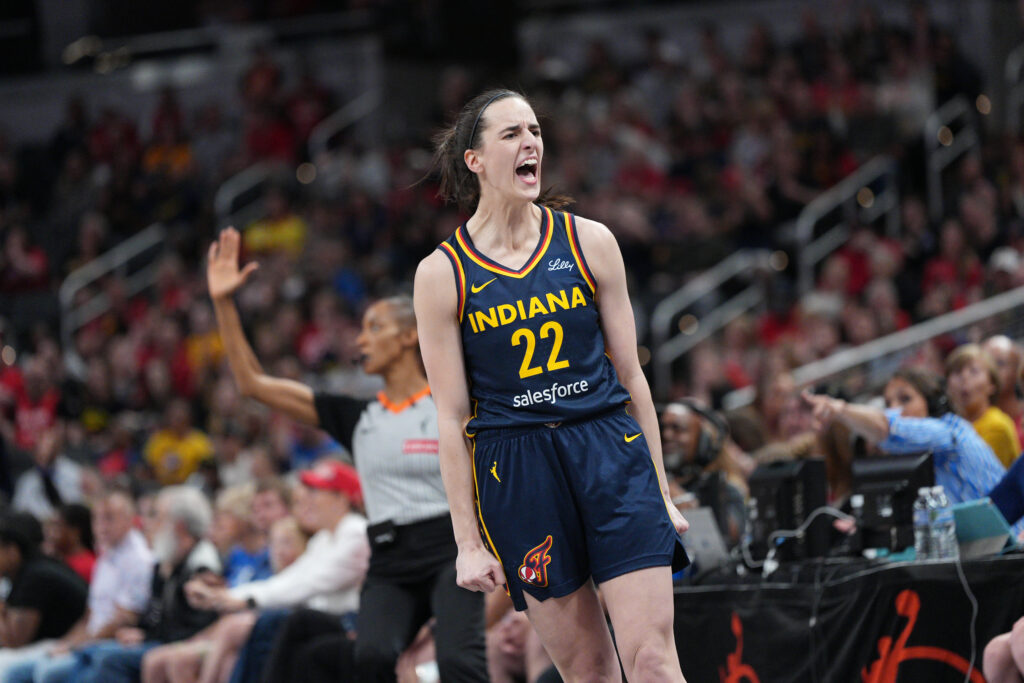
At the center of the controversy is Caitlin Clark.
According to the transcript, Clark scored 12 points in only 13 minutes against France while contributing three rebounds and four assists in the later box-score discussion.
She also hit one of the most important shots of the first half.
Yet she remained a reserve.
Meanwhile, Paige Bueckers reportedly received only two minutes and 38 seconds in the championship game.
Those numbers create an uncomfortable question even after victory.
Did Lawson’s veteran-heavy strategy prove itself because Team USA won gold?
Or did Clark’s extraordinary production in limited minutes show that Team USA could have extracted even more from its younger stars?
The transcript provides evidence for both arguments.
France made the opening half difficult.
The video describes Team USA struggling to establish control while the French created pressure and threatened to carry a significant advantage into halftime.
The Americans had the names.
They had the depth.
They had championship experience.
France had momentum.
That difference created enormous pressure around every substitution.
The narrator had repeatedly criticized what it called the “old and burnt” veteran group.
That language reflects the commentator’s provocative style rather than an objective description of the players.
But underneath the jokes was a serious basketball issue.
Could the veteran lineup respond when Team USA faced real championship pressure?
During the first half, the answer remained uncertain.
Then Lawson reportedly inserted Clark and Angel Reese late in the second quarter.
Clark delivered immediately.
According to the transcript, she buried a three heading into halftime.
Team USA entered the break down only two.
The video correctly emphasizes that the shot was not a game-winner.
It did not erase everything France had done.
But its timing made it enormous.
A team staring at a potentially damaging deficit suddenly entered halftime only one possession behind.
That changes psychology.
France had controlled significant stretches of the game.
Instead of receiving a comfortable halftime cushion as a reward, it now had Team USA directly behind it.
The Americans had survived.
The deeper roster was still alive.
And the third quarter completely changed the game.
The video gives significant credit to the veterans here.
Breanna Stewart responded.
Jackie Young became aggressive.
Chelsea Gray produced.
Kahleah Copper contributed offensively.
Team USA’s defense tightened.
The pace changed.
Whatever happened in the locker room, the veteran group returned looking dramatically different.
That creates the strongest argument supporting Lawson.
She trusted experience.
When the championship reached its most dangerous point, those experienced players delivered.
Stewart reportedly finished with 22 points and ten rebounds.
Young contributed 18 points, six rebounds and five assists.
Copper scored 15.
Gray recorded 12 points, five assists and four rebounds according to the numbers cited in the transcript.
Those are substantial championship contributions.
Anyone attempting to frame the final as Clark succeeding while the veterans failed would therefore be ignoring what the source actually describes.
The veterans were central to the comeback.
But acknowledging their performance does not eliminate the Clark question.
Clark reportedly finished with 12 points in 13 minutes.
The transcript initially mentions three assists and a plus-11 rating.
Its later box-score discussion credits her with three rebounds and four assists.
The source is therefore internally inconsistent regarding her assist total.
The larger point, however, remains unchanged within the video.
Clark produced significant offense in very limited playing time.
She was not allowed 30 minutes to establish rhythm.
She was not controlling every possession.
She was not starting the game knowing that an early miss would be followed by another ten opportunities.
She entered from the bench.
She entered a championship game under pressure.
And she produced.
That is why the minutes become more controversial than the points.
Twelve points alone do not necessarily create a rotation argument.
Twelve points in 13 minutes do.
The transcript repeatedly returns to that distinction.
Limited minutes can be difficult for offensive players.
A starter can miss several early shots and remain on the floor long enough to recover.
A reserve may receive only a short window.
One missed three can transform an efficient five-minute stretch into an apparently poor performance.
Clark reportedly overcame that problem.
Her three before halftime became the loudest example.
But the video also emphasizes her passing, pace and shooting gravity.
Clark can change defensive positioning without touching the basketball.
Her range can pull defenders farther from the paint.
Her passing can punish aggressive coverage.
Her pace can accelerate possessions before defenses become organized.
Those qualities can matter even when she is not producing huge scoring totals.
Against France, however, she also scored.
That combination creates a legitimate coaching question.
If Clark could produce that much in 13 minutes, what would have happened with 18?
What about 20?
What about 22?
The transcript carefully acknowledges that more minutes do not automatically create proportionally greater production.
Basketball is not mathematically predictable that way.
A player scoring 12 in 13 minutes would not necessarily score 24 in 26.
Matchups change.
Fatigue changes.
Defenses adjust.
Different combinations create different opportunities.
But once a player repeatedly demonstrates an ability to handle pressure, maintaining a very small role becomes increasingly difficult to justify without explaining the basketball reasoning.
That is the heart of the Clark debate.
The Bueckers situation is even more mysterious.
According to the video, Bueckers played only two minutes and 38 seconds.
The commentator speculates about several possible explanations.
Perhaps she was injured.
Perhaps Lawson simply preferred another rotation.
The original commentary even jokes about whether Curt Miller had made a phone call asking Team USA not to use her.
The transcript itself correctly rejects treating that joke as evidence.
Nothing in the supplied material establishes any secret instruction or conspiracy.
Therefore, the only responsible conclusion is that this source does not explain why Bueckers played so little.
But uncertainty does not eliminate the basketball question.
If Bueckers was healthy, why did a player who had been involved during the tournament suddenly receive almost no meaningful championship minutes?
Was the matchup unfavorable?
Did Lawson decide that experience mattered more?
Was there a physical issue not visible to viewers?
The transcript cannot answer those questions.
It can only establish that the extremely limited playing time generated controversy.
That distinction between criticism and conspiracy is important.
A coaching decision can be questioned without inventing a hidden motive.
And Lawson’s decisions deserve to be examined within the full context of the result.
Team USA won.
That matters.
Coaches are ultimately judged heavily by outcomes.
Lawson trusted her veterans.
The veteran lineup responded.
The United States captured gold.
That gives Lawson an extremely powerful defense against anyone claiming her approach completely failed.
But championships can simplify complicated stories.
A gold medal does not necessarily prove every substitution was perfect.
It proves the overall approach produced the required result.
There is a difference.
Elite talent can overcome imperfect decisions.
 Great coaching can also look questionable temporarily before ultimately succeeding.
Sometimes both realities exist within the same game.
The supplied video believes this final contains evidence for both.
For approximately the first 18 minutes, the Americans reportedly looked vulnerable.
France created exactly the scenario critics feared.
Team USA was behind against an opponent capable of punishing a slow start.
Suddenly, every substitution mattered.
Every empty possession became more expensive.
Every talented player sitting on the bench became part of the discussion.
Clark’s limited role therefore attracted additional scrutiny.
Her ability to create immediate offensive pressure represented one possible solution.
But Team USA did not build the championship game around her.
It used her in bursts.
Those bursts still mattered.
Then the veteran lineup seized control.
According to the transcript, once France surrendered the lead, its decision-making deteriorated.
Turnovers increased.
Possessions became less patient.
The French offense struggled to reproduce its earlier rhythm.
The pressure shifted.
For much of the first half, Team USA had been the team trying to survive.
During the third quarter, France became the team trying to stop the avalanche.
This is where experience became particularly valuable.
Veteran players do not always demonstrate their importance through spectacular highlights.
Sometimes experience means recognizing that an opponent is beginning to break and refusing to allow recovery.
Team USA reportedly did exactly that.
The defense became more physical.
Ball pressure increased.
France’s creators became uncomfortable.
The Americans began dictating the game.
Once the veteran group created the lead, the role of the younger players changed.
Clark no longer needed to rescue Team USA.
Reese did not need to become the primary scorer.
Ryan Howard did not need to dominate possessions.
They needed to maintain pressure.
According to the narrator, that division of responsibility ultimately became the strongest argument for Lawson’s management of the final.
The veterans cracked the game open.
The younger group helped prevent France from closing it.
That does not make every minute allocation perfect.
It does demonstrate how Team USA’s depth can function as a championship weapon.
France’s offensive collapse helped expand the margin.
The transcript cites Marine Johannes at five points while shooting one-for-six from three and committing five turnovers.
Ryan Howard is credited with four steals.
Those defensive events mattered.
Turnovers do more than remove potential French points.
They create American transition opportunities.
Transition basketball magnifies Team USA’s depth and athleticism.
France preferred structure.
The Americans eventually created chaos.
Once Team USA controlled pace, the talent difference became more difficult for France to overcome.
The narrator therefore argues that the gold medal was not won because of one Clark three.
It was not won because of one Stewart basket.
It was not won because Gray suddenly produced.
It was won when the Americans collectively changed the terms of the game.
France controlled significant portions of the first-half rhythm.
Team USA controlled the second-half pressure.
Clark’s individual production nevertheless remains impossible to ignore.
Twelve points.
Thirteen minutes.
A critical three before halftime.
Positive impact while she was playing.
A gold medal afterward.
For Clark supporters, those numbers naturally produce one question.
Why only 13 minutes?
The video does not provide definitive evidence explaining Lawson’s exact reasoning.
Therefore, the article cannot invent one.
What it can say is that Clark maximized much of the opportunity she received.
That is why the narrator identifies the most controversial aspect of her championship performance as the amount of time required to produce it.
“The most controversial part of Clark’s final is not what she did.”
“It is how little time she needed to do it.”
That framing captures the entire postgame debate.
Clark did not need to start for her performance to matter.
Starting and importance are not identical concepts.
Basketball analysis can become overly focused on whether a player appears among the opening five.
What matters more is when a player enters, what the game needs and whether that player changes the situation.
According to the transcript, Clark did.
She entered a difficult championship.
She scored 12.
She delivered an important shot before halftime.
She finished as a world champion.
That performance also carries implications beyond one tournament.
Stewart, Gray, Copper and the other veterans will not play forever.
Clark, Bueckers, Howard, Reese and other younger players represent an approaching generation.
At some point, those players will inherit larger responsibilities.
This tournament gave them championship experience while the veterans were still present to carry significant pressure.
The transition was not always smooth.
It generated arguments.
It produced rotation controversies.
It created questions that remained unanswered even after gold.
But in the final, enough pieces worked together.
The veteran group reportedly refused to lose.
Clark produced in limited minutes.
The younger unit maintained momentum.
The defense disrupted France.
Team USA’s depth became overwhelming.
That is why reducing the championship to “Lawson was right” or “Lawson was wrong” misses the complexity described by the source.
Lawson trusted the veterans.
They rewarded that trust.
Clark produced quickly.
Bueckers barely played for reasons this transcript cannot establish.
The younger group still contributed.
All of those things can be true simultaneously.
Now both sides of the rotation debate leave with evidence.
Lawson’s supporters have the strongest evidence possible.
Gold.
Her veteran lineup responded when the championship was threatened.
Her critics also have numbers they will continue discussing.
Clark scored 12 points in 13 minutes.
Bueckers reportedly played only two minutes and 38 seconds.
Those facts, as presented by the transcript, ensure that victory will not end the conversation.
It may intensify it.
Team USA leaves as champion.
Clark leaves as a world champion.
The veterans leave having delivered under pressure.
But one question follows Lawson out of the tournament.
If Caitlin Clark could do that much in only 13 minutes, how much longer can Team USA justify keeping her role that small?


