BERLIN — Caitlin Clark may have just changed the economics of women’s basketball again.
This time, the biggest development did not begin with a logo three, a no-look pass, or another record-breaking performance.
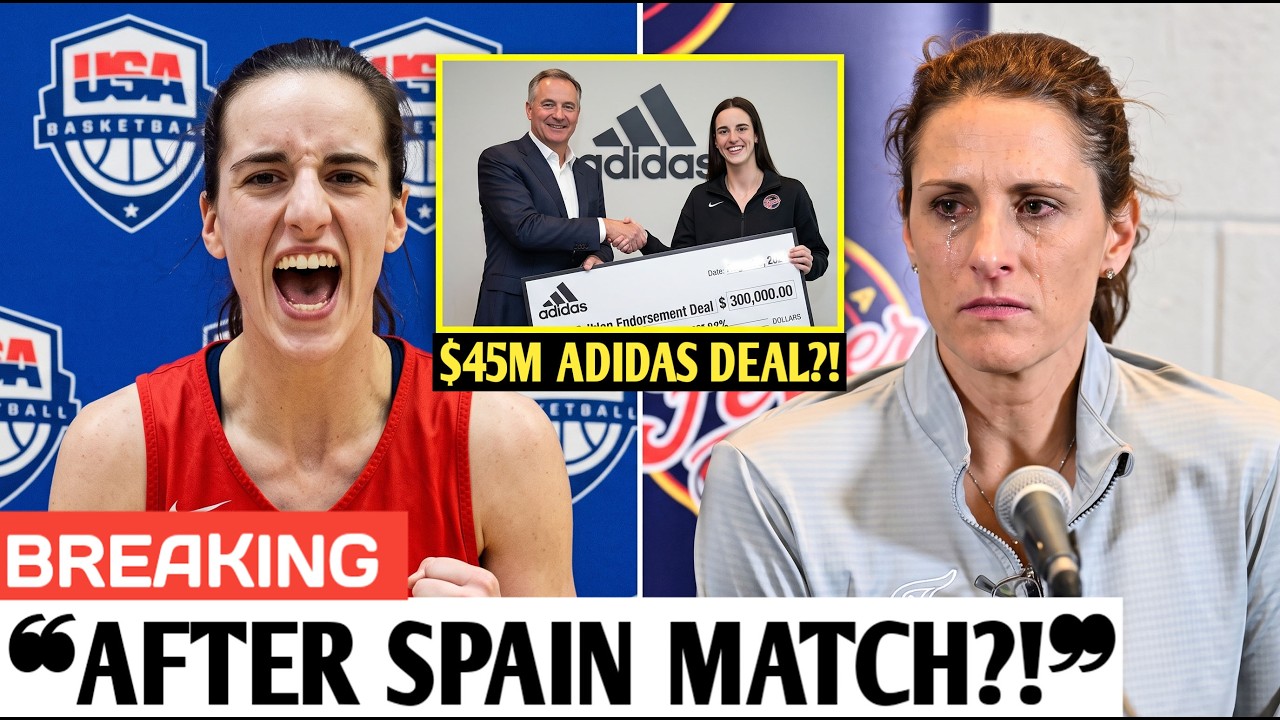
It began with money.
A lot of money.
According to the transcript, multiple outlets reportedly revealed that Clark had agreed to a massive multi-year endorsement agreement with Adidas valued at approximately $45 million.
The source describes the reported contract as a five-year guaranteed package containing additional performance incentives.
Those incentives allegedly include All-Star selections, MVP voting, and participation in major international tournaments.
If accurate, the structure would make the deal significant for reasons extending far beyond Clark’s personal finances.
It would represent another enormous indication of how dramatically the commercial market values her presence.
Clark was already associated with one of the most prominent endorsement portfolios in women’s basketball.
The transcript references her previously reported Nike agreement, describing it as approximately $28 million and including plans for a signature shoe.
The source claims the Adidas arrangement would not replace that relationship.
Instead, it says the new agreement allegedly occupies separate apparel and lifestyle categories that remained available under her existing endorsement structure.
That distinction is crucial.
If the transcript’s claims are accurate, Clark would not simply be moving from one major sportswear company to another.
She would potentially be building relationships across multiple commercial categories at the same time.
The source estimates her combined guaranteed endorsement portfolio across several brands could exceed $100 million.
That figure should be treated as an estimate rather than an independently established total.
Still, the larger point is difficult to miss.
Clark’s off-court economic value has reached a level almost impossible to compare with traditional WNBA salary structures.
That contrast immediately created discussion throughout the basketball world.
According to the transcript, one of the strongest reactions came from Indiana Fever coach and Team USA assistant Stephanie White.
White reportedly learned about the Adidas news at the same time as the public.
Her first reaction, according to the source, was laughter.
Not because the deal seemed ridiculous.
Quite the opposite.
White reportedly framed the contract as confirmation of something she believes the basketball marketplace has already decided.
Clark belongs in the biggest conversations.
White’s reported message was simple.
People can continue debating Clark’s status, her role, her ranking, and her place within women’s basketball.
The market has already delivered its own verdict.
That argument immediately transformed the endorsement story into something much larger.
White was no longer talking merely about money.
She was using a commercial development to make a competitive point.
That distinction matters because Clark’s role inside Team USA has already generated enormous debate.
Questions have surrounded playing time.
Questions have surrounded rotations.
Questions have surrounded whether coaches are maximizing Clark’s influence.
Now the commercial marketplace has reportedly assigned a staggering dollar figure to the same athlete whose basketball role remains endlessly debated.
For Clark supporters, the contrast is impossible to ignore.
A corporation can allegedly commit tens of millions of dollars to Clark while basketball institutions still argue over exactly how central she should be.
The transcript interprets White’s comments as a message directed toward people inside the Team USA environment.
That interpretation remains speculation.
White did not explicitly identify a target in the quoted remarks provided by the source.
But her phrasing was undeniably powerful within the transcript’s narrative.
“The market has decided.”
Four words can carry enormous weight.
They suggest popularity is no longer theoretical.
Commercial influence is no longer merely anecdotal.
According to the transcript, brands are now placing enormous financial bets on Clark’s continued growth.
Then came Kara Lawson.
The Team USA head coach was reportedly asked directly about the Adidas development approximately 90 minutes after White’s comments began circulating.
Lawson’s response was considerably more restrained.
According to the transcript, she praised anything that elevates the visibility of women’s basketball.
She framed the development as positive for the entire sport.
The source immediately focused on what Lawson supposedly did not say.
She did not mention Clark by name in the quoted response.
That omission became another controversy.
The transcript compares Lawson’s reaction with earlier public praise she allegedly gave other stars when they signed endorsement extensions.
From that contrast, the narrator suggests Lawson may have deliberately shifted attention away from Clark.
That conclusion cannot be proven from the quote alone.
Coaches often broaden individual questions into team-centered answers.
Lawson may simply have wanted to avoid allowing an endorsement story to dominate Team USA preparation.
But because Clark’s role already generates intense scrutiny, even a missing name becomes significant.
That is the unusual reality surrounding her.
Clark does not have to speak to create a story.
Sometimes other people’s reactions create the story for her.
That pattern continued when the transcript turned toward the players’ union.
The source attributes another striking reaction to a union representative appearing on national television.
According to the transcript, the discussion centered on a fundamental economic problem.
What happens when one player’s off-court commercial value becomes dramatically larger than what the league’s salary system can pay even its highest-earning stars?
That is not merely a Caitlin Clark question.
It is a labor question.
It is a collective bargaining question.
It is a question about whether women’s basketball’s economic structure can keep pace with the commercial growth surrounding its biggest stars.
If individual endorsement opportunities explode while league compensation remains relatively constrained, tension becomes inevitable.
Players will notice.
Agents will notice.
Sponsors will notice.
Owners will notice.
The next collective bargaining discussion will certainly notice.
The transcript then introduces Kelsey Mitchell.
Mitchell’s reported reaction may be the most human moment in the entire story.
According to the source, Mitchell expressed happiness for Clark while also acknowledging that the situation made her reflect on her own career.
Mitchell has been an elite professional player for years.
She has earned All-Star recognition.
She has built an accomplished WNBA résumé.
Yet the commercial marketplace does not necessarily reward achievement equally.
That difference can be emotionally complicated without automatically becoming jealousy.
Two things can be true simultaneously.
A teammate can genuinely celebrate Clark.
That same teammate can also recognize that Clark’s economic universe looks completely different from her own.
The transcript portrays Mitchell’s response as an honest acknowledgment of that reality.
That matters because women’s basketball is entering a new economic era.
The sport has always contained talent.
It has always contained accomplished stars.
But concentrated commercial attention on this scale can change locker-room dynamics, media narratives, salary debates, and marketing strategies.
Clark’s value is no longer just about how many points or assists she produces.
She affects television.
She affects ticket demand.
She affects merchandise.
She affects sponsorship discussions.
And according to the transcript, she may now influence the way major international brands approach women’s basketball.
That is where Adidas enters the larger strategic picture.
The source argues that a reported $45 million investment would not simply be about selling clothing.
It would be about positioning.
Clark’s popularity gives a brand proximity to one of the most recognizable figures in women’s sports.
That becomes especially important internationally.
The transcript specifically points toward markets such as Germany, France, and China.
The timing also receives enormous attention.
Clark was in Berlin with Team USA when the reported agreement became public.
Adidas has deep historical ties to Germany.
The transcript interprets that timing as deliberate rather than accidental.
Again, that remains analysis from the source.
But the broader commercial logic is understandable.
Major brands want announcements to land when attention is highest.
Clark competing internationally places her in front of a global audience.
A major endorsement announcement during that window naturally generates more conversation than the same news released during a quiet period.
The contract’s alleged tournament incentives create an even more fascinating issue.
According to the transcript, Clark could receive financial benefits connected to international participation.
If accurate, that would mean brands have a direct commercial interest in her appearing on Team USA rosters.
That does not mean Adidas would control USA Basketball decisions.
Selection committees remain responsible for basketball choices.
But it would add another economic layer around those decisions.
Leaving Clark off a roster would no longer be interpreted purely as a basketball decision.
Fans would analyze it.
Broadcasters would analyze it.
Sponsors would analyze it.
Corporate partners could have their own financial interests affected by the outcome.
That is the type of structural pressure modern sports organizations increasingly face.
Basketball decisions rarely exist in complete isolation from business.
The transcript compares the situation with the NBA’s experience during Michael Jordan’s rise.
That comparison is not about claiming Clark has already matched Jordan’s accomplishments.
It is about market concentration.
During Jordan’s era, the NBA recognized that one athlete had become disproportionately important to global growth.
The league did not solve that issue by suppressing his popularity.
It used his popularity to grow the larger product.
That may be the central challenge facing the WNBA today.
How does a league benefit from Clark’s extraordinary drawing power without reducing every other player to supporting status?
How does it celebrate a singular commercial phenomenon while continuing to build A’ja Wilson, Angel Reese, Paige Bueckers, Kelsey Mitchell, and other stars?
That balance matters.
A healthy league cannot depend permanently on one individual.
Injuries happen.
Careers end.
Public attention shifts.
But refusing to acknowledge concentrated star power does not eliminate it.
It simply creates a gap between institutional messaging and marketplace reality.
The transcript repeatedly argues that Clark has already become the commercial center of gravity.
Whether one agrees completely with that conclusion or not, the reported endorsement figures explain why the argument exists.
Brands invest based on expected returns.
They measure engagement.
They measure search interest.
They measure sales.
They measure audience behavior.
A reported $45 million commitment would represent an extraordinary vote of confidence.
Perhaps the most striking part of the story, however, is what Clark allegedly did after the news broke.
Nothing.
According to the transcript, she did not immediately post a celebratory video.
She did not hold a press conference.
She did not publicly discuss the contract.
She reportedly attended Team USA practice and continued preparing for basketball.
When asked about Adidas while walking toward the team bus, the source says Clark smiled, put on her headphones, and kept moving.
That reaction fits the public image Clark has generally projected throughout enormous attention.
Basketball first.
Everything else later.
Whether intentionally or not, silence can become powerful when everyone around a player is talking.
White reacted.
Lawson reacted.
Teammates reportedly reacted.
Analysts reacted.
The commercial world reacted.
Clark reportedly practiced.
That contrast almost becomes the story itself.
The athlete at the center of the storm appears less interested in discussing the storm than everyone orbiting around her.
That approach may also protect Team USA.
Clark is participating in an environment where individual attention can easily become distracting.
Turning an endorsement announcement into a prolonged personal celebration could shift attention away from the team.
Remaining quiet allows the basketball to remain central.
It also allows Clark’s value to speak through other measurements.
The contract number speaks.
Ticket demand speaks.
Jersey sales speak.
Television audiences speak.
Brands speak.
Clark does not necessarily have to.
The bigger question is what comes next.
If the reported Adidas agreement is accurate, its importance will extend far beyond one athlete receiving a massive payday.
It could influence future endorsement negotiations throughout women’s basketball.
Agents representing other stars will use Clark’s deal as a comparison point.
Brands will reassess how much elite women’s athletes are worth.
Players will ask why commercial revenues are expanding faster than league salaries.
The union will carry those questions into bargaining rooms.
Broadcasters will reevaluate which players drive viewership.
Teams will rethink marketing strategies.
And younger athletes will enter professional basketball with very different expectations about what their personal brands can become.
Clark’s rise has already changed attendance conversations.
It has changed television conversations.
Now it may be changing endorsement economics.
That is why Stephanie White’s reported reaction matters.
The market does not wait for basketball institutions to reach consensus.
Fans decide what they want to watch.
Brands decide what attention is worth.
Sponsors decide where they want to invest.
The transcript argues those decisions are increasingly pointing toward Clark.
But there is also a warning inside this moment.
Women’s basketball should not confuse one superstar’s commercial success with the completion of the sport’s growth.
Clark can open doors.
She cannot walk through every door for everyone else.
The league still needs deeper investment.
It needs stronger player development.
It needs competitive storytelling.
It needs sustainable franchises.
It needs more nationally recognizable stars.
It needs structures capable of converting sudden attention into permanent growth.
That is the real opportunity.
Clark’s reported Adidas deal should not create a smaller league built around one individual.
It should help create a larger league with more opportunities for everyone.
That is the lesson the NBA eventually learned from Jordan.
Use the brightest star to illuminate the entire stage.
Do not dim the star because others are not shining as brightly yet.
And do not assume the stage will remain illuminated forever without building infrastructure underneath the moment.
Team USA provides a fascinating laboratory for that challenge.
Clark is surrounded by elite players.
She must coexist with established veterans.
She must share touches.
She must accept coaching decisions.
She must function inside a system that cannot revolve exclusively around commercial popularity.
That is how it should be.
Endorsement value should never automatically determine playing time.
A $45 million contract does not make a basketball player immune from criticism.
The court still matters.
Production still matters.
Defense still matters.
Chemistry still matters.
Winning still matters.
But pretending that commercial influence exists completely separate from sport is equally unrealistic.
The modern athlete occupies both worlds.
Clark may now occupy them at a scale women’s basketball has rarely seen.
That makes every decision around her more complicated.
For USA Basketball, she is a player.
For broadcasters, she is audience.
For sponsors, she is reach.
For teammates, she is both friend and economic anomaly.
For opponents, she is still simply number 22 who must be defended.
And that may be Clark’s greatest advantage.
When the ball is tossed up, $45 million disappears.
Adidas disappears.
Nike disappears.
The media debate disappears.
The union debate disappears.
All that remains is basketball.
Clark still has to make shots.
She still has to make passes.
She still has to defend.
She still has to win.
That is where this story will ultimately be judged.
The reported Adidas agreement may rewrite the economic record book.
Stephanie White’s reaction may intensify the debate about Clark’s place within the sport.
Lawson’s restrained response may continue generating speculation.
Teammates may wrestle honestly with what Clark’s unprecedented commercial value means for their own careers.
But Clark herself has another opportunity to do what she has always done best.
Step onto the floor.
Pick up the basketball.
And let everyone else argue about what happens next.


